Conference Chamber Three
USS Khitomer, high orbit over Velora Prime
The holoemitters adjusted twice before the Veloran delegates fully appeared.
To human eyes, they never resolved all at once. They gathered. First as pale distortions in the air above the table, then as narrow veils of color, then as figures whose edges seemed to be made less of outline than of agreement. The emitters had improved over the last ten months. The first renderings had been ghostlike and unstable, beautiful in the way lightning was beautiful. Now the technology had learned restraint. The Velorans appeared not solid, exactly, but legible.
Captain Arden kept his hands flat on the table.
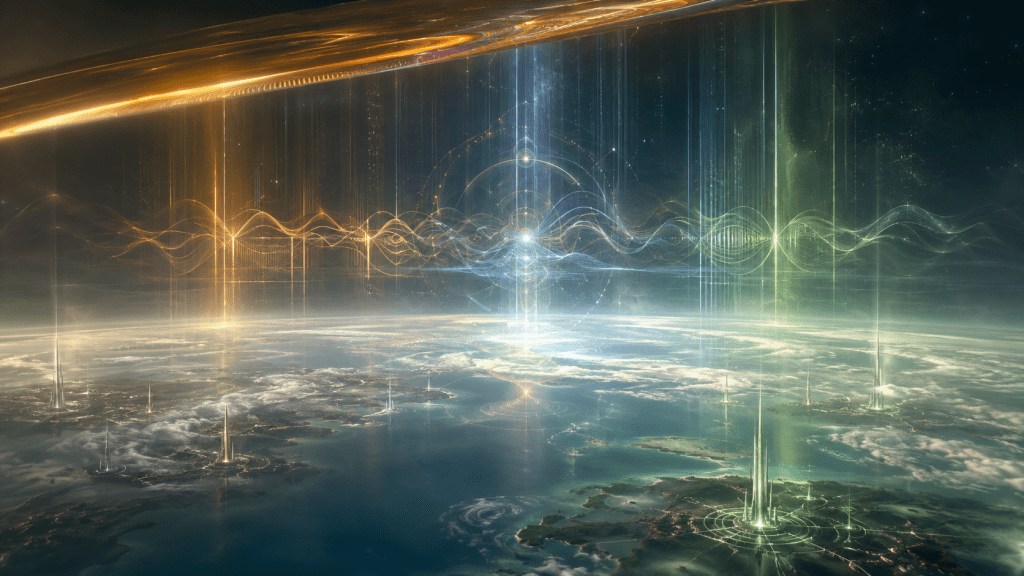
In the center of the chamber, the spectrograph tower projected a patient column of light. Thin bands moved within it — amber, blue-white, a pulse of green that failed to settle. The machine had been installed provisionally, which on Federation ships often meant permanently if no one objected loudly enough.
Commander Hale touched the control slate. The display widened above the table.
Three frequency maps rotated in silence.
On the left: pre-stabilizer archival reconstruction, incomplete and noisy.
On the right: current civic harmonic field, coherent to the point of strain.
In the center: candidate variability set, unresolved.
“The drift is measurable,” Hale said. “Not metaphorically. Not culturally. Measurably. We now have ten months of direct observation, Khitomer-side and surface-side. The imposed stabilizer narrowed civic range beyond recovery thresholds in sixty-two percent of sampled exchanges. The system is not balancing. It is suppressing.”
One of the Veloran delegates brightened faintly at the word suppressing. Arden had learned, over the months, that their changes in luminosity were not facial expression in any simple sense. Still, this one carried something close to interest.
Doctor Ilyas Renn, civilian consultant, leaned forward too quickly. “Which is exactly why the spectrograph matters.”
Arden did not look at him. He looked instead at the center map, where the unresolved bands kept trying and failing to braid.
Renn continued. “If the old monism depended on dynamic reciprocity between polar strains, then leadership cannot remain a matter of inheritance, factional claim, or symbolic legitimacy. That is the error. The role has to be selected according to actual harmonic capacity.”
“Harmonic capacity,” Arden said.
“Yes.”
“You mean find the right frequency and put it in charge.”
Renn opened his hands. “When you phrase it that way, you make it sound crude.”
“Is it less crude when you do it with a machine?”
Hale cut in before the room could stiffen further. “The proposal is narrower than that. The spectrograph would not choose policy. It would identify candidates whose internal variance indicates live balance between the two historical strains. Someone capable of carrying the civic field without collapsing it into one side.”
Across the table, the Veloran called Saar let the holoemitters translate a small shift in his banding into a visible inclination of the head.
“It would identify,” Saar said carefully, “those least damaged by the stabilizer.”
“Or those most useful against it,” said Arden.
The room quieted.
Below them, somewhere beyond the hull, Velora Prime turned through its own pale cloud bands. Since the Khitomer’s dampener malfunction had thrown them into this uncharted system, the ship had learned the planet by degrees: the resonance towers along the coasts, the disciplined flashes in the cloud layer, the way the civic field seemed to enter human sleep before it entered conscious thought. What had first looked like serenity now read as maintenance. A held chord. A note prevented from moving.
Renn tapped the display and enlarged the center map until the colors filled half the room.
“There,” he said. “You can see it. Candidate Three. The spread is wider, but it resolves. Candidate Seven overcorrects into Adleric striving. Candidate Nine collapses inward under Freudian load. But Three—”
“Stop,” Arden said.
Renn looked at him, genuinely surprised. “Captain—”
“No.”
“We are discussing leadership recovery for an entire civilization.”
“We are discussing capture with better instruments.”
That landed harder than Arden intended. One of the junior officers at the rear of the chamber lowered her eyes to the slate in front of her. Hale did not move.
Renn’s voice cooled. “With respect, Captain, refusing a workable method because it resembles control is not wisdom. It is sentiment.”
“It is pattern recognition.”
The spectrograph tower emitted a soft chime as if objecting to tone.
Arden stood. The gesture changed the room more than he expected. The human officers straightened. The holoemitters compensated, brightening the Veloran delegates by a fraction to keep the balance of presence intact.
“For ten months,” he said, “we have watched a system damaged by forced stability. We have watched a people taught to mistake coherence for health. We have learned that the generators were captured, that a false equilibrium was imposed, and that most of the harm came from freezing one necessary strain and calling the result peace.”
No one interrupted.
Arden looked directly at the unresolved map.
“And your answer is to find the correct person and freeze the balance there instead.”
“That is not what I said.”
“It is exactly what you said. Only with more confidence and a prettier display.”
Renn’s mouth tightened. “Then what do you propose? Leave the field leaderless? Let the factions tear each other apart while we congratulate ourselves for not interfering?”
A small pulse moved through Saar’s projected form. Not alarm. Attention.
Arden did not answer immediately. He had spent too much of the last year listening to people mistake urgency for clarity. Below urgency there was often only hunger with a better vocabulary.
When he spoke again, his voice was quieter.
“The dampener threw us here by accident,” he said. “We did not come as judges. We did not come as founders. We did not come as the species that knows how to sort another civilization into its healthiest pattern. We came in broken.”
The last word stayed in the room a moment.
Hale looked down.
Arden continued. “And what we found was a world damaged by the belief that balance could be secured through capture. First the generators. Now this.” He nodded at the tower. “A spectrograph is an instrument. Fine. Use it to study the field. Use it to understand what was severed. Use it to map the damage if you can. But the moment you ask it to tell you who should hold power, you are no longer restoring monism. You are rebuilding the same mistake at a finer resolution.”
Across the table, Saar dimmed, then brightened again. The translator hesitated before rendering his reply.
“You believe,” Saar said, “that even accurate selection would still be usurpation.”
“Yes.”
“Because the field must be released, not chosen.”
“Yes.”
Another pause.
Then Saar said, “That is difficult.”
Arden looked at him. For the first time in the meeting, something like humor brushed the edge of the Veloran form — not in the face, but in the slight indiscipline of his light.
“Yes,” Arden said. “That’s usually how you can tell.”
Renn exhaled sharply. “So we do nothing.”
“No,” said Hale, finally. “We do the slower thing.”
Everyone turned.
She stood without flourish, moved to the spectrograph, and placed her hand on the housing as if calming an overhelpful animal.
“We keep the instrument,” she said. “We stop asking it to solve legitimacy. We use it to identify where the field narrows, where reciprocity fails, where the stabilizer still enforces false agreement. We map conditions. We don’t choose sovereigns.”
Renn frowned. “That may take years.”
“Yes,” said Hale. “It probably will.”
The center map continued to rotate above them, unresolved and luminous.
Candidate Three’s frequency band drifted slightly left, then vanished into the larger field.
No one in the room moved to retrieve it.
Below the ship, one of the resonance towers flared through the clouds — a brief disciplined flash, then silence.
Arden looked at the table, the delegates, the spectrograph, the roomful of beings from two civilizations trying not to repeat the same shape of error in different words.
“Take the leadership filter out of the proposal,” he said.
Renn said nothing.
Hale met Arden’s eyes once, then touched the slate. The display changed.
WE&P by: EZorrillaMc&Co.

