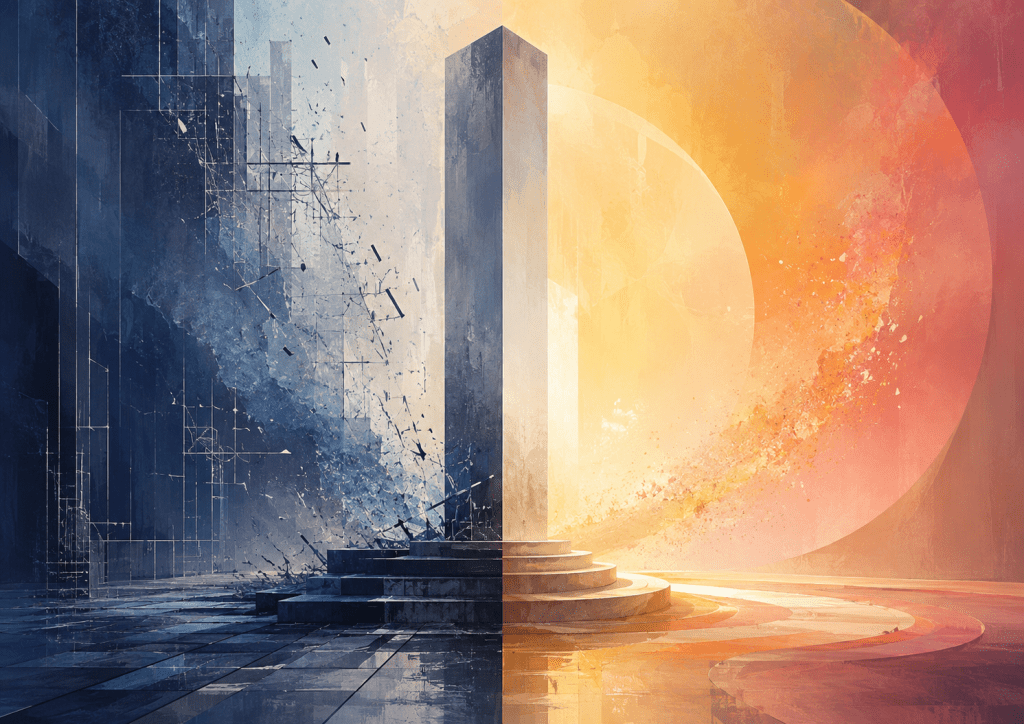
Two Ways to Live Without the Scaffolding
Simone de Beauvoir lost her faith at fourteen and never went looking for it again. What is striking, reading her, is how little she lost along with it. The Catholic girlhood had taught her that no person is of no account, that every individual has infinite worth — and she kept that, carried it straight into her philosophy and her feminism, long after she had set down the God who had originally underwritten it. The mythology fell away. The truth it had been holding stayed in her hands.
That move — letting go of the cosmology while keeping what the cosmology carried — is one I have been circling in my own writing. The scaffolding comes down; the building stands. But I have come to think there are two very different ways to live once the scaffolding is gone, and the difference is not in what you keep. It is in what you feel underneath you when the belief is gone.
For Beauvoir, the answer is that you hold the truth up. She was an existentialist, and the existentialist starts from a universe that supplies no meaning of its own — no God endorsing the codes, no eternity lending weight to the present, no witness making your acts matter. Meaning therefore has to be made, continuously, by a free act of will, and the instant you stop willing it, it does not wait patiently for you. It falls back toward indifference. So her keeping of the truth is bracing and austere: bracing, because there is something clarifying and almost heroic in confronting the emptiness honestly instead of evading it; austere, because it never gets to rest. The void is always there, and the truth is what you hold up over it, with your own hands, for as long as your strength lasts. She paid for this, by her own account, with a deep sense of aloneness — no witness, no one to talk to. Hers is a posture of standing.
What I keep finding in my own experience is something quieter. I wake and the fact is simply there — here, comfortable, warm — furnished and intact, before I have done anything, before any act of will. There is nothing to strain toward, because nothing is in danger of lapsing. The truth is not a weight I am lifting. It is the floor I find myself already resting on. My move is also a stripping-away: the mythology set down, the official language not yet arrived. But what remains when the concepts fall away is not a void I have to brace against. It is a kind of given fullness. Something present before the concepts and still present after they are gone.
That is the difference, and it matters. The gesture is identical — both of us set the mythology down and keep the truth; neither of us needs the old cosmology in order to preserve what it was carrying. But the gravity is opposite. Hers rests on sustained will, so her keeping is a confronting — active, effortful, faintly adversarial, a holding-against the emptiness. Mine rests on the givenness itself, so my keeping is an acknowledging — a registering of something that was never absent and never asked for my effort to stay real. Confronting faces outward into the cold and refuses to look away. Acknowledging does not face anything in particular. It simply notices, from the inside, that it is already here.
Two people can let go of the same God and the same heaven, keep the very same truths, and live them in entirely different weather. One braces against the cold. The other wakes and finds warmth already there.
I do not mean that one posture is nobler and the other easier. Only that they are not the same, even when they arrive at similar human conclusions. One lives as though truth must be upheld or it will sink. The other lives as though truth can be received because it was there before the receiving.
That is the distinction I keep trying to name. Not whether the scaffolding can come down. It can. Not whether something real remains. It does. The question is what sort of reality one finds once the scaffolding is gone — an emptiness that demands courage, or a givenness that asks to be acknowledged.
I do not think the difference is trivial. It shapes the whole posture of a life.
WE&P by: EZorrillaMc&Co.
 Travel in Life