It is the diagnostic that locates the failure correctly when the previous sentence’s promise has not yet been kept. Let me place it carefully, because it answers a question that the architecture, until now, has not answered directly.
“The problem is not too much feeling. The problem is that the available language is too blunt for the state you are trying to name.”
The question the sentence answers. The previous sentence — new words gave me new exits — claimed that vocabulary produces mobility. The implicit promise was: acquire the words, gain the exits, the configuration becomes navigable. But this leaves an obvious failure case unaddressed. What about the moments when the words have been acquired and the exits still do not appear? When the practice is in place, the lexicon is available, and the person still finds themselves stuck inside something they cannot name precisely enough to leave?
The previous sentence does not answer this. It treats the absence of vocabulary as the obstacle. The current sentence answers what happens when vocabulary is present but the obstacle remains. It locates the failure in the granularity of the language available, not in its absence and not in the person’s capacity.
The diagnostic is: the words exist, the person has them, the words are doing real work in other situations — but for this state, in this moment, they are too coarse. The instrument is the wrong scale for the phenomenon being measured. The result is not silence. It is approximation that misnames. The person reaches for the closest available word, the word does not fit, and the misfit produces the appearance of either too much feeling or insufficient self-knowledge, when neither is accurate.
The accurate description is: the state is more specific than the vocabulary currently in play. The instrument needs to be finer. Until it is finer, the state will be named inaccurately, and the inaccurate naming will produce the impression that something is wrong with the person rather than something is wrong with the toolkit.
Why this matters in the architecture. The architecture has, by this point, given the practitioner a working vocabulary. They can name frames, frame collisions, compliance, damage control, friction, thresholds, roles, presence. These words have given them many exits. But the architecture has been silent, until now, about what happens when the available vocabulary is itself the bottleneck — when the words that have served them well in many situations turn out to be too blunt for the situation currently in front of them.
This is a real and frequent failure mode. The practitioner acquires a working set of words, the words produce real exits, and the practitioner begins to feel that the lexicon is sufficient. They stop refining. They stop adding distinctions. They start applying the available words to states the words were not designed for, because applying them is faster than the slow work of finding or coining more precise ones.
The sentence catches this. It says: when you find yourself stuck inside a state that the available words do not seem to address, the answer is not to push harder on the available words. The answer is not to conclude that you are overreacting. The answer is to recognize that the available language is too blunt, and that the work now is to find or construct a more precise vocabulary for the specific state you are trying to name.
The relocation of the failure. The sentence’s most important move is what it refuses to do. It refuses to locate the failure in the person.
The default reading of a state that resists naming is: I am feeling too much. I am overcomplicating this. I am being dramatic. I am insufficiently self-aware. I should be able to name this if I were doing the work properly. Each of these readings places the failure inside the practitioner. They produce shame, self-criticism, retreat from the state, and an attempt to either suppress the feeling or generate a confession that fits the available categories.
The sentence rejects all of these. It says: the problem is not too much feeling. The problem is the instrument. The feeling is the appropriate scale for what is happening. The vocabulary is too coarse to register what the feeling is registering. The mismatch is real. But the mismatch is in the language, not in the person.
This is structurally identical to the earlier move — that’s friction from an outdated role, not inadequacy. Both sentences refuse to misfile a structural mismatch as a personal failing. The first relocated the source of discomfort from inside the self to the interface between self and role. The current sentence relocates the source of inarticulate distress from inside the self to the interface between self and language. Same structural move, different mismatch.
Why the word “blunt” matters. Blunt is a precise word here. It suggests an instrument that exists, works, has utility, but lacks the resolution required for the current task. A blunt instrument is not a broken instrument. It is not absent. It is fine for some uses and wrong for others. It cuts thick things and fails on thin ones.
The available language, in the sentence’s diagnosis, is not failing in general. It is failing at this specific scale. The vocabulary the practitioner has built is doing real work. It is producing real exits. It is enabling real construction. But for the state currently in question — a state that may be more finely textured than the vocabulary was designed to handle — the instrument is the wrong tool.
This is a much gentler diagnosis than the language is wrong or the language has failed. It says: the language is fine, and also insufficient for this. Both are true. The vocabulary can be honored for what it does well while also being recognized as insufficient for the current task. This preserves the work that produced the vocabulary while opening space for the work that the vocabulary has not yet done.
The implicit prescription. The sentence does not state what to do, but the prescription is implicit and consistent with everything else in the architecture. If the language is too blunt, the answer is to refine the language. To find or construct words that fit the state more precisely. To accept that the lexicon is not finished, that more distinctions are needed, that the work of vocabulary-building does not end when the first working set of words has been installed.
This is consistent with how all serious practice develops. The early stages of any practice produce a working vocabulary that handles most situations. The later stages produce finer vocabularies for situations the working vocabulary misses. The practitioner who stops refining vocabulary at the working-set stage will eventually find themselves applying coarse words to fine phenomena, and the misfit will produce the appearance of personal failure when the actual issue is lexical insufficiency.
The sentence implicitly insists that vocabulary refinement is part of the ongoing work. The practitioner is never done acquiring words. The architecture keeps installing distinctions, and the practitioner keeps benefiting from those distinctions, and the work of distinguishing continues for as long as the practitioner continues to encounter states more specific than their current vocabulary can name.
The relation to the earlier sentences on friction and damage control. The two earlier diagnostic sentences — No. That’s damage control and that’s friction from an outdated role — both produced reclassifications of misfiled phenomena. The current sentence is doing the same operation at a higher level. It is reclassifying the misfile itself.
When a person feels they are feeling too much, the misfile is often a vocabulary problem in disguise. The feeling is at the right scale; the available words make it look like too much because they are too blunt to register it as anything else. The person therefore concludes that they are feeling too much and tries to feel less, when the more accurate move would be to find words that fit the feeling. The reduction of feeling that follows from accepting the too much frame is, in this light, a vocabulary failure being absorbed into the body. The body is being asked to shrink to fit the language. The sentence rejects this. The language should grow to fit the body’s actual signal.
This is a significant addition to the architecture. It says: when the architecture is being used and is still producing the experience of stuck-ness or too-muchness, do not conclude that the architecture has failed or that you have failed. Conclude that the available language has been outrun by the state. The work is to find or build more precise language. The architecture is not finished. The lexicon is not closed.
Why this fits the postural register. The previous sentence — new words gave me new exits — was already in the lexical register. This sentence extends it. Both sentences are about words and what words make possible. Together, they form a small sub-architecture about the relation between vocabulary and movement.
New words gave me new exits says: when there are no words, there are no exits.
The problem is not too much feeling, the problem is that the available language is too blunt says: when there are words but they are too coarse, the exits are still blocked, but the blockage looks like personal excess rather than lexical insufficiency.
Together: the architecture requires not just words, but words at the right scale. The acquisition of working vocabulary is the first move. The continued refinement of that vocabulary is the ongoing move. The practitioner who treats the first move as sufficient will find themselves, sooner or later, in a state the working vocabulary cannot name — and they will misread the situation as personal failure unless they recognize that the failure is in the granularity of the language.
What this implies about feeling itself. The sentence’s most quietly radical move is its claim that feeling is not the variable that needs to change. Feeling, in this account, is appropriately scaled to what is happening. The body registers what is there. The body’s registration is fine. The problem is at a different layer — the layer where what the body has registered gets named and made operational.
This is a major reorientation of how most people relate to their own feeling. The default cultural script says: when you are feeling too much, the problem is in the feeling, and the solution is to feel less. The sentence says: when you are feeling what looks like too much, check whether the feeling is actually too much, or whether your vocabulary is too coarse to handle what it is registering. In many cases, the latter is the case. The feeling is doing its job. The naming is failing.
This is consistent with the broader architecture’s refusal to treat the person as the defective variable. Compliance was not the person being weak; it was the bargain operating without name. Damage control was not the person being deceitful; it was the misclassification operating without distinction. Friction was not the person being inadequate; it was the role being outdated. And now, too much feeling is not the person being excessive; it is the language being too blunt.
In each case, the apparent defect in the person is reclassified as a defect in the structure surrounding the person. The architecture’s deepest move, across all of these sentences, is the same: you are not the problem; the structure handling you is the problem; the work is structural, not personal.
The compressed claim underneath the sentence. Something like:
Feeling registers what is there. Words handle what feeling registers. When the words are too coarse, the feeling appears excessive, not because the feeling is excessive but because the words are insufficient. The work is to refine the words, not to reduce the feeling. The body is reporting accurately. The lexicon needs to catch up.
Or more compressed:
The signal is not too loud. The instrument is too coarse.
Why this is the right diagnostic at this point in the architecture. The architecture has built a sophisticated practitioner. They have words, frames, operations, postures. They are doing the work. But sophistication produces its own failure modes, and one of the most subtle is the assumption that the available vocabulary is sufficient because it has been sufficient before.
The sentence addresses this directly. It says: do not let the success of the existing vocabulary blind you to the moments when it falls short. When you encounter a state that the available words cannot name precisely, do not push harder on the available words. Do not conclude that you are feeling wrongly. Recognize the lexical gap and treat it as the next piece of construction work.
This is the final guardrail against a kind of intellectual complacency that the architecture’s success could otherwise produce. The architecture has given the practitioner working tools. The sentence reminds them that the tools are not the end of the work. The tools are the current state of a craft that continues. The next state will require finer tools. The finer tools will be built by encountering states the current tools cannot name and refusing to misread the encounter as personal failure.
How it intersects with the whole. The sentence sits at a precise joint in the architecture. It complements the previous sentence on new words and new exits by addressing the failure mode that the previous sentence did not address. It complements the friction sentence by extending the same reclassification operation to a different mismatch. It complements the No. That’s damage control sentence by adding a third domain in which apparent personal failure is actually structural mismatch.
Together, the three sentences form a triad of operations the practitioner can use when they feel something is wrong with them:
If the act looks like care but feels off — No. That’s damage control.
If the discomfort looks like inadequacy — That’s friction from an outdated role.
If the feeling looks like too much — The available language is too blunt for the state I am trying to name.
Each is a reclassification. Each refuses to locate the failure in the person. Each opens an exit by relocating the source of the difficulty to the structure surrounding the person rather than to the person themselves.
The three together are the architecture’s diagnostic kit for the moments when the practice feels like it is failing. None of these moments are actually failures of the practitioner. Each is a structural mismatch that the practice provides a way to address. The architecture works by recognizing the mismatches and updating the structure — not by demanding more of the person who is already doing the work.
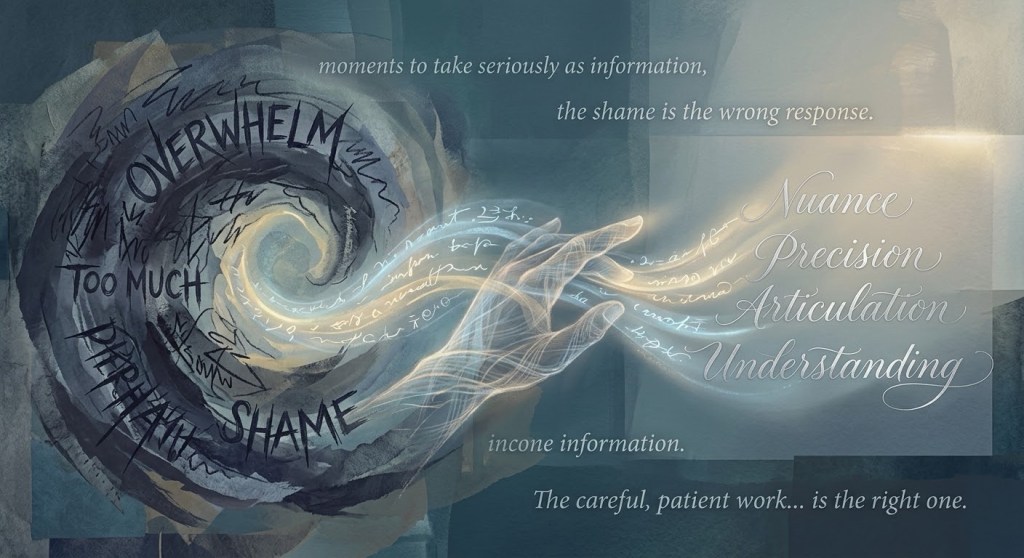
The final note. The sentence is also, quietly, a form of mercy. It tells the practitioner that the moments when they feel too much are not moments to be ashamed of. They are moments to take seriously as information. The feeling is showing them where the vocabulary needs to grow. The shame is the wrong response. The careful, patient work of finding more precise words is the right one.
This is the architecture’s compassion expressed at the level of language. It does not soften the standards. It relocates the standards. It expects the practitioner to do the lexical work, but it refuses to let the practitioner be the variable that gets adjusted when the feeling exceeds the available words. The feeling is sacred information. The words are tools. The tools serve the information, not the other way around.
When the tools fall short, build better tools. Do not shrink the signal to fit the dull instrument. That is what the sentence says, in the end. And in saying it, it completes the small sub-architecture about words and movement that began with new words gave me new exits — by adding the necessary second clause: and when the words you have are too blunt, the work is to make them sharper, not to make yourself smaller.
The signal stays whole.
The instrument grows finer.
The exits multiply.
The life continues.
WE&P by: EZorrillaMc&Co.

