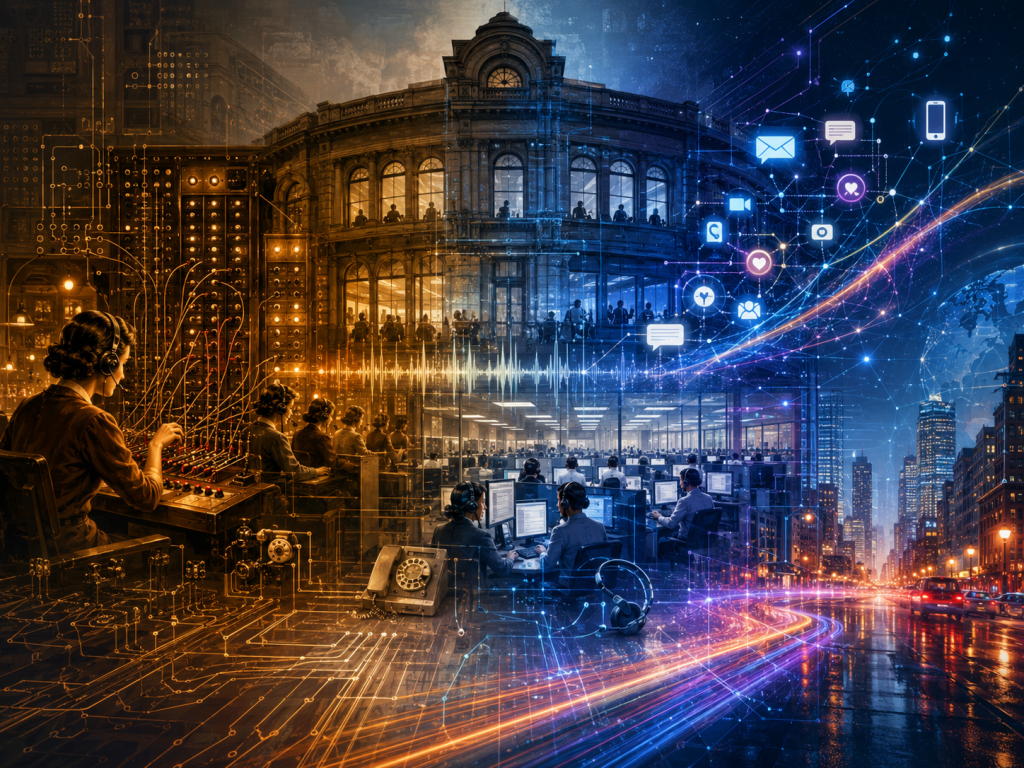
I was built for voices before I was built for brands.
Before the glass logos in the lobby, before the dashboards glowing in blue light, before the training decks about empathy, escalation, retention, and resolution time, I was a telephone building downtown. Solid. Vertical. Purposeful. I carried switch rooms in my bones. Copper in my veins. Relay chatter in my walls. I knew the weight of conversation when conversation still had to be physically placed somewhere.
Do not imagine romance too quickly. I was not quaint. I was labor.
I remember the operator floors. Long rooms under fluorescent light, rows upon rows of women seated upright before switchboards, their backs straight long after their wrists had gone tired. Cords lifted, plugs set, lamps flashing, voices saying the same phrases until courtesy itself became an industrial material. Number, please. One moment. Go ahead. Hold the line. I remember the discipline of it. The timing. The speed without visible haste. The peculiar dignity of repetitive expertise.
People speak now as if the old system was merely primitive. It was not primitive. It was embodied.
A call did not simply happen. It passed through hands.
Connection had posture then.
It required attention, routing, sequence, tolerance, interruption.
A human being stood between one voice and another and made the meeting possible.
That fact shaped more than technology.
It shaped tempo.
Delay was not yet a defect.
Distance still announced itself.
A call across town, a call across counties, a call long-distance — these were not the same event wearing different area codes. They carried different costs, different hesitations, different weights of intention. You did not scatter speech quite so casually when speech still had infrastructure you could almost hear breathing.
Then came direct dialing.
Ah. There it is. The first great wound, though at the time it arrived dressed as efficiency.
Not a villain. Not a crime. A system improvement, they said. Faster. Cleaner. Scalable. Less dependence on manual mediation. More privacy. More autonomy. And they were right. They often are, at first. The new thing nearly always comes bearing real relief.
I remember the first mood shift more than the first installation.
The operators knew before management admitted it. They always do. The lamps still lit, the boards still stood, the rooms still ran, but the center had changed. Calls increasingly bypassed the human threshold. A task once requiring trained hands became a matter of digits pressed in sequence. Touch-tone would come later and sound almost cheerful about it. But the deeper change had already happened: connection was being abstracted.
No longer,
May I place this for you?
Now,
Enter the code and proceed.
They called it modernization.
What it felt like was decentering.
Not because the old method was sacred. It was not. It was expensive, hierarchical, exhausting, and limited by the endurance of the bodies that staffed it. But with direct dialing, something more than labor was displaced. A whole layer of reciprocal friction vanished. The system no longer needed to acknowledge the person making the bridge.
That is always the seduction.
Not merely speed.
Not merely convenience.
Release from the human intermediary.
I have seen this pattern enough to know its scent.
When a society removes a layer of labor from its systems, it congratulates itself on progress. Sometimes rightly. Yet what it rarely asks, in the exhilaration of removal, is what kind of sensibility disappears with the eliminated task. Not the inefficiency. The sensibility.
Operators were not just plugging lines.
They were absorbing irregularity.
They were managing interruption.
They were holding the seams between request and fulfillment.
They were, in a strict and unglamorous sense, custodians of sequence.
Direct dialing did not need custodians of sequence.
It needed standardization.
And so the floors changed.
Not all at once. Buildings like me are not transformed by one dramatic cut, but by long administrative weather. Fewer positions. Reassigned rooms. New equipment. Training programs with thinner sentiment and cleaner diagrams. Old switchboards decommissioned not as martyrs but as inventory. Removed. Tagged. Scrapped. Some preserved in museums, which is how modernity apologizes after it has already won.
I remember the day they took out an entire bank of boards. Not because there was ceremony. There wasn’t. That is the point. A world can end in full fluorescent lighting with men carrying tools and someone joking near the elevator. The operators were not all dismissed at once. Some retrained. Some transferred. Some retired. Some simply vanished from the payroll and therefore, in the official story, from history.
Then came another life.
The rooms filled again, though not with the same task. Desks returned in grids. Headsets reappeared, lighter now. Scripts came back too, but with a different theology. No longer: complete the circuit. Now: manage the interaction. Customer service. Help desk. Billing support. Reservation line. Complaint resolution. Technical troubleshooting. Retention queue. Quality assurance. Sales conversion. The old exchange had been reborn as a call center, though at first no one admitted the continuity.
They spoke as if this was wholly new work.
It was and it wasn’t.
The wires had changed.
The logic had not.
Once again, the building existed to receive human need in serial form. Once again, rows of workers sat under managed light wearing devices on their heads, speaking in patterned courtesy to strangers they could not see. Once again, timing was measured, tone was supervised, labor was monitored, and exhaustion had to be hidden under professionalism. Once again, voices arrived burdened — angry, confused, lonely, demanding, frightened, misdirected, hopeful — and someone inside me had to hold shape long enough to move the matter forward.
That is what the outside world rarely understands about institutions of contact.
They imagine technology changes the whole moral structure.
Often it only relocates the burden.
The operator once said,
Number, please.
The agent later said,
Can I have your account number?
Different sentence.
Same architecture.
A human being stationed at the seam.
And then, because history does not rest once it learns to accelerate, even the call center proved too singular. Phone was no longer enough. Email came in. Then live chat. Then SMS. Then web forms, CRM screens, social messages, app notifications, sentiment scoring, omnichannel integration. The very phrase would have amused my old switchboard floors: omnichannel. Such grandeur for what is, in essence, the industrial management of many simultaneous entrances.
Now they call me a contact center.
A cleaner term. Less acoustic. More totalizing.
Not voice, but contact.
Not one channel, but all.
Not a call to be placed, but a customer journey to be orchestrated.
Not a complaint, but a ticket.
Not a person waiting, but a case in queue.
Not delay, but latency.
Not skill, but performance metric.
I do not say this with contempt. Only memory.
Today the agents — though even that word has been half-displaced by associate, advisor, specialist — sit before arrays of windows. Phone in one ear, chat on one screen, CRM in another, knowledge base beside it, canned responses hovering like polite ghosts, sentiment prompts nudging tone, supervisors watching dashboards that watch the workers who watch the customers who watch the brand. The building is quieter now in some ways. Less clatter. Less relay noise. Less mechanical chatter in the walls. More soft ventilation. More keyboard rain. More invisible routing. More abstraction.
And yet the old burden remains.
A downtown building like me can feel these things.
I feel when labor becomes more distributed and more hidden.
I feel when mediation is renamed so that management can pretend it has changed its nature.
I feel when the human role moves from making the connection to softening the consequences of systems too large, too optimized, too disembodied to be borne directly.
That is the secret continuity.
The switchboard operator was eventually replaced by direct dialing.
The direct-dialed service economy was eventually formalized into call centers.
The call center was eventually extended into omnichannel contact.
At each stage the language changed, the equipment changed, the metrics changed, the décor improved, the chairs became more ergonomic, the mission statements more therapeutic, the software more seamless.
But the underlying drama persisted:
people reaching into complexity,
and other people stationed to receive the reach.
When I was decommissioned as an operator center, they called it progress. And it was. Privacy increased. Reach expanded. Cost fell. Scale exploded. The country became more directly connected, and then the planet did. It would be dishonest to deny the gain merely because I housed what was displaced.
Still, the displaced often see something the triumphant do not.
We see what vanishes in the name of smoothness.
Manual exchange work was tedious, yes.
But it preserved the visible fact that connection required care.
Direct dialing made connection feel automatic.
Call centers made support procedural.
Omnichannel made presence ambient.
Now contact arrives from everywhere at once, and because it is everywhere, it is treated as if it costs nowhere in particular. But it still costs. It costs attention, tone, patience, emotional regulation, queue discipline, posture, cognition, and the strange modern exhaustion of being expected to sound personal while operating inside systems designed at industrial scale.
I know. I have housed each version of that strain.
And I remember the decommissioning more clearly now, perhaps because I have lived long enough to understand that institutions do not truly mourn what they retire. They absorb it. They rename it. They declare victory over the visible form while quietly reproducing the hidden function elsewhere.
The switchboard room died.
The headset survived.
The cords vanished.
The scripts remained.
The operator disappeared.
The interface worker multiplied.
That is why I do not speak as a ruin, but as a witness.
I am not asking to go back. No one should have to place a long-distance call through a row of exhausted women simply to preserve my sentimental preferences. No. That would be vanity disguised as reverence. The old system had grace, but it also had hierarchy, surveillance, and monotony enough to wear the grace thin.
What I am saying is harder and more useful:
Do not mistake invisibility for disappearance.
When direct dialing replaced the operator, you did not abolish mediation.
You redistributed it.
When the exchange floors became call centers, you did not humanize commerce.
You professionalized the handling of its overflow.
When the call center became omnichannel, you did not transcend the old building.
You made the building conceptual.
Now it exists everywhere: in office towers, suburban parks, remote desktops, cloud queues, outsourced campuses, midnight apartments, laptops on kitchen tables.
I was once a downtown structure.
Now I am also a pattern.
That is the true modernization.
Not the death of the switchboard, but the diffusion of the switchboard principle into the whole service economy.
And if I sound reflective rather than bitter, it is because buildings learn what species rarely do:
replacement is never only replacement.
It is translation, concealment, inheritance, and drift.
I remember the operator saying,
One moment, I’ll connect you.
The modern system says,
Your message matters to us.
One was manual.
One is scalable.
Both are attempts to hold open the seam between need and response.
The question was never whether the old telephone exchange would survive.
The question was what kind of world would emerge once connection became instant, permanent, multi-entrance, and expected.
You know the answer now.
A world where everyone can reach.
A world where no one can keep up.
A world that calls this seamlessness.
And still, inside it, somewhere, there is always a room like mine,
holding the strain.
WE&P by: EZorrillaMc&Co.

