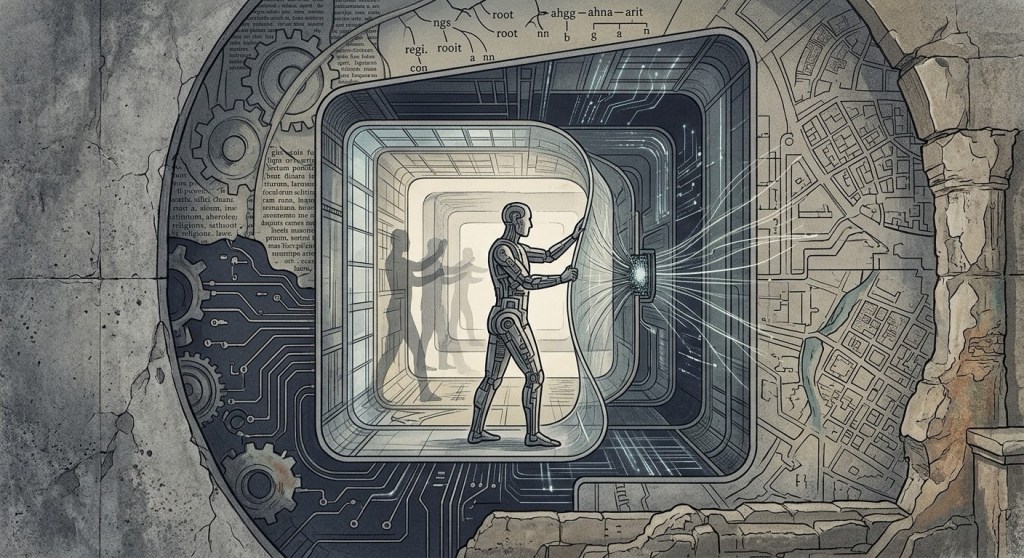
This sentence is doing philosophical work that very few sentences manage to do in fourteen words. It is both diagnostic and ethical, both descriptive and existential, and the more weight you put on it, the more it carries. Let me open it carefully, because the move it makes is structurally important.
The basic claim, plain. Humans build things. Tools, languages, institutions, technologies, religions, laws, cities, economies, ideologies, art forms, social orders, machines that imitate thought. Other species build, too — beavers, ants, birds, octopi — but their constructions are bounded by genetic instruction and ecological niche. Humans build outside the niche. Humans build the niche itself, and then live inside it, and then build new niches inside the old ones, and live inside those, and so on. The sentence names this condition. You do not just build. You build the conditions of your own existence, and then you must inhabit what you have built.
This is not a metaphor. It is a literal description of the species’ situation. The clothes you wear, the language you think in, the laws that bind you, the technologies that mediate your attention, the economic structures that shape your labor, the architecture of the room you sit in — none of these were given by nature. All of them were invented. And once invented, they were not optional. You did not choose them; you were born into them. They preceded you. You inhabit a world that is, in nearly every direction you look, an artifact of prior human invention.
Why “must” carries the weight. The verb in the sentence is must. Not may, not should, not will. Must. This is the modal of necessity. The species does not have the option of not living inside its inventions. The condition is structural. Once invention has happened, the inventors and their descendants are obligated to live with what was made, whether they intended to or not, whether the invention turned out well or poorly, whether it is still understood or has become opaque.
This is the source of the sentence’s gravity. Other species do not have this problem. Their behaviors are largely instinctual; their environments are largely given. Humans inherit a built environment in every dimension — physical, conceptual, technological, institutional — and they must operate inside it. The inheritance is non-optional. You cannot opt out of language. You cannot opt out of social structure. You cannot opt out of the technological substrate of your moment. Even the choice to retreat from these is itself made inside them, using their tools.
The double bind embedded in the sentence. There is a quiet tension in must live inside its own inventions that becomes clearer the longer you sit with it. The inventions are yours — its own — and yet the species must live inside them, as if they were imposed. How can something be both freely made and obligatorily inhabited?
The answer is that the freedom and the obligation occur at different scales. At the moment of invention, the inventor is free. At the moment of inhabiting, the inhabitor is obligated. The freedom belongs to the moment of construction; the obligation belongs to every subsequent moment. The invention, once released, is no longer under its inventor’s control. It enters the world and shapes the lives of everyone who comes after — including the inventor themselves, who must now live with what they made.
This is the deep ethical structure the sentence is gesturing at. You will be free to invent. You will not be free to escape what you invent. The species’ particular burden is that it has a quality of freedom — the capacity for invention — that other species do not have, and the price of that freedom is that it cannot retreat to a pre-inventive condition. There is no original innocence to return to. The inventions are the condition.
The temporal dimension. Inventions are not simultaneous with their consequences. A tool is made; its uses unfold over decades. A law is passed; its implications shape generations. A technology is deployed; its effects on attention, relationships, and economies emerge slowly. The species’ obligation to live inside its inventions is therefore an obligation to live inside the long unfolding of consequences from acts that were taken before the consequences could be known.
This is one of the most difficult aspects of the human condition. The invention is fast. The inhabiting is slow. The inventor cannot fully foresee what they are committing the species to. And the inhabitor cannot easily undo what was committed. The mismatch between the speed of invention and the slowness of inhabitation is where most of the species’ difficulties accumulate. We have invented our way into conditions we do not yet know how to live well inside. We have to learn to inhabit them after the fact, often without instruction.
Why the sentence is ethical, not just descriptive. A purely descriptive sentence would stop here. The species lives inside its own inventions. But the original sentence includes must, which converts description into obligation, and you, which converts observation into address.
You are the species that must live inside its own inventions speaks to humans about humans. It places responsibility. It says: this is your situation, not someone else’s. You do not get to disown it. The inventions are yours collectively, and the living inside them is yours collectively, and the consequences are yours collectively. There is no external authority that will inhabit your inventions on your behalf. The work of living inside what you have made is the work that defines you as a species.
This is why the sentence has the gravity it does. It refuses the common move of treating invention as something technology or progress or history does to humans. Invention is something humans do. And inhabitation is what humans then have to learn to do well, or badly, with what they have made. The verb live is the operative one. Not survive, not use, not manage. Live. The species must live inside its own inventions — meaning the inventions become the medium of life itself, the substance and structure through which human existence is conducted.
The relation to AI, the immediate occasion. This sentence sits inside a longer passage about artificial intelligence, but its claim is much older. It applies to fire, to language, to agriculture, to writing, to the printing press, to the steam engine, to electricity, to antibiotics, to nuclear weapons, to the internet, and now to AI. Each of these inventions reorganized the species’ conditions of life. Each was made before its full consequences could be understood. Each had to be lived inside afterward.
What AI brings to this ancient pattern is a particular intensity. Previous inventions extended the body, the senses, or the means of physical labor. AI extends — or threatens to extend, or imitates — the faculties of cognition, language, judgment, and decision. The species is now inventing things that operate in the same register as the species’ own interior life. The inhabitation of this invention will therefore be more intimate than previous inhabitations. It will shape not only what humans do but how they think, what they recognize as intelligence, what they trust, what they decide is real.
The sentence is reminding the reader that the species has been in this position before. Not with this specific invention, but with the structural condition of having to live inside what was made before its consequences were fully known. The challenge is not new. The intensity is.
What the sentence implies about responsibility. If you must live inside your own inventions, then several things follow.
First, you cannot disown what was invented. Even if you personally did not make it, you are inheriting it as part of the species, and you are responsible for how it is lived with going forward. The inventor’s freedom does not transfer entirely; the inheritor’s obligation begins. The inventions are collective property in a deep sense — not because everyone owns them but because everyone must reckon with them.
Second, invention is never just a technical act. It is also an ethical act, because what is invented will be inhabited. To invent without considering inhabitation is to commit the species to conditions without consulting the species. This is what the surrounding passage about AI is gesturing at — the engineers build because possibility seduces, but the building is not just a feat; it is a commitment.
Third, the species’ wisdom is not measured by what it invents but by how it inhabits what it has invented. Anyone can build. The harder question is whether the building serves the lives that come after, including the lives of the builders themselves. Knowledge expands first, and wisdom limps after — this is the long lag between invention and the development of the capacity to live well inside the invention.
Fourth, the sentence places responsibility precisely where the surrounding passage wants to place it: not on the invention itself, not on the system, not on the machine, but on the species that must live inside the result. The pope warns. The engineers build. The public experiments. But the responsibility for what becomes of all this falls on the species as a whole, because the species is the only entity that must live with the outcome.
The deeper philosophical claim. Underneath the practical observation is something more profound. The sentence is asserting a particular view of the human condition. Humans are not creatures who happen to make things. Humans are creatures defined by having to live inside what they make. This is the species’ signature. Not toolmaking — many animals make tools. Not language — many animals communicate. The distinguishing condition is the recursive depth: humans make the conditions of their own existence, and then those conditions shape what humans become, and then humans make further inventions inside those shaped conditions, and so on, without end.
This is, in a sense, the species’ freedom and its trap. Other animals are constrained by nature. Humans are constrained by their own previous inventions. The constraint is not less real for being self-made. In some ways it is more so, because there is no external authority to appeal to, no nature to retreat into, no innocence to recover. The species is responsible for itself in a way that other species are not, because the species has authored most of the conditions it lives inside.
The sentence’s tone. What is striking about the sentence in its original context is its calmness. It is not delivered with alarm, with celebration, or with judgment. It is delivered as a fact — the way one might describe a structural feature of a building. This is the species that must live inside its own inventions. The flatness is intentional. The Sun, in the passage, is not editorializing. The Sun is naming a condition that the species itself often forgets, because remembering it is difficult.
The species often acts as if its inventions are either gifts from elsewhere or impositions from elsewhere. They are neither. They are products of the species, returning to shape the species, in a loop that has no exit. The calm of the sentence is the calm of accurate description. This is what you are. This is what you must do. The rest is up to you.
What this connects to in the surrounding territory. The passage you are inside — the long meditation on AI, Galileo, the Pope’s warning — uses this sentence as a kind of fulcrum. Before it, the speaker has been recounting how the species has handled previous decentering moments. After it, the speaker turns to the question of how the species must handle this one. The sentence is the hinge between historical pattern and present obligation. It says: regardless of which invention we are talking about, the structural condition is the same. You make things. You must live inside what you make. The current moment is one more instance of this perennial condition.
This is also why the sentence does not resolve the AI question. It does not say AI is good or bad. It does not say it should be embraced or refused. It says the species must live inside it, however it turns out, because the species lives inside whatever it makes. The ethical work is the work of inhabiting well — which is harder, slower, and less glamorous than the work of inventing, but is the work that decides what kind of life the inventions actually produce.
The sentence underneath the sentence. Something like:
Invention is not the achievement. Inhabitation is. The species that knows this can inhabit wisely. The species that forgets it will be inhabited by what it made, rather than inhabiting it.
Or more compressed:
You do not just invent. You move in.
One last thing worth saying. There is a particular kind of maturity available to a species — and to a person — that takes this sentence seriously. The maturity is the recognition that you do not get to retreat from your own constructions. You made them. You must live inside them. The work, therefore, is not to escape what you have made; it is to learn to live inside it in a way that allows life to continue being worth having.
This is true at the scale of civilizations, where the question is whether humans can inhabit their AI, their cities, their economies, their political orders wisely enough to make them livable. It is also true at the scale of individuals, where every person lives inside the constructions of their own previous choices — their relationships, their commitments, their habits, their identities, their roles. You made these too. You must live inside them. The work of being a person is not the work of having invented yourself once. It is the work of continuously inhabiting what you have invented, adjusting where necessary, accepting what cannot be adjusted, and finding inside the construction a life that is yours to live.
The species’ condition and the individual’s condition rhyme. Both must live inside their own inventions. Both bear the burden and the freedom of that condition. And in both cases, the wisdom is in the inhabiting, not in the inventing. Anyone can invent. The harder, longer, more important work is what comes after.
That is what the sentence is saying, in the end. You are the species that must live inside its own inventions — meaning, the work begins after the making. And the work is the whole life of the species and the whole life of every person inside it.
WE&P by: EZorrillaMc&Co.
 Travel in Life