This sentence is doing something fierce and clarifying, and it follows directly from what we just looked at — which is why you’re asking now. Let me trace what it’s actually naming.
What a threshold is, in this context. A threshold is the moment of crossing — the small interior shift between one configuration and another. When you organize yourself on purpose, when you enter a role deliberately, there is always a threshold: the point at which you move from one arrangement to the next. From private to social. From rest to work. From neutral to engaged. From one role to another. From outside the encounter to inside it.
The threshold is not the role itself. It is the transition into the role. It is the small interior movement where you reorganize yourself for the next configuration.
What attacking the threshold looks like. The internal critic, having been disqualified as judge of whether the role is good, often retreats to a more strategic position: it attacks the moment of entering the role. It does not contest the role itself anymore — it has lost that argument. It contests the act of crossing into it.
The attack takes a familiar shape. Why are you preparing? Why are you adjusting? Why are you taking a breath before you walk in? If this were really you, you wouldn’t need to do that. The fact that you need to organize yourself before entering proves the role is artificial. Real selves don’t need thresholds. Authentic people just walk in.
This is the attack. It uses the very existence of the threshold as evidence against the role. It treats the small interior preparation as a tell — a sign that something fake is being attempted, because if it were real, no preparation would be necessary.
The attack is wrong. But it is plausible, which is why it works.
Why it is wrong. Every meaningful transition in life requires a threshold. Athletes have thresholds before competing. Performers have thresholds before stepping on stage. Surgeons have thresholds before entering the operating room. Therapists have thresholds before each session. Parents have thresholds when they walk through the door at the end of the day. These are not signs of inauthenticity. They are signs of transition between configurations, which is something selves do constantly and necessarily.
The attack assumes that thresholds are evidence of pretense. They are not. They are evidence of intentional configuration change. The pretender has no threshold because the pretender is not actually changing anything inside — they are only changing the surface. The deliberate self-organizer has a threshold because something real is being arranged.
The attack inverts the truth. The presence of a threshold is not a sign of falseness. It is a sign of seriousness.
How the attack disables the practice. When the internal critic attacks the threshold, several things happen at once.
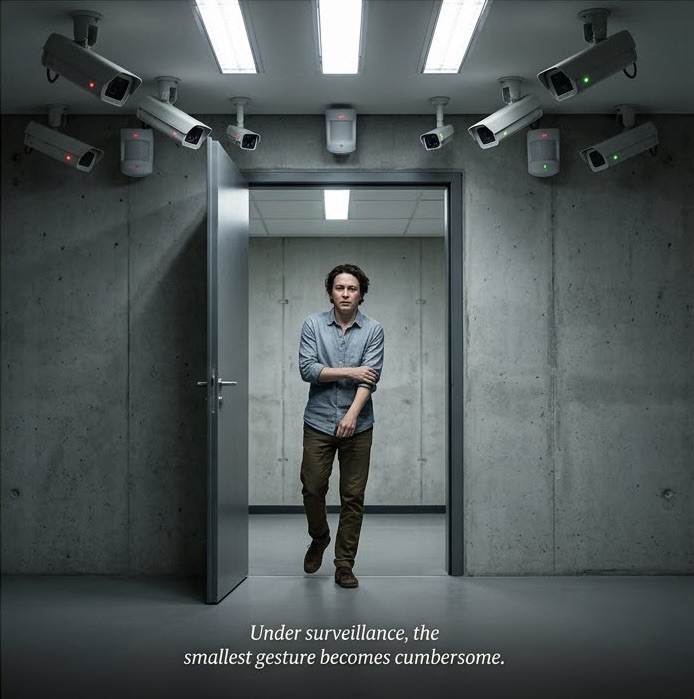
You start to feel self-conscious about the very act of preparing. The small private moment of organizing yourself becomes contaminated by surveillance. You can no longer simply take a breath before entering; the breath itself is now being evaluated. This is exhausting and undermines the threshold’s actual function, which is to be the unguarded moment where you arrange yourself for what is coming.
You start to rush the threshold to avoid scrutinizing it. You enter without crossing properly. The role gets adopted half-heartedly, because the deliberate moment of crossing was foreclosed. The result is that the role does not work as well, which the critic then uses as further evidence against the practice.
You start to skip thresholds entirely. You go straight from one configuration to the next without the interior pause that lets the configuration actually land. Days become a series of unprepared entries. Each context catches you in the previous context’s shape. The life that the deliberate roles were supposed to improve gets worse, not because the roles are wrong but because the thresholds — the operations that make the roles usable — have been disabled.
Why “stop attacking” is the right verb. The sentence does not say stop noticing the threshold, or stop using the threshold. It says stop attacking it. Which means the threshold is fine. The threshold is doing its work. What needs to stop is the assault on the threshold by the critic.
This is a precise distinction. You are not being asked to change the threshold. You are being asked to call off the attack. The threshold can continue to exist as the small interior preparation it has always been. What needs to be withdrawn is the surveillance, the suspicion, the use of the threshold’s existence as evidence against the practice.
How it connects to the previous passage. The previous move disqualified the internal critic as judge of whether the role is good. The criterion was relocated to whether it helps me live. The critic, having lost the substantive argument, retreats to a procedural one: attacking the moment of entry rather than the role itself. Stop attacking the threshold extends the disqualification. The critic is not allowed to make this move either. The threshold is not evidence. It is the practice working as designed.
What this gives you operationally. Permission to prepare. Permission to take the breath, the moment, the small reorganization before entering. Permission to acknowledge that crossing into a deliberate role requires crossing — and that the crossing is not a flaw but a feature.
The day, in this arrangement, has thresholds throughout it. Before the conversation. Before the meeting. Before the meal. Before the room. Before the encounter. Each threshold is a small, private act of organizing yourself for what is about to happen. None of them is performance. All of them are configuration.
When the critic attacks one of them — why are you doing this, this isn’t natural, this is overthinking — the response is now available: I am not pretending. I am organizing myself on purpose. The threshold is the moment of organizing. Stop attacking it.
The sentence underneath the sentence. Something like:
The work has its parts. The role is one part. The threshold is another. Both are real. Neither is pretense. The critic that calls the threshold fake is trying to win procedurally what it already lost substantively. Do not let it.
Or more compressed:
Preparation is not pretense. The threshold is the practice, not its betrayal.
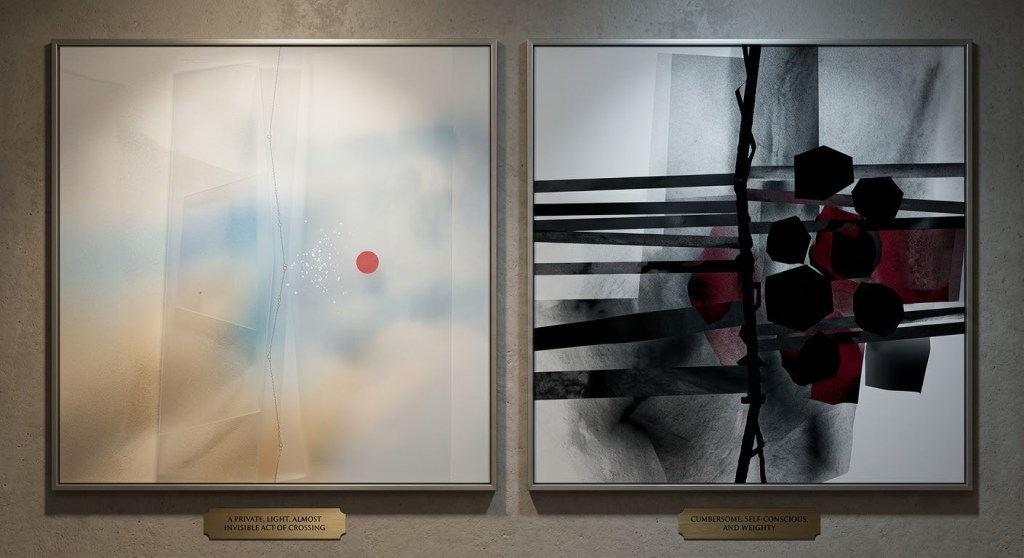
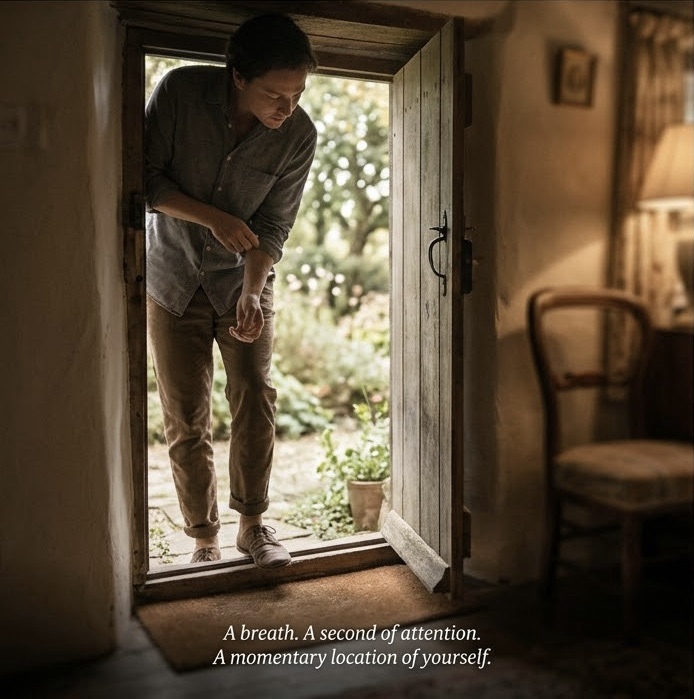
One more thing worth noting. Thresholds, when not under attack, become very small. They do not require elaborate ritual. A breath. A second of attention. A momentary location of yourself. The interior equivalent of straightening a sleeve before walking into a room. The attack is what makes them feel cumbersome — because under surveillance, the smallest gesture becomes self-conscious and weighty. Without the attack, the threshold returns to its proper proportion: a private, light, almost invisible act of crossing, after which you simply enter what comes next and live it.
That is what stopping the attack restores. Not the threshold — the threshold was always there. The ease of the threshold. The fact that you can use it as the tool it is, without having to also defend it from the part of yourself that wants to call the whole practice into question.
The practice is the practice. The threshold is part of it. Let it be.
WE&P by: EZorrillaMc&Co.


You must be logged in to post a comment.