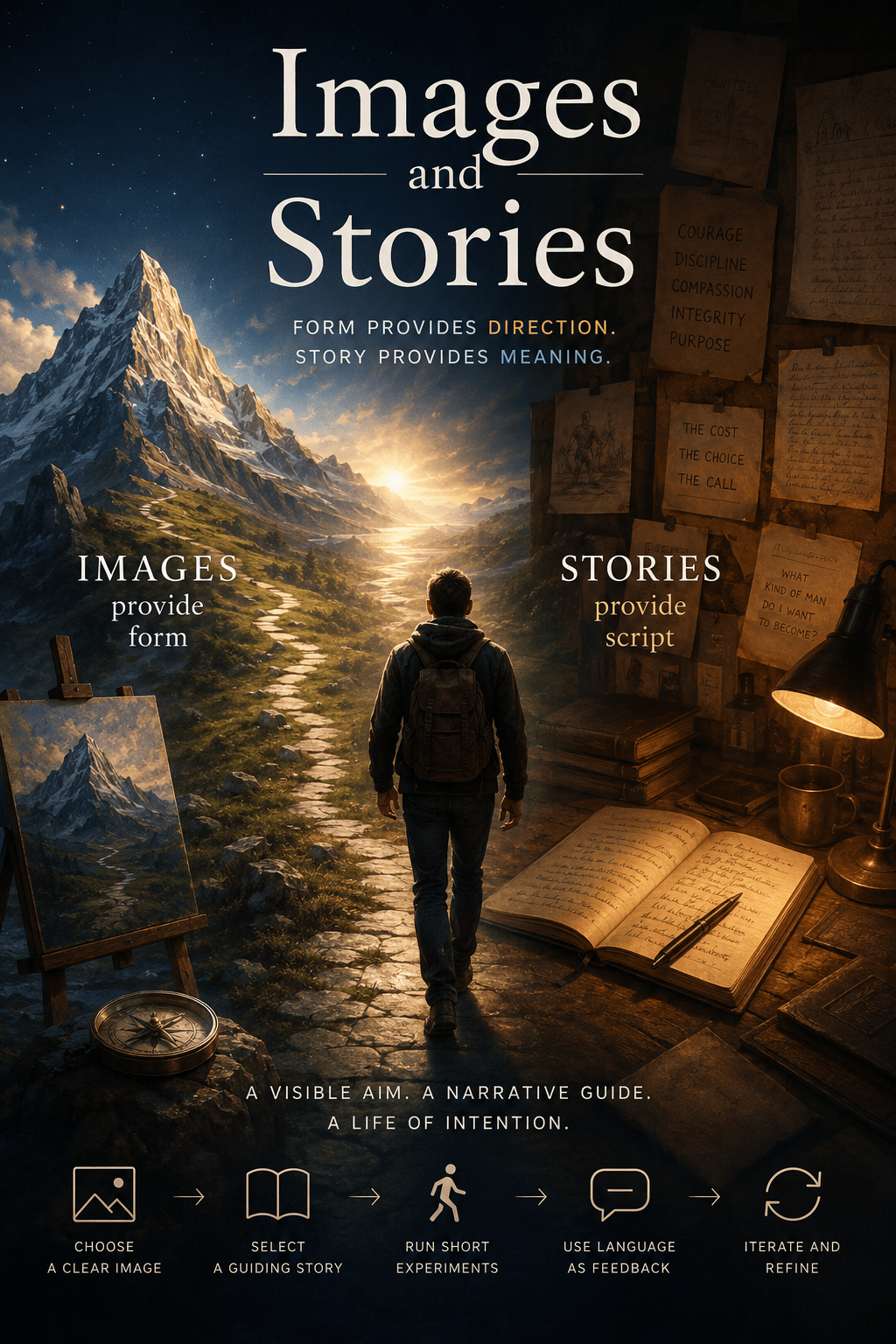
Images provide form; stories provide script. Visuals supply a concrete posture or target to move toward, while narratives supply the emotional contours and interpretive language needed to test and refine that posture. Together they transform vague longing into actionable possibilities by making both the aim and the means legible.
How They Work Together
Images act as models that can be imitated. Stories act as counterpoints that can be argued with, adopted, or rejected. This creates a productive dialectic: a posture is tried on visually, and a narrative is used to interpret and judge the fit. Over time, that loop reshapes desire and identity by giving a clear image to aim for and a story to think and feel against.
Modeling plus counterpoint produces two effects. First, it clarifies what maturity or change might look like in practice. Second, it supplies the vocabulary to want that change—naming the costs, the trade-offs, and the values that make the change desirable.
Developmental Consequences
Maturity becomes a selectable skill rather than an accidental arrival. When an image makes a quality legible and a story supplies the inner moves to enact it, wanting and cultivating that quality becomes possible. The combination supplies both direction and feedback: the image orients behavior; the story supplies phrases and scenarios that reveal whether the behavior aligns with deeper aims.
Practical implication: once an image and a story are aligned, short experiments can be run to test whether the new posture fits. These experiments provide data—bodily signals, emotional responses, social feedback—that inform whether to keep, adjust, or discard the new orientation.
Practical Steps
- Choose a clear image that embodies the quality to be cultivated.
- Select a guiding story that models the inner moves and emotional logic of that quality.
- Run short experiments by enacting the image and narrating the experience with the chosen story.
- Use language as feedback: adopt phrases from the story to notice when the posture feels authentic or strained.
- Iterate: refine the image and story based on lived experience and external feedback.
These steps create a low-friction pathway from intention to habit: a visible aim plus a narrative script that makes the aim emotionally intelligible.
Creative and Relational Uses
For creators and leaders, images orient teams and stories coordinate feeling and meaning. For individuals, images reduce ambiguity about who one might be; stories let one rehearse the emotional cost and reward. In relationships, shared images and stories create mutual expectations—useful when explicit, risky when assumed.
Caveat: images can be seductive and stories can be persuasive; both should be tested against lived reality and ethical considerations. They are tools for formation, not substitutes for repair or accountability.
Conclusion
Images point the way; stories teach how to walk. Together they make a new desire legible and actionable. When combined deliberately—chosen, tested, and iterated—they provide a scaffold for becoming the kind of person that was previously only imaginable.
WE&P by: EZorrillaMc&Co.

