Tarin did not look at it.
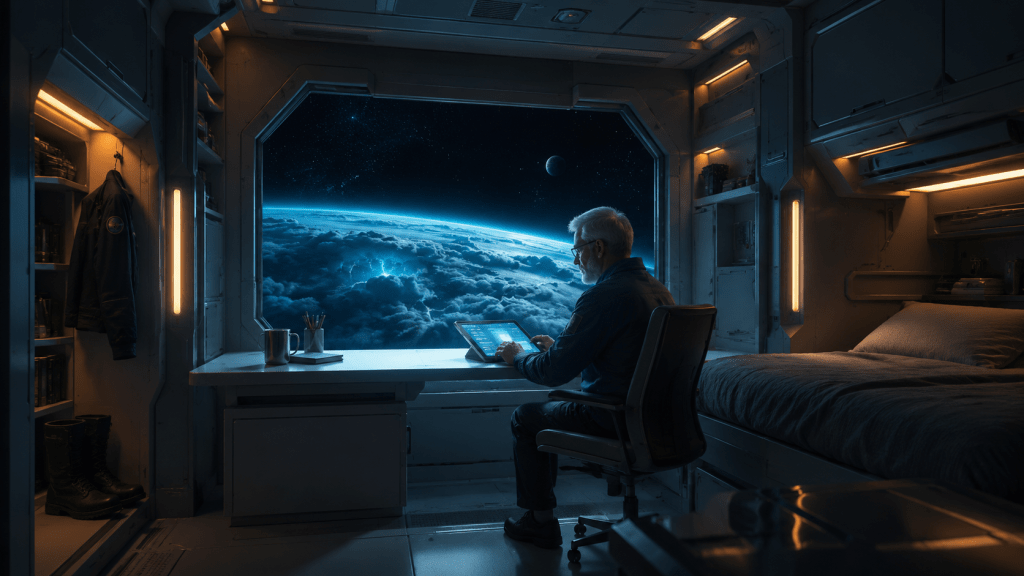
Outside the window, the night side of Pelagos rolled beneath the station in slow blue-black silence, the storm belts faintly lit by electrical blooms that opened and vanished inside the clouds. At this hour, messages usually came from the lower hemisphere. From Arion, if the relay was clean. Arion never trusted scheduled communication. He sent fragments instead: three words from a ferry terminal, a photograph of rain on a pressure window, a question with no answer required.
The pad buzzed again.
Tarin smiled before he meant to.
Then the smile stopped.
No.
That was not Arion’s rhythm.
Arion sent once, then waited. Or sent five times in a row if he had seen something beautiful and wanted to make sure Tarin saw it before beauty became memory. Two pulses, evenly spaced, belonged to systems. Offices. Departments. Requests that believed themselves neutral because they had been formatted.
He picked up the pad.
The header carried the seal of Station Command.
For a moment, he thought it had to be a mistake. He had no pending assignment. No transfer request. No active petition. His name had been taken off the long-range registry six months ago, at his own insistence, after the survey run through the Kestral Chain ended with three dead, one missing, and an inquiry that concluded nothing except that bad weather became worse when proud people pretended it was still navigable.
He opened the message.
FIELD SCIENCE OFFICER
STATION OPERATIONS ATTACHMENT
PROVISIONAL APPOINTMENT OFFER
Tarin read the title twice.
Not captain. Not lead surveyor. Not mission authority.
Field Science Officer.
Station Operations Attachment.
He laughed once, quietly, because the words had the dry courtesy of a door closing without accusation.
The message continued. He did not read it cleanly the first time. Phrases lifted out of the block and arranged themselves in the air.
Environmental intelligence.
Survey support.
Away-team analysis.
Transit corridor assessment.
Planetary interface.
Crew recovery metrics.
Return debrief.
Station integration.
Return appeared three times.
He set the pad down.
The room held its shape around him: one chair, one bed, the narrow galley still smelling faintly of boiled grain, his boots lined beneath the wall hooks, his jacket hung with uncommon care. He had been in this rented module for nine days, which was already longer than he had intended. On the third day, he had felt the old restlessness rise. On the fifth, it had changed flavor. By the seventh, he had stopped checking departure boards without deciding to stop.
That had frightened him more than any storm.
He stood and crossed to the window.
Below, Pelagos rotated as if it had all the time in the universe. The night side was not empty. He knew that now. The first weeks in orbit, he had thought only the day side mattered: the ports, the ocean farms, the solar mirrors, the towers bright with commerce and argument. But the night side was where instruments learned patience. Heat signatures. Magnetic drag. Silent migrations under cloud. Pressure systems forming without spectacle.
He had learned to read it because there had been nothing else to do at 0300 except look.
The pad buzzed a third time.
This one was not the offer.
Arion.
A line of text appeared below the command seal, intimate and badly timed.
Are you awake, or only pretending to be unavailable?
Tarin stared at it.
Then he looked back at the job offer.
Two doors, he thought.
No. That was too romantic.
One door and one voice.
He picked up the pad and opened Arion’s message first.
Awake, he wrote.
The reply came almost immediately.
Good. The night coast is throwing green fire again. I thought of you.
A photograph followed: dark water, a line of mineral lamps along a harbor wall, and beyond them the faint auroral discharge Pelagos sometimes released when the upper atmosphere rubbed against the station’s shielding field. Green fire. Arion had a weakness for naming phenomena as if language could make them stay.
Tarin sat down.
For a while he let the two messages coexist. The photograph below, the offer above. Night coast and command seal. Personal weather and institutional form. Neither one requiring him to move yet.
That was new.
Once, any invitation had become a vector. A message from Arion would have pulled him toward the next shuttle, the next descent window, the next rented room with salt on the floor. A command offer would have pulled him toward refusal before he even understood it, because refusal had often disguised itself as freedom.
Now both remained markers.
Not instructions.
He opened the offer again and read it from the beginning.
Commander Sayeed’s name appeared at the bottom, which surprised him. He had met her only twice. Once after the Kestral inquiry, when she had said nothing comforting and therefore become the only person in the room he trusted. Once in the station garden, where she had found him studying a maintenance map instead of the engineered trees.
“You keep looking at the supports,” she had said.
“I don’t trust trees on stations.”
“No,” she said. “You don’t trust beauty without infrastructure.”
He had liked her against his will.
The appointment began in thirty days. Provisional term: six months. Station-based, with field deployment as assigned. No independent mission command. No personal vessel. No discretionary route selection.
He felt the old resistance rise at that.
There it is, he thought.
Sharp. Narrowing. Proud.
He let it speak without answering.
No personal vessel.
The phrase touched something younger than reason. He saw himself at twenty-seven, sleeping in the engine bay of a survey skiff because he had spent his cabin allowance on extra fuel cells. He saw himself at thirty-nine, refusing a safer convoy because convoy speed felt like humiliation. He saw himself at fifty-one, alone over the ice moons of Ravan, eating ration paste with numb fingers and calling it purity because no one could ask anything of him if no one knew where he was.
No personal vessel.
He breathed out.
Maybe that was the point.
A station was not the opposite of a ship. He had been wrong about that. A station was a vessel that had agreed to be found. It held traffic, weather, hunger, repairs, argument, arrivals, grief, bad coffee, lost children, diplomats, smugglers, exhausted pilots, and people who needed somewhere to put their bags down fully.
A station did not prove itself by crossing distance.
It proved itself by receiving motion and sending it back out cleanly.
He read the duty list again.
Environmental intelligence.
Away-team analysis.
Transit corridor assessment.
Crew recovery metrics.
Return debrief.
Return, return, return.
He imagined the job incorrectly at first: a desk, reports, restraint, becoming one of those pale officers who spoke of field conditions from upholstered rooms.
Then another image came.
A team standing in the lock before descent. Someone younger checking his gloves too many times. Someone older pretending his knee did not hurt. A pilot watching weather data with forced boredom. Tarin at the side, not commanding them, not performing bravery for them, but reading the conditions.
What does the mission need?
What can the body bear?
What must be brought back?
The thought did not thrill him.
That was how he knew it was serious.
Thrill leaned forward. Thrill wanted the corridor, the hatch, the burn. This was steadier. Heavier. It did not ask him to disappear into the voyage. It asked him to become responsible for what the voyage cost.
His pad chimed again.
Arion:
You went quiet.
Tarin typed:
I received an offer.
A pause.
From a person or an institution?
Tarin smiled.
Institution.
Then be careful. Institutions use nicer paper.
It is station work.
Another pause.
Are you disappointed?
Tarin looked at the window, at the planet, at the night side turning with all its hidden weather.
No, he wrote, and discovered it was true only after he had sent it. Not exactly.
Arion replied:
That sounds dangerous.
Tarin laughed.
The sound startled him. It had been a while since laughter had arrived without needing to prove health.
He stood, took the pad, and crossed to the small desk built into the wall. He had not used it except as a place to drop keys and wrappers. Now he cleared it. Cup to the galley. Knife to the drawer. Old transit slips into the recycler. He wiped the surface with his sleeve, then sat.
The chair was uncomfortable. Good. Comfortable chairs encouraged fantasy. This one required posture.
He opened a reply field to Commander Sayeed.
For ten minutes, he wrote nothing.
Then he typed:
I have received the appointment offer.
He stopped.
Too formal.
He deleted it.
Commander,
I have received the offer. I need clarification on three points before I answer.
He listed them.
Field deployment frequency.
Authority during away-team environmental assessment.
Expected relationship between station operations and independent scientific recommendation.
He read the list back.
No poetry. No confession. No announcement of transformation. Just the terms under which a man might learn to return.
He sent it.
The message left the pad without ceremony.
Tarin sat there afterward, hands resting on the desk, feeling for the familiar regret that usually followed any reduction of possibility. It did not come. In its place was a quieter sensation, almost physical, like a strap settling across the chest before launch.
Not restraint.
Harness.
Outside, the night side of Pelagos rolled on. The station lights reflected faintly in the glass, so that for a moment he could see both at once: the planet below and his own face, older than he expected, present in the room.
Arion sent one more message.
Green fire is fading.
Tarin looked at it, then at the cleared desk, then at the command seal still waiting in the corner of the screen.
He typed:
Let it fade. Tell me what remains.
Then he set the pad down, stayed seated, and let the station hold.
Tarin did not look at it.
Outside the window, the night side of Pelagos rolled beneath the station in slow blue-black silence, the storm belts faintly lit by electrical blooms that opened and vanished inside the clouds. At this hour, messages usually came from the lower hemisphere. From Arion, if the relay was clean. Arion never trusted scheduled communication. He sent fragments instead: three words from a ferry terminal, a photograph of rain on a pressure window, a question with no answer required.
The pad buzzed again.
Tarin smiled before he meant to.
Then the smile stopped.
No.
That was not Arion’s rhythm.
Arion sent once, then waited. Or sent five times in a row if he had seen something beautiful and wanted to make sure Tarin saw it before beauty became memory. Two pulses, evenly spaced, belonged to systems. Offices. Departments. Requests that believed themselves neutral because they had been formatted.
He picked up the pad.
The header carried the seal of Station Command.
For a moment, he thought it had to be a mistake. He had no pending assignment. No transfer request. No active petition. His name had been taken off the long-range registry six months ago, at his own insistence, after the survey run through the Kestral Chain ended with three dead, one missing, and an inquiry that concluded nothing except that bad weather became worse when proud people pretended it was still navigable.
He opened the message.
FIELD SCIENCE OFFICER
STATION OPERATIONS ATTACHMENT
PROVISIONAL APPOINTMENT OFFER
Tarin read the title twice.
Not captain. Not lead surveyor. Not mission authority.
Field Science Officer.
Station Operations Attachment.
He laughed once, quietly, because the words had the dry courtesy of a door closing without accusation.
The message continued. He did not read it cleanly the first time. Phrases lifted out of the block and arranged themselves in the air.
Environmental intelligence.
Survey support.
Away-team analysis.
Transit corridor assessment.
Planetary interface.
Crew recovery metrics.
Return debrief.
Station integration.
Return appeared three times.
He set the pad down.
The room held its shape around him: one chair, one bed, the narrow galley still smelling faintly of boiled grain, his boots lined beneath the wall hooks, his jacket hung with uncommon care. He had been in this rented module for nine days, which was already longer than he had intended. On the third day, he had felt the old restlessness rise. On the fifth, it had changed flavor. By the seventh, he had stopped checking departure boards without deciding to stop.
That had frightened him more than any storm.
He stood and crossed to the window.
Below, Pelagos rotated as if it had all the time in the universe. The night side was not empty. He knew that now. The first weeks in orbit, he had thought only the day side mattered: the ports, the ocean farms, the solar mirrors, the towers bright with commerce and argument. But the night side was where instruments learned patience. Heat signatures. Magnetic drag. Silent migrations under cloud. Pressure systems forming without spectacle.
He had learned to read it because there had been nothing else to do at 0300 except look.
The pad buzzed a third time.
This one was not the offer.
Arion.
A line of text appeared below the command seal, intimate and badly timed.
Are you awake, or only pretending to be unavailable?
Tarin stared at it.
Then he looked back at the job offer.
Two doors, he thought.
No. That was too romantic.
One door and one voice.
He picked up the pad and opened Arion’s message first.
Awake, he wrote.
The reply came almost immediately.
Good. The night coast is throwing green fire again. I thought of you.
A photograph followed: dark water, a line of mineral lamps along a harbor wall, and beyond them the faint auroral discharge Pelagos sometimes released when the upper atmosphere rubbed against the station’s shielding field. Green fire. Arion had a weakness for naming phenomena as if language could make them stay.
Tarin sat down.
For a while he let the two messages coexist. The photograph below, the offer above. Night coast and command seal. Personal weather and institutional form. Neither one requiring him to move yet.
That was new.
Once, any invitation had become a vector. A message from Arion would have pulled him toward the next shuttle, the next descent window, the next rented room with salt on the floor. A command offer would have pulled him toward refusal before he even understood it, because refusal had often disguised itself as freedom.
Now both remained markers.
Not instructions.
He opened the offer again and read it from the beginning.
Commander Sayeed’s name appeared at the bottom, which surprised him. He had met her only twice. Once after the Kestral inquiry, when she had said nothing comforting and therefore become the only person in the room he trusted. Once in the station garden, where she had found him studying a maintenance map instead of the engineered trees.
“You keep looking at the supports,” she had said.
“I don’t trust trees on stations.”
“No,” she said. “You don’t trust beauty without infrastructure.”
He had liked her against his will.
The appointment began in thirty days. Provisional term: six months. Station-based, with field deployment as assigned. No independent mission command. No personal vessel. No discretionary route selection.
He felt the old resistance rise at that.
There it is, he thought.
Sharp. Narrowing. Proud.
He let it speak without answering.
No personal vessel.
The phrase touched something younger than reason. He saw himself at twenty-seven, sleeping in the engine bay of a survey skiff because he had spent his cabin allowance on extra fuel cells. He saw himself at thirty-nine, refusing a safer convoy because convoy speed felt like humiliation. He saw himself at fifty-one, alone over the ice moons of Ravan, eating ration paste with numb fingers and calling it purity because no one could ask anything of him if no one knew where he was.
No personal vessel.
He breathed out.
Maybe that was the point.
A station was not the opposite of a ship. He had been wrong about that. A station was a vessel that had agreed to be found. It held traffic, weather, hunger, repairs, argument, arrivals, grief, bad coffee, lost children, diplomats, smugglers, exhausted pilots, and people who needed somewhere to put their bags down fully.
A station did not prove itself by crossing distance.
It proved itself by receiving motion and sending it back out cleanly.
He read the duty list again.
Environmental intelligence.
Away-team analysis.
Transit corridor assessment.
Crew recovery metrics.
Return debrief.
Return, return, return.
He imagined the job incorrectly at first: a desk, reports, restraint, becoming one of those pale officers who spoke of field conditions from upholstered rooms.
Then another image came.
A team standing in the lock before descent. Someone younger checking his gloves too many times. Someone older pretending his knee did not hurt. A pilot watching weather data with forced boredom. Tarin at the side, not commanding them, not performing bravery for them, but reading the conditions.
What does the mission need?
What can the body bear?
What must be brought back?
The thought did not thrill him.
That was how he knew it was serious.
Thrill leaned forward. Thrill wanted the corridor, the hatch, the burn. This was steadier. Heavier. It did not ask him to disappear into the voyage. It asked him to become responsible for what the voyage cost.
His pad chimed again.
Arion:
You went quiet.
Tarin typed:
I received an offer.
A pause.
From a person or an institution?
Tarin smiled.
Institution.
Then be careful. Institutions use nicer paper.
It is station work.
Another pause.
Are you disappointed?
Tarin looked at the window, at the planet, at the night side turning with all its hidden weather.
No, he wrote, and discovered it was true only after he had sent it. Not exactly.
Arion replied:
That sounds dangerous.
Tarin laughed.
The sound startled him. It had been a while since laughter had arrived without needing to prove health.
He stood, took the pad, and crossed to the small desk built into the wall. He had not used it except as a place to drop keys and wrappers. Now he cleared it. Cup to the galley. Knife to the drawer. Old transit slips into the recycler. He wiped the surface with his sleeve, then sat.
The chair was uncomfortable. Good. Comfortable chairs encouraged fantasy. This one required posture.
He opened a reply field to Commander Sayeed.
For ten minutes, he wrote nothing.
Then he typed:
I have received the appointment offer.
He stopped.
Too formal.
He deleted it.
Commander,
I have received the offer. I need clarification on three points before I answer.
He listed them.
Field deployment frequency.
Authority during away-team environmental assessment.
Expected relationship between station operations and independent scientific recommendation.
He read the list back.
No poetry. No confession. No announcement of transformation. Just the terms under which a man might learn to return.
He sent it.
The message left the pad without ceremony.
Tarin sat there afterward, hands resting on the desk, feeling for the familiar regret that usually followed any reduction of possibility. It did not come. In its place was a quieter sensation, almost physical, like a strap settling across the chest before launch.
Not restraint.
Harness.
Outside, the night side of Pelagos rolled on. The station lights reflected faintly in the glass, so that for a moment he could see both at once: the planet below and his own face, older than he expected, present in the room.
Arion sent one more message.
Green fire is fading.
Tarin looked at it, then at the cleared desk, then at the command seal still waiting in the corner of the screen.
He typed:
Let it fade. Tell me what remains.
Then he set the pad down, stayed seated, and let the station hold.
WE&P by: EZorrillaMc&Co.

