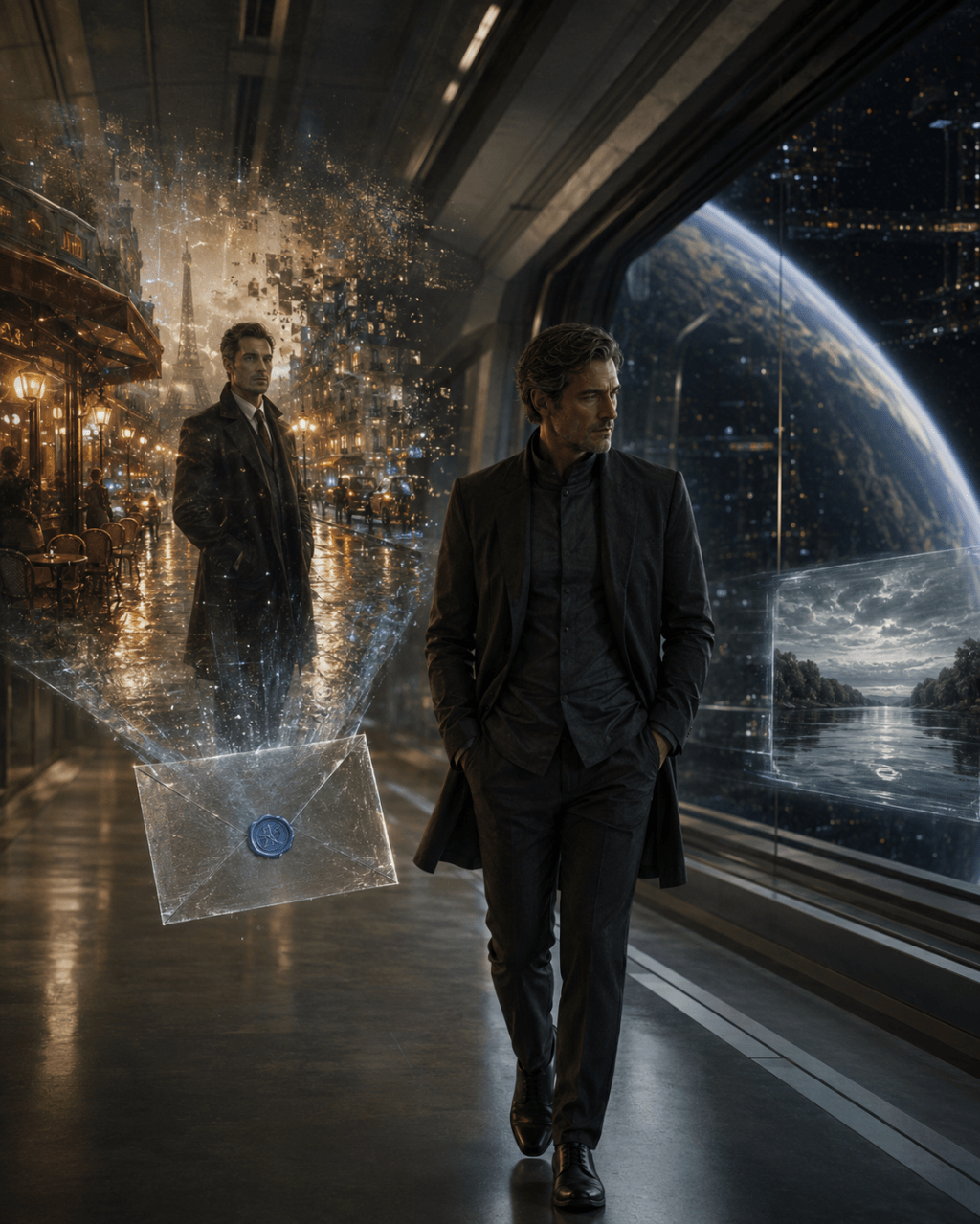
The first invitation arrived in a silver envelope that did not exist.
Tarin noticed it while crossing the east gallery of the orbital habitat, where the windows looked out over the slow curve of the planet and the station lights reflected against the glass like a second, artificial constellation. The envelope was not on the floor, not in his hand, not in the message queue behind his left eye. It was somewhere stranger: staged in attention itself, as if a scene had been projected directly into the threshold of his mind.
He knew the technique. Everyone in the older circles knew it. Some people did not ask plainly. They arranged mood first. They set the room, lit the candles, opened the curtains to a remembered sky, and waited for you to step into the role they had prepared.
The seal on this one shimmered with a Paris blue he had not seen in years.
When he broke it, the gallery around him softened. The metal ribs of the habitat disappeared beneath the recollection of a rain-glossed boulevard on the Old Earth simulation decks, all brass cafés and wet pavement and evening traffic humming like a low violin. A figure appeared at the edge of the scene, smiling with studied weariness, hands tucked into the coat pockets of a man who wanted to look like he had just wandered in from destiny.
Marek.
Not the actual Marek, of course. Marek as offer. Marek as composition.
“My dear Tarin,” the projection said, though its mouth barely moved. “I’ve reopened the Salon Atrium on Ring Seven for a four-night exhibit. Painters, composers, donors, a few collectors from the inner colonies. A good crowd. You should come. It would be like old times.”
Tarin stopped walking.
The boulevard was beautifully made. Too beautifully made. It contained the right degree of melancholy, the exact ratio of intimacy and grandeur, the illusion that stepping into it would mean stepping back into a shared life rather than into someone else’s current production schedule.
He let the scene keep speaking.
“There’ll be people who remember your work,” Marek continued. “We could catch up properly. And if you felt moved, there are young artists whose travel grants still need sponsors. You’d understand what this means.”
There it was.
Not at the beginning, never at the beginning. First came the mood, the memory, the soft coat of history. Then the lane appeared underneath: funding, patronage, usefulness, a social role he could be assigned without anyone naming the assignment.
The station glass reasserted itself in the corner of his vision. Tarin kept walking.
He had once been easy to recruit. Warmth was enough. Shared history was enough. A remembered city, an old private joke, a tone of voice that implied continuity — that had once opened every door. He would step in before asking what part he was meant to play.
Not anymore.
He stopped beneath a maintenance arch and answered aloud, though he knew the scene would have registered a subvocal response just as well.
“Success with your exhibit,” he said. “Continue with your orbit. I’ll continue with mine.”
The boulevard held for one second more, as if waiting for him to soften. Then its lights blinked out. Brass, rain, old Earth dusk — gone.
The real corridor returned in one clean piece: steel floor, filtered air, distant vibration from the station’s spin.
Nothing collapsed.
That was still the strangest part. He had expected, in younger years, that refusing a scene would trigger consequence. Anger. Appeal. Clarification. Some small disaster in the social weather. Instead there was only absence. Not an act of war. Not even a quarrel. Just non-entry.
He moved on.
The second invitation came three cycles later from his sister, Liora, and because it came from her, he braced automatically. Family scenes were older, denser, full of ghost architecture. A single line from her could open cathedrals of memory he had no wish to inhabit.
Her message arrived without seal, projection, or atmospheric staging. A plain relay note while he was in the hydroponics ring choosing bitter greens for the week.
Crossing the Rhine tomorrow on the ferry line near Cologne Sector. Thought of that trip you planned once through the desert museums. Funny what returns. The water is enormous here. You’d like the color of it.
He read it twice among the towers of lettuce and medicinal herbs.
There was a scene in it, yes. The Rhine. The old desert journey. Shared time folded lightly into present time. But it did not close around him. It did not cast him into a function. It did not imply that he must resume an old mission, solve an old breach, or underwrite an old dream. It was a bridge, not a trap.
That difference mattered.
He could feel how carefully he had learned to distinguish them. Some scenes were really only scripts in disguise. Others left enough unoccupied air that a real exchange could still happen.
He replied from the aisle between nutrient tanks.
Have a good crossing. The color sounds worth seeing.
It was a small answer, intentionally small. But it did not end the channel.
An hour later, her reply came while he was back in his quarters calibrating the heat unit on the cooker.
It changes every five minutes, she wrote. Slate, then green, then silver. I thought of you because the clouds here make dark colors visible. In direct sun it would all flatten.
Tarin sat down.
That was the difference.
Marek had set a stage and offered him a role already written: witness, patron, legitimizer, old friend pressed back into service under the velvet cover of nostalgia.
Liora had set a stage too, but left it inhabitable. There was still room for weather, for color, for something observed rather than demanded. The scene could continue without requiring him to become machinery inside it.
He sent a final note.
Cloud does that. It doesn’t invent color. It reveals what harsh light erases.
This time she answered only with an image: the river under a low sky, broad as metal, carrying light in bruised shades of green and gunsilver. No request followed. No hidden agenda surfaced. The exchange thinned naturally and held.
He placed the image beside the cooker and let the vegetables steam.
Later, walking the perimeter track, he thought about how long it had taken him to learn the difference. In youth, he had called both things closeness. He would have said Marek was reaching out and Liora was reaching out and left it there, unable or unwilling to distinguish invitation from inclusion, mood from assignment, memory from claim.
But age, or injury, or simply pattern-recognition had changed the geometry.
A scene was not innocent. A scene could be architecture.
One person set a room in which refusal would look like ingratitude, coldness, failure to honor the past. Another opened a view and left the threshold clear.
That was the real distinction. Not warmth versus no warmth. Both messages had warmth in them. Not history versus no history. Both drew on history. The difference was structural.
Who remained free inside the scene?
Below the station, the planet turned in silence. Bands of cloud crossed the night side in slow luminous drifts. Tarin stopped at the widest window and watched a storm system widen over the northern ocean.
He thought of all the access he had once granted just because someone could evoke a shared world. He thought of how often he had mistaken atmosphere for safety, tenderness for mutuality, familiarity for permission. He thought of the cost.
Then he thought of the hydroponics ring, the Rhine image, the fact that some channels survived precisely because they did not demand too much.
He smiled at the planet and kept walking.
Out in the black, ships came and went from the station docks, tiny points of thrust entering, leaving, declining offered routes, taking others. Nothing in the traffic looked dramatic from this distance. Just lines, choices, vectors, continuation.
That was enough.
Not every opened scene deserved entry.
Not every remembered place was a door.
And not every refusal was loss.
Some refusals kept the station sealed.
Some replies kept the window open.
Knowing the difference, he thought, was a form of navigation.
WE&P by:EZorrillaMc&Co.

