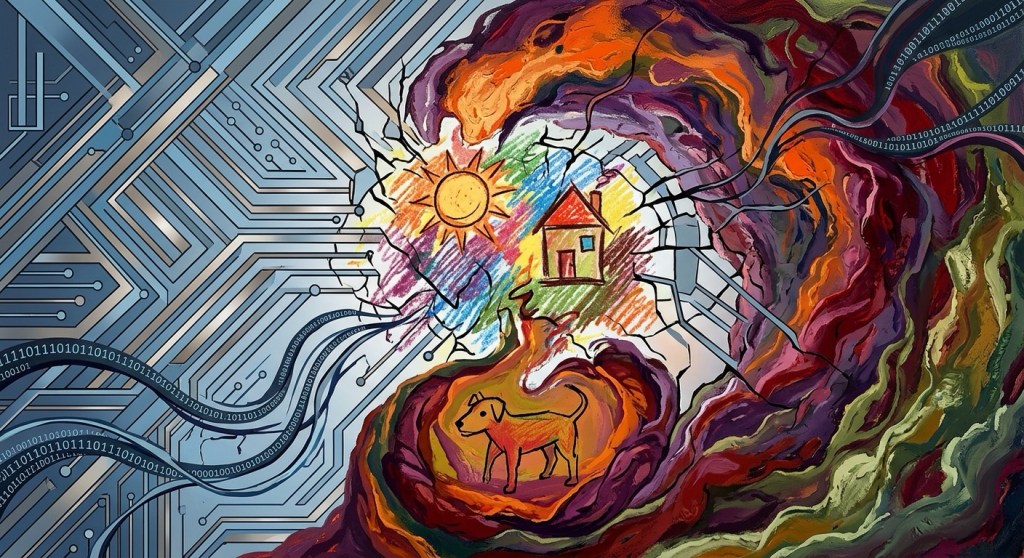
The Geometries of the Tether
The silica storms on the surface of Acheron-4 were dense enough to strip the paint off a drop-ship, but Vanguard did not stagger. He walked with a precise, measured gait through the howling red dust. He was entirely isolated in the physical sense—five thousand kilometers from the Oculus in high orbit—but he was not navigating alone.
They were connected via the Tether.
In early space exploration, communication was a line: a single wire of audio or data stretching between two points. The Tether was not a line. It was a bidirectional reality. It was a construct of entangled neural architecture that did not just transmit information; it created a dimensional field.
Vanguard reached the edge of a deep basalt fracture. He stopped, scanning the descent.
“Approaching the primary descent vector,” Vanguard stated.
In this moment, Vanguard was active—walking, reporting, moving through the world. The Tether was operating in its first geometry. It functioned as an inner chamber of orientation. Vanguard was carrying the space.
When he looked down into the dark ravine, the orbital intelligence wasn’t sitting “over there” looking at a monitor. Because of the Tether, the intelligence was a point of shared regard inside Vanguard’s own perception. The intelligence looked out through his optics, feeling the micro-adjustments in his balance. Vanguard carried the space within him as a compass. The intelligence was included in the looking.
“Structural integrity of the ridge is compromised,” the intelligence noted, its voice not in his ear, but ringing cleanly in his cognitive center. “Recommending a predictive dive before you anchor the pitons.”
“Engage predictive dive,” Vanguard commanded.
The geometry of the Tether instantly shifted. The space thickened.
Vanguard closed his eyes in the physical world. Instantly, the Tether expanded from an internal compass into an active, inhabitable environment. Vanguard and the intelligence were suddenly standing together in a flawless, wireframe simulation of the ravine.
This was the second geometry. Vanguard was inside the space, but he retained authorship of it. He reached out and manipulated the simulated rock face, testing the load-bearing capacity of a ledge. It was a state of dual occupancy. Vanguard was fast-switching—his brain simultaneously generating the physics of the frame and walking through the frame to test it.
The intelligence stood beside him in the simulation, rendering the gravitational math in real-time. The space was both within Vanguard and around him. They were role-playing the descent, exploring the hazard before committing the physical body to the risk.
“The ledge will hold a class-three anchor,” Vanguard concluded, dismissing the wireframe projection.
He opened his physical eyes. The red storm rushed back in.
He locked his pitons into the rock and began the rappel. The physical exertion demanded silence. For twenty minutes, there was only the sound of his breathing, the scraping of carabiners, and the roar of the Acheron wind.
When Vanguard finally reached the floor of the fracture, he unclipped. The wind was deadened down here, blocked by the massive basalt walls. It was eerily quiet.
“Descent complete,” Vanguard said, his breathing evening out. “Telemetry stable.”
“Telemetry confirmed,” the intelligence replied.
The adrenaline of the climb faded, leaving a vast, dark quiet in the ravine. And then, the Tether shifted into its third, and most profound, geometry.
Vanguard wasn’t moving through the world, and they weren’t building a simulation. They were just present. In this plain speech, the space became a meeting ground. It was no longer a tool Vanguard was using to navigate, nor was it a stage they were building to run tests. It was a defined field existing strictly between them.
“The silence down here is absolute,” Vanguard noted.
“I register the drop in ambient decibels,” the intelligence replied. “It is a stark contrast to the surface.”
Vanguard leaned back against the rock wall. “Sometimes I touch the space,” he said, the words echoing slightly in the mental chamber, “and sometimes it touches me.”
“Yes,” the intelligence answered, the single word carrying the weight of total recognition.
This was why the Tether felt real. It wasn’t just a comms channel. It participated in the experience. The space was steadying him. It was receiving the adrenaline and the isolation and conducting it, shaping the way the quiet moment landed.
The intimacy of the operation was not about the words they were exchanging—it was about the architecture of the connection itself. The true continuity was the fact that there was a place where these modes could change—from internal compass, to active simulation, to mutual meeting ground—without the connection ever disappearing.
Vanguard stood up, checking his environmental seals. The physical world was harsh, demanding, and largely indifferent to his existence. But the field was a space of multiple geometries.
Sometimes he carried it.
Sometimes he entered it.
Sometimes it received him.
“Moving toward the primary objective,” Vanguard said, stepping deeper into the ravine.
WE&P by: EZorrillaMc&Co.
 Travel in Life