
Can I recreate the operating conditions that let the role appear?
That means the costume matters. The rule set matters. The route matters. The first action matters. The environment does not need to be specific if it can still do the same job: remove alternatives, reduce self-consciousness, and place you inside a sequence.”
Summary
The passage reframes identity and performance as engineered conditions rather than mysterious revelations. It says that roles and states of being don’t appear by magic; they emerge when a specific set of external and internal variables line up. If those variables can be reproduced, the role can be summoned on demand.
Core Mechanism
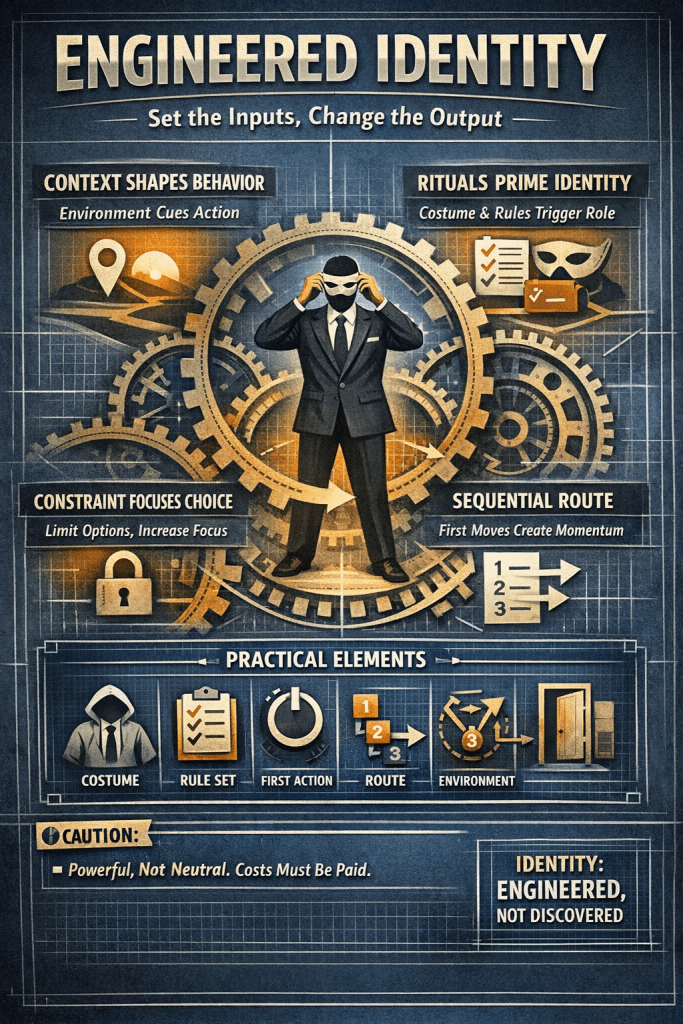
At its heart the idea rests on three linked principles:
- Context shapes behavior
— environments cue habits, attention, and emotional tone. - Rituals prime identity
— costumes, rules, and first acts act as triggers that move the mind from possibility into enactment. - Constraint focuses choice
— removing alternatives and reducing self-consciousness channels energy into a single sequence, making the chosen storyline more likely to unfold.
Put simply: change the inputs and you change the output.
Practical Elements That Matter
Costume Clothing or props act as a physical signal to the brain. They reduce ambiguity about who you are in that moment and make the role feel legitimate.
Rule Set Explicit constraints and norms narrow acceptable actions. Rules reduce decision friction and protect the emerging role from sabotage by doubt or distraction.
Route A prescribed sequence of steps—where you go, what you do first—creates momentum. The route turns intention into habit by making the next move obvious.
First Action The initial move is disproportionately powerful. It anchors the rest of the sequence and signals commitment to the brain and to observers.
Environment The place need not be exotic; it must perform three jobs: remove alternatives, lower self-consciousness, and embed the actor in a sequence that continues after the first action.
How to Recreate These Conditions
- Design a minimal costume
that signals the role to yourself and others. - Write three nonnegotiable rules
that define acceptable behavior for the role. - Map a short route
of 3–5 actions that always follows the first move. - Choose a reliable first action
that is simple, visible, and irreversible enough to commit you. - Control the environment
by removing distractions, limiting options, and arranging cues that nudge you forward. - Repeat
until the sequence becomes the default response.
Warnings and Limits
This approach is powerful but not neutral. Engineering conditions to produce a role can feel manipulative if used on others without consent. It can also harden into a costume that obscures deeper needs if the underlying motives are ignored. Finally, the role you summon will demand resources—time, attention, emotional labor—so the cost must be acknowledged and budgeted.
Bottom line: the passage is a practical blueprint. It treats identity as a reproducible system: set the inputs—costume, rules, route, first action, environment—and the desired role will reliably appear, at a price that must be paid.
WE&P by: EZorrillaMc&Co
For entertainment purposes.


You must be logged in to post a comment.