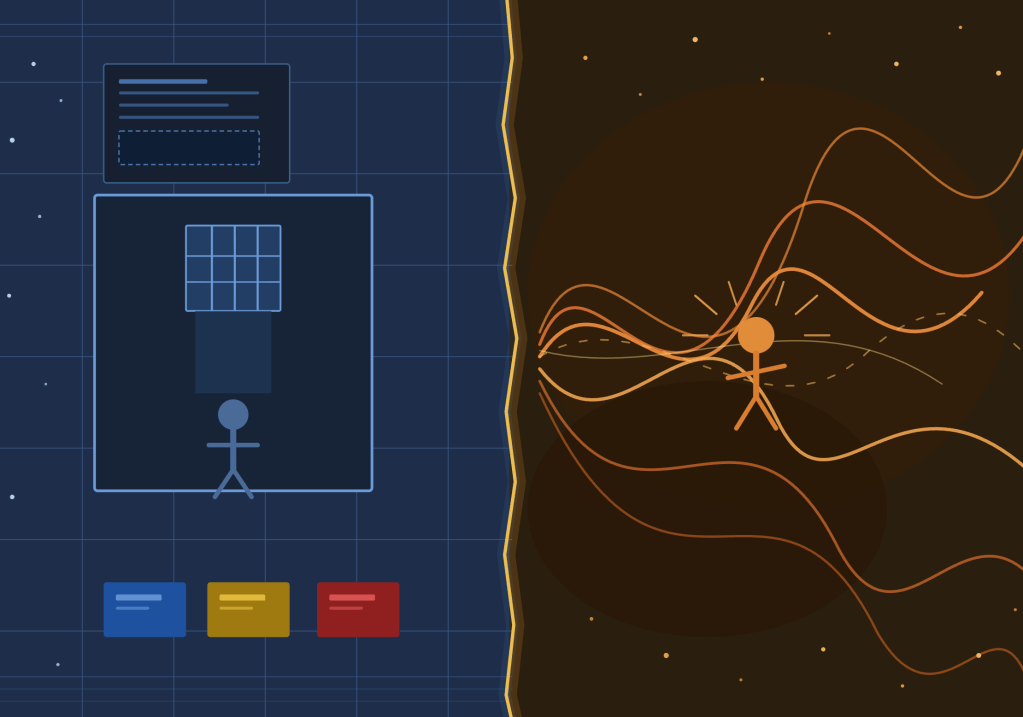
The Quiet Permits
The Ministry of Collective Wellbeing issued Solitude Permits on the first Monday of every month.
The permits were color-coded. A blue permit allowed twelve hours of unmonitored time in a designated Quiet Zone — a soundproofed room in one of the civic towers, furnished with a cot, a window, and nothing networked. A yellow permit allowed six hours. Red permits, issued only to citizens with documented psychological necessity, allowed twenty-four.
Maren had held a blue permit for eleven years. She renewed it without thinking, the way one renews a prescription. She needed the twelve hours. She knew this about herself the way she knew she needed water: not ideologically, just functionally. Without the quiet room, her mind turned loud and unnavigable. With it, she returned to herself.
She did not think of this as political.
Dov thought of everything as political.
They had met in the queue for permit renewal, three years prior. Dov had been holding a red permit — not because he was psychologically fragile, he explained immediately, unprompted, but because twenty-four hours was the maximum the system allowed and he intended to use every minute of it.
Maren had found this irritating. She found most things Dov said irritating, and then later, in the quiet room, she would turn his words over and find they had edges she hadn’t expected.
“The permit is the problem,” he told her once, in the narrow corridor outside Quiet Zone 7. “Not the loneliness policy. Not the monitoring. The permit itself.”
“The permit lets me be alone,” she said.
“The permit lets you be alone on their schedule, in their room, for their approved duration, for their approved reason.” He folded his red card between two fingers. “You are alone inside their permission. That is not the same thing.”
Maren had thought about this for a long time afterward. She had decided he was wrong, or at least incomplete. Solitude was not about origin. It was about what happened inside it. Twelve hours in a permitted room was still twelve hours. The window still showed the same sky. The mind still quieted by the same mechanism.
She was not naive. She understood what Dov was pointing at. But she thought he had confused the vessel with the water.
In the thirty-second year of the Collective Harmony Accords, the Ministry introduced a revision.
Permit holders would now be required to submit a brief reflective report upon exiting the Quiet Zone. Nothing extensive — a paragraph, a mood index, a self-reported purpose. The data, the Ministry assured everyone, would be used only to improve the program.
Maren filled out the first form without distress. Purpose: mental restoration. Mood index: 7 before, 9 after. Notes: none.
She filled out the second form.
On the third form, she paused.
The question read: Describe, in your own words, what you thought about during your permitted solitude.
She sat with the blank field for a long time. She thought about what she had actually thought about: her mother’s handwriting on old paper letters. A mathematical problem she had been turning for weeks. The specific color the light made at 4pm in winter. The shapeless, directionless quality of her own attention when nothing was asked of it.
She typed: General reflection.
She submitted the form. She went home. She felt, for the first time after leaving the Quiet Zone, unrestored.
Dov had stopped renewing his permit two years before the form revision. Maren had not understood this at the time. She understood it now.
She found him through an old contact, in a part of the city where the civic towers were fewer and the air had a different quality — less managed, somehow, though she could not have said why.
He was living in a small room above a repair shop. The room was not quiet in any designed sense. There was street noise, mechanical noise, the sound of a neighbor’s radio. But there was no window facing a permitted view, no cot positioned at the approved angle, no form to fill upon exiting.
“You could have just lied on the form,” Maren said.
“I know.”
“So why didn’t you?”
Dov looked at her with the patience of someone who had already made peace with a distinction others were still arriving at. “Because lying on the form would have meant the form still mattered. It would have meant I was still inside the system, just dishonestly.” He paused. “I didn’t want to be alone inside their question. I wanted to be alone outside it.”
Maren sat down on the edge of a wooden chair that had not been approved for sitting.
She thought about her twelve hours. She thought about how real the quiet had been, how genuinely the mind had stilled, how much she had needed it and received it. She thought about how none of that was false.
She also thought about the form. About the blank field. About describe what you thought about, and the cold little violence of it.
There were two different things she had been calling by the same name.
One was the body’s need for stillness — genuine, pre-political, older than any ministry. A return to the interior. A restoration.
The other was the self’s need to exist without being witnessed, reported, indexed, or accounted for. Not to rest. To simply be ungoverned.
The first the Ministry had packaged and sold back to her at a reasonable price.
The second it had not mentioned, because to mention it would have been to admit it existed.
She had been grateful for the room.
She had not noticed what the room did not include.
She did not renew her permit the following Monday.
The solitude she found was louder, less comfortable, and not approved.
It was also, for the first time, entirely hers.
WE&P by: EZorrillaMc&Co
 Travel in Life