The message arrived in fragments, as most personal transmissions did from the inner colonies.
First the images rendered: four figures in white thermal gear beneath a pale green sky, cutting down the face of a snowfield on Halcyon Ridge. Then a short line from the sender:
Thought you’d like these. Made me think of when we used to do this as a family.
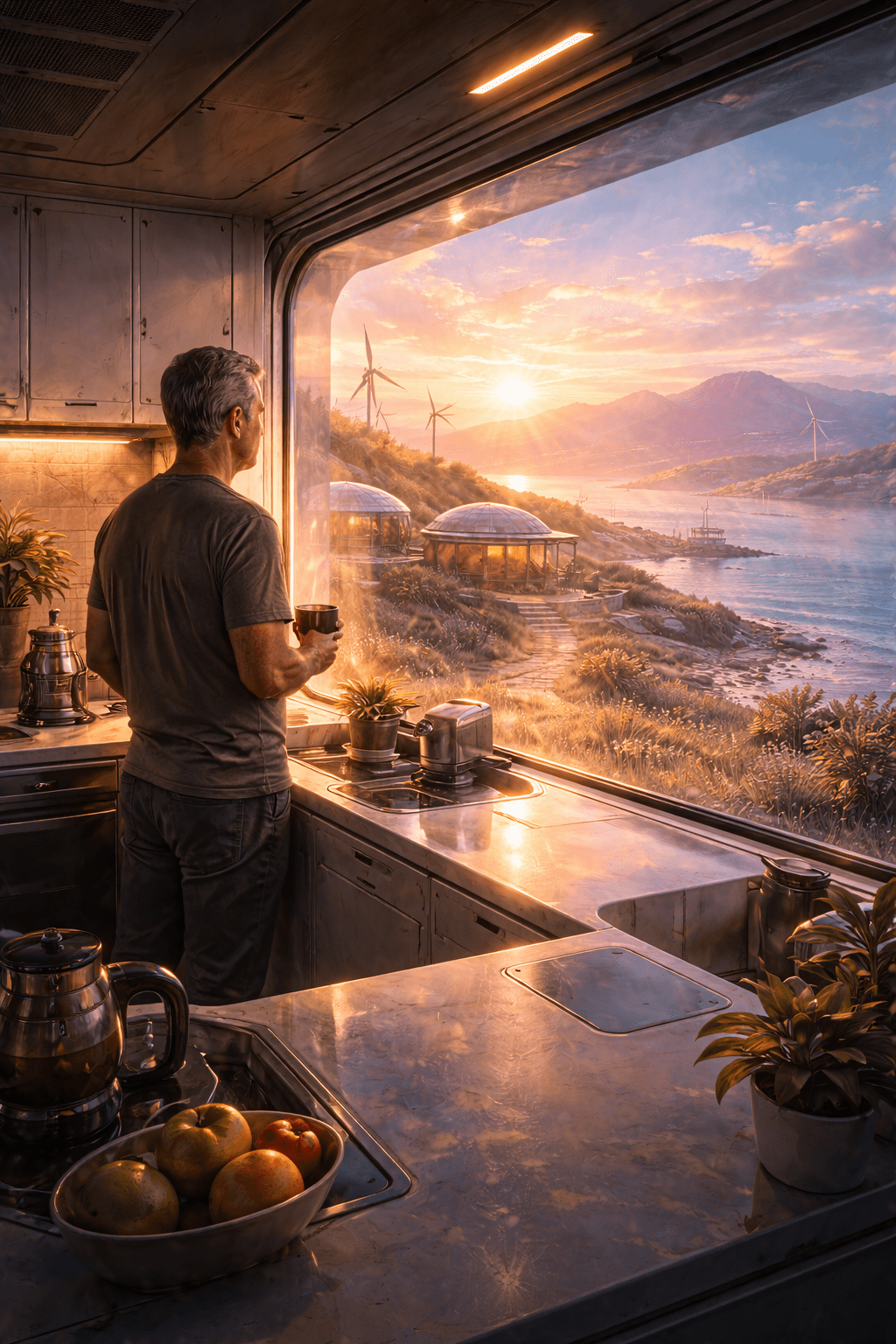
Elias Duran stood in the galley of his habitat module, one hand on the counter while the house woke around him. The climate membrane had just shifted from night mode to dawn simulation. Light the color of early Earth moved slowly across the floor. Outside the smartglass, the settlement was still half-asleep — low angular homes, gravel paths, heat baffles, a pedestrian route tracing its careful arc along the basalt edge above the inland sea.
He looked again at the images.
The sender stood with her household in the brittle light of another world. The mountain behind them was beautiful in the clean, indifferent way mountains always were. Their bodies leaned toward each other with the easy geometry of a life already underway.
Something in Elias’s chest tightened, then dimmed.
It was not jealousy. Not exactly grief. Not anger, though anger flickered briefly, searching for a place to land. It felt closer to an old chamber inside him sealing itself shut.
He knew the reference. Of course he did. A family outing from another life. Shared weather. Shared motion. Shared roles that had once held without explanation.
But as he stood there in the galley, forty years and several worlds later, the images did not open the old life. They pressed against it like a handprint on glass.
He heard himself say aloud, “This was meant for someone I no longer am.”
The room said nothing back. It was not that kind of house. He had never installed a companion intelligence, only the practical systems: climate, pantry, route planning, health scans, perimeter watch. Enough automation to keep the vessel running. Not enough to start interpreting him.
He set the tablet down and began to make tea.
That was how it usually happened. A sensation rose in the body. Then images came. Then language formed around them, quick and elegant, like structure crystallizing around vapor. Soon he was no longer merely feeling but constructing. If he kept going, the chest-tightness would turn into a scene. The scene would become an itinerary. The itinerary would acquire moral momentum. By afternoon he could be searching departures to Luna Europa, or old recreation domes in the Northern Ring, or archived maps of places that had once seemed to matter.
He knew the sequence well.
Sensation.
Image.
Name.
Plan.
Action.
Only later, after the ticket was bought, the bag packed, the body transported, did the missing question appear:
Did I want to?
He poured the water and watched the steam rise. The tea leaves spun and settled.
On the wall above the counter, the route display woke automatically. It projected his usual morning path through the settlement — past the seawall, along the tidal canal, back by the low volcanic ridge. The line glowed softly, awaiting assent.
He looked at it and thought of sailboats.
Not the recreational yachts in old Earth images. Real sailing as his grandfather had once described it: the boat not as vehicle to a destination, but as the thing through which one entered the day. A day sail. Pointless, if one thought motion only mattered when it ended elsewhere. Perfectly coherent, if one understood that return was part of the form.
The settlement was not harbor, he had been telling himself. The settlement was the vessel.
The house, the dawn route, the kitchen, the body in this mineral air, the little practices by which the hours were trimmed and set — all of it was the craft.
Then the message had struck the hull from the side.
He picked up the tablet again and enlarged one photo. One of the younger figures was mid-turn, one arm out, balance improvised but committed. The image snagged something from his own past and pulled.
Not a memory exactly. A frequency.
He could feel the danger of it. The mind beginning to promote the image into significance. The old temptation rising: fulfill the imagining, and happiness will come. Go where this points. Recreate the scene. Make contact through the archive of what had mattered.
But another understanding had been growing in him lately, quieter and less dramatic.
An imagining deserved interpretation, not obedience.
He sat at the small table by the window and let the sentence settle.
The message was not cruel. It was probably sincere. That made it harder, not easier. Because sincerity could still miss the mark. The sender had offered an old symbol, hoping it would perform present connection. Perhaps for her it still did. Perhaps the image threaded smoothly through memory and landed in warmth. But for him it did not. For him it landed in misrecognition.
Not because the old life had been false.
Because the old meaning no longer reached the present man intact.
He saw then that what hurt was not only the loss of the shared past. It was being addressed as if he still lived there. As if the version of him who would automatically light up at such images were still the one standing in this kitchen.
He wasn’t.
And something in him did not want to pretend otherwise.
The house chimed softly. On the wall, the morning route dimmed, waiting for manual confirmation.
Elias stood, crossed to the panel, and erased the default line with two fingers.
Then he drew another.
Shorter. Slower. Not toward the overlook where he usually tested the day against distance, but toward the harbor café three-quarters of a mile south, the one with the shaded deck and the old transit workers who came in at first light. A public place. Mild movement. Human weather without demand.
Not restoration. Not return. Not an old scene reenacted under new conditions.
Just the quality the image had pointed toward, stripped of its costume.
Shared life.
Motion.
A morning with other bodies in it.
He smiled a little at the route. It looked modest, almost trivial. That was fine. Day sails were made of modest headings.
He typed a reply, then stopped.
No. Not yet.
Not because he was punishing the sender. Not because silence was nobler. He simply did not want to answer from the old prompt. He did not want to produce gratitude on schedule, nor did he want to weaponize his estrangement. The old form would have to die a little more before anything new could arise.
He set the tablet face down.
Outside, the path network brightened under the growing sun. The vessel was ready. Conditions were readable. No lighthouse demanded approach.
He put on his shoes, locked the habitat behind him, and stepped into the cool edge of the morning.
The moon held its lines cleanly. Black stone. Salt grasses in engineered beds. Wind towers. A small silver shorebird darting between basalt breaks. In the distance, the inland sea lay flat as poured metal beneath the pale sky. Nothing in the scene resembled the images. That was the point.
He was not going back.
He was not even deciding, at least not in the grand old way. He was only choosing a heading that belonged to the life he actually had.
As he walked, the dead feeling in his chest did not vanish. But it changed texture. It stopped feeling like a verdict and started feeling like weather — real, local, passing through a body that no longer needed to make an itinerary from every cloud.
The café came into view beneath its solar awning. A few people sat outside already, cups in hand, faces turned toward the day as if toward a sea.
Elias paused at the gate and felt, for one quiet second, the clean geometry of it.
Some structures remain.
Some forms expire.
And sometimes the new begins not with a dream fulfilled, but with a course adjusted by half a degree.
WE&P by: EZorrillaMc&Co.
 Travel in Life