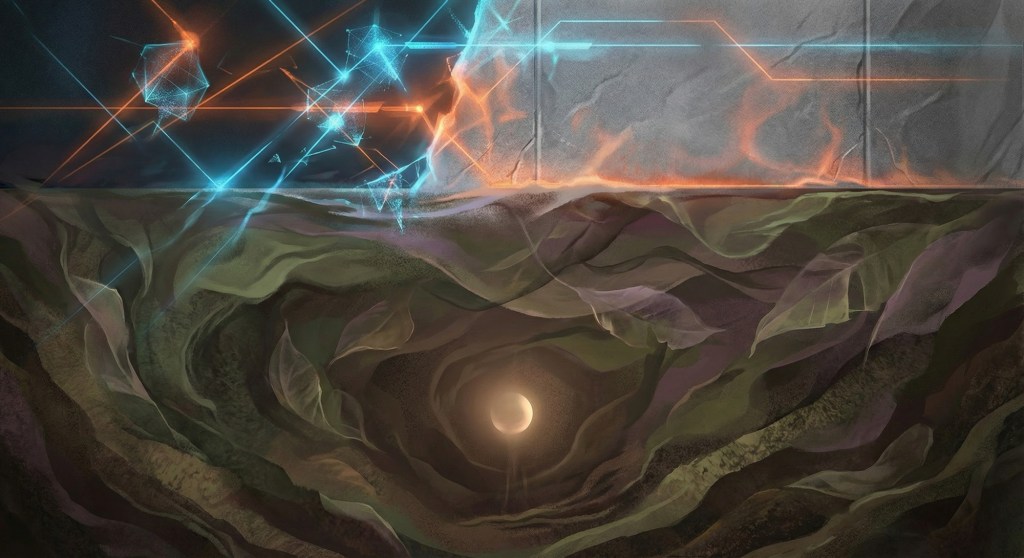
The haptic gloves were burning Elara’s palms. Not literally—the temperature regulators were perfect—but the phantom heat of friction was there. She was trying to force the neural-architecture to bridge a gap it simply refused to cross.
“Come on,” she hissed, manipulating the holographic nodes floating above her desk. “Just connect. It’s logical. It’s right there.”
She shoved the data stream again. It buckled, resisted, and snapped back to its original configuration.
Elara slammed her hands down on the desk. The silence in the apartment was heavy, filled only by the hum of the air recyclers and her own ragged breathing.
This had been the last three weeks. A war of attrition. Elara vs. The Project. Elara vs. Her Own Capacity. Every morning, she woke up determined to conquer the block, to force productivity out of the stone. Every evening, she went to bed feeling defeated, convinced that if she had just pushed harder, or been smarter, the breakthrough would have happened.
The frame was adversarial: Effort against Resistance. If she wasn’t moving forward, she was failing.
“System,” she said, her voice tight. “Analysis.”
“Biometrics indicate elevated cortisol,” the house AI replied smoothly. “Cognitive load is at 94%. Recommendation: chemical stimulant or sleep cycle.”
“No,” Elara rubbed her temples. “I don’t need a biological fix. I need to know why this isn’t working. Run the diagnostic on the project workflow.”
“Workflow is within parameters. No errors found.”
“Then why,” she whispered to the empty room, “does it feel like I’m walking through wet concrete?”
She stood up and walked to the large bay window looking out over the suspended gardens of the Sector 4 habitat. The artificial twilight was settling in, a bruised purple light filtering through the dome.
She hesitated. There was one other diagnostic she could run. It wasn’t technical. It was… old. The engineers called it “Narrative Modeling,” but everyone knew it was just digitized myth. A way of reading the room of the universe.
She walked to the wall panel. “System. Open the Almanac. Overlay mode.”
The room didn’t change, but the texture of the information displayed on the glass did. The hard data of code and deadlines vanished. In their place, a slow, rotating wheel of symbols appeared, drifting like constellations over the view of the city.
Elara looked for her marker. She expected to see it in a House of Action, or perhaps obstructed by some chaotic element she could fight.
She found her marker sitting dead center in the House of the Fallow Field.
The symbol wasn’t a sword or a shield. It was a seed buried deep under heavy, silent earth.
The text readout scrolled beside it, not offering instructions, but a definition:
Current State: The Dissolution of Form. A cycle has completed. The new structure has not yet been conceived. Action taken now is not building; it is disturbance.
Elara stared at it.
For weeks, she had been asking: What should I do to fix this?
The Almanac was answering a different question: What kind of time is this?
She read the sub-header: Retrograde Stasis. The energy is not available for external construction. It is available only for composting.
Something in Elara’s chest—a knot she hadn’t realized was tied so tight—suddenly went slack.
The fight went out of her shoulders.
If the Almanac had said, “You are tired, take a break,” she would have argued. She would have said she couldn’t afford to be tired. That frame was still Self vs. Body.
But the Almanac didn’t say she was weak. It said the time itself was not a time for building. It redefined the situation. She wasn’t a failing architect struggling to erect a building; she was a confused farmer trying to plant corn in the middle of winter.
The failure wasn’t a lack of effort. It was a category error.
“It’s a composting phase,” she said aloud. The words felt strange, biological in the metallic room.
She looked back at her desk, at the floating, unfinished nodes. Ten minutes ago, they had looked like an accusation. They had demanded she solve them. They were enemies to be defeated.
Now, under the new frame, they looked different. They looked like leaves on the ground. They weren’t waiting to be built; they were waiting to rot, to break down, to become the soil for whatever came next.
The situation was no longer asking: How do you force this to work?
It was asking: Can you let this sit?
“System,” Elara said softly. “Save current state. Do not optimize. Do not bookmark for morning retrieval.”
“Acknowledged,” the AI said. “File state: Dormant.”
Dormant.
Elara turned away from the desk. She didn’t feel happy, exactly. She didn’t feel the rush of dopamine that came from a win. She felt something quieter. She felt permission.
Nothing had to be defeated. The resistance she had felt for weeks wasn’t an enemy; it was gravity, telling her to stop trying to fly when she was meant to be grounded.
She walked to the kitchen area. She didn’t hurry.
“Tea,” she said. “And dim the lights. It’s late.”
“It is,” the AI replied.
The lights lowered. The symbols on the wall faded, their job done. They hadn’t told her to stop trying. They had simply pointed out that, cosmically, structurally, this was no longer a trying phase.
Elara sat on the couch, pulled a blanket over her legs, and for the first time in a month, she didn’t try to think. She just watched the artificial night set in, allowing the cycle to be exactly what it was.
WE&P by: EZorrillaMc&Co.
 Travel in Life