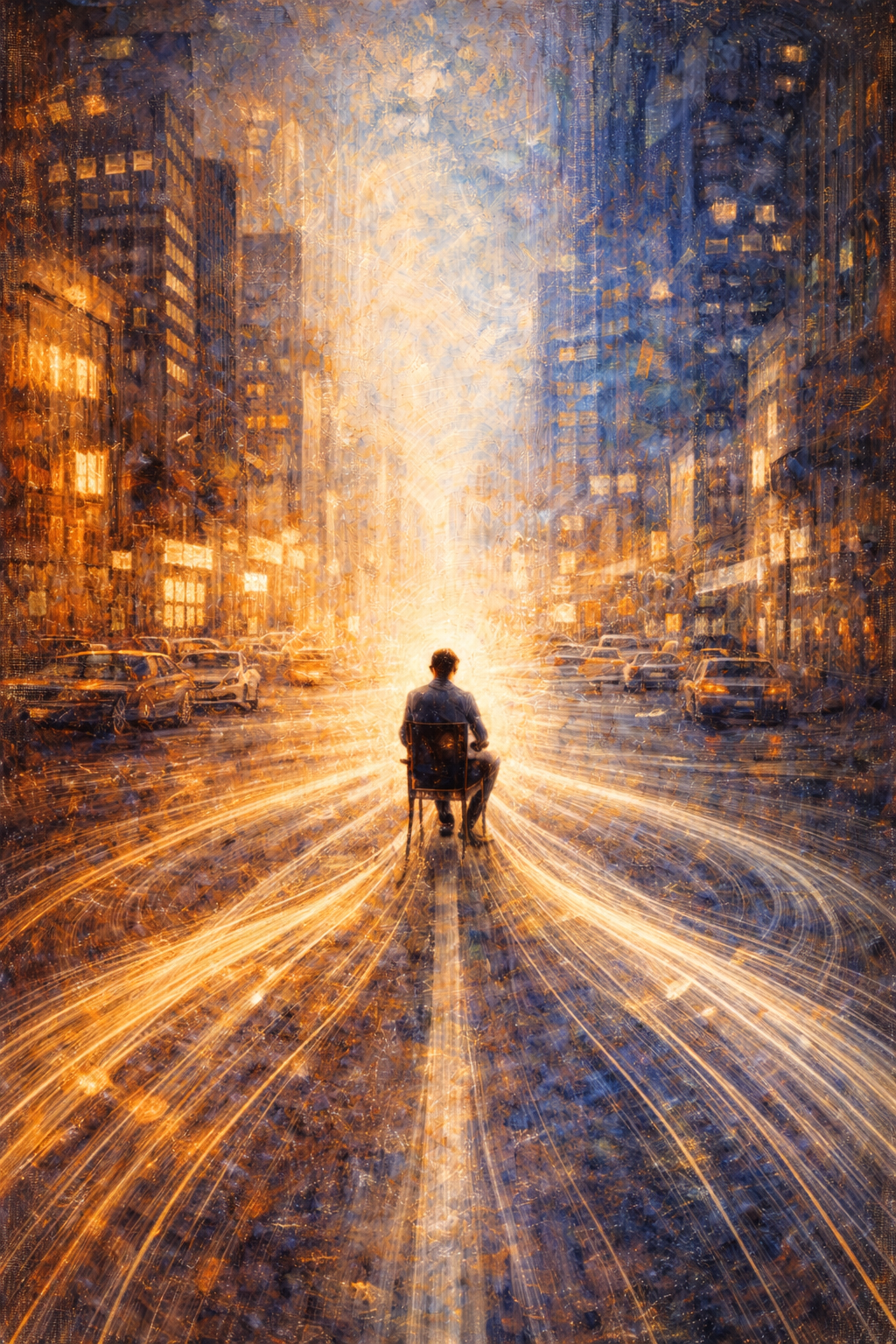
The ritual gives the day edges. Without edges, nothing can be inhabited.
An edgeless day is not free—it is diffuse. It spreads without resistance, hours bleeding into one another until nothing can be entered fully and nothing can be left cleanly. Morning lingers past its usefulness. Evening arrives too late to close. The self drifts, not because it lacks intention, but because there is nowhere to stand.
Edges do not constrain experience; they make it locatable. An edge is what tells you where something begins and where it is allowed to end. Without that, every moment asks to be negotiated. Every action competes with every other. Attention fractures not from excess choice, but from the absence of permission to stop.
Ritual supplies that permission.
By marking entry and exit—by insisting that certain actions occur only in certain postures, in certain places, at certain times—the ritual carves the day into rooms. Each room can be inhabited because it is bounded. You can sit fully inside it without wondering what you should be doing instead. You can leave it without carrying it forward as residue.
This is why spectacle exhausts. It has no edges. It offers intensity without closure, stimulation without sequence. You are meant to remain inside it indefinitely. The ritual does the opposite. It limits. It refuses continuation. It ends things on purpose.
To inhabit something is not to fill it. It is to occupy it with the knowledge that it will hold and that it will release you when its work is done. The ritual provides that holding. It tells time when to begin, when to stop, and when nothing more is required.
Without edges, life becomes unenterable.
With them, even the ordinary becomes livable.
WE&P by: EZorrillaMc&Co.
 Travel in Life