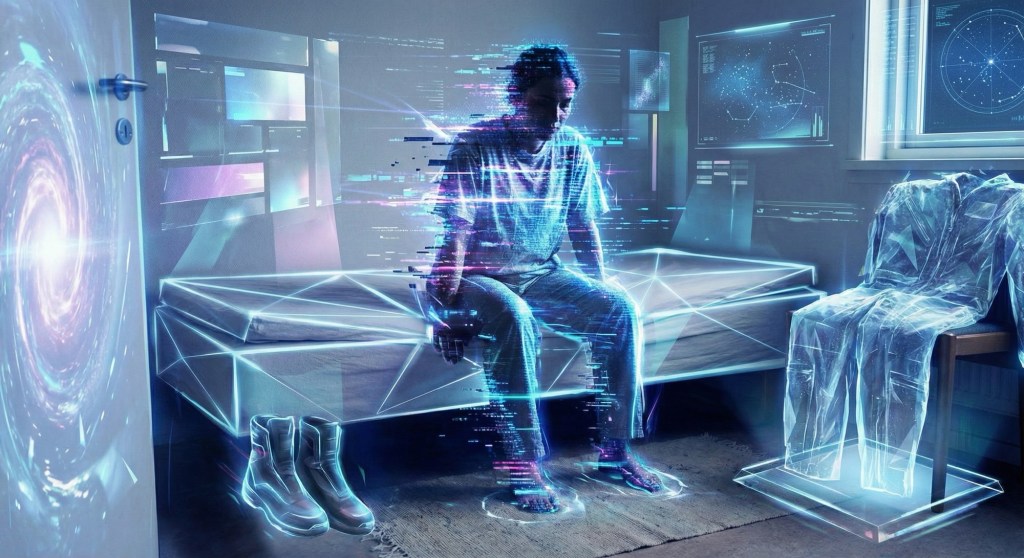
The Void of Becoming
When Elara sat on the bed, the panic wasn’t because she missed the ship. The panic was because she didn’t know who she was in the quiet.
The flight suit was armor. It told everyone (and her) exactly what she was.
The civilian cotton felt “dangerously light” because it offers no definition.
She stood in the hotel room looking at that gear.
• The Battery Packs said: “I am essential. I have power when others don’t.”
• The Rugged Bag said: “I can handle rough terrain. I am tough.”
If she left them, she was walking onto the next chapter as a woman was is just… her.
A woman who might run out of battery.
A woman with a Grav-Crate like a normal tourist.
A woman who is no longer signaling “I am ready for disaster.”
That is the difficulty of becoming. It requires one to be ordinary for a moment, to figure out what comes next.
Elara stood in front of the recycling chute. The bag was gone. The extra power cells were gone.
She looked down at her hands. They were empty.
For twenty cycles, her hands had always held something—a throttle, a wrench, a scanner, a weapon. They were shaped by the tools they held.
Now, they just hung at her sides. They felt useless. They felt light.
“Who am I if I’m not fixing something?” she whispered.
She looked at the reflection in the polished metal of the airlock door. She saw a woman in simple clothes, carrying a simple crate. She didn’t look like a hero. She didn’t look like a survivor. She looked like a blank slate.
The terror rose up in her throat—the urge to run back, to grab a wrench, just to feel the weight of purpose in her palm.
But then she flexed her fingers.
Without the wrench, her hand was open.
Without the heavy pack straps cutting into her shoulders, her posture straightened.
Without the noise of the engine, she could hear her own heartbeat.
She realized that “becoming” wasn’t about building a new armor immediately. It was about trusting that she was solid enough to exist without one.
“I am not what I carry,” she said.
She stepped through the airlock. She didn’t know what she would do with her hands tomorrow. Maybe she would plant a garden. Maybe she would write a book. Maybe she would just hold a cup of coffee.
But for the first time, her hands were free to pick it up.
WE&P by: EZorrillaMc&Co.
 Travel in Life