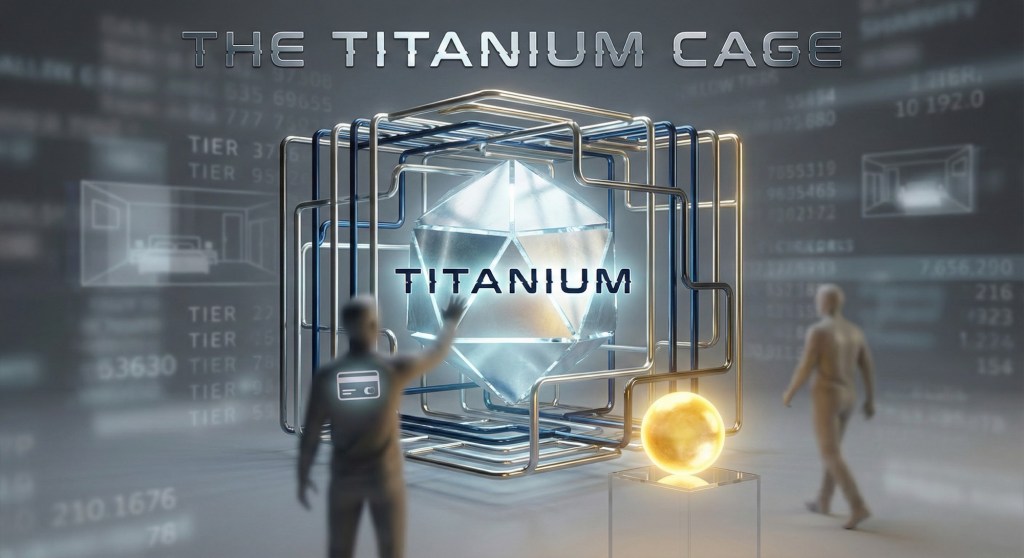
The Titanium Cage
Julian slid his card across the marble, the heavy thwack of the metal laminate echoing in the quiet lobby. “Titanium Elite,” it read in embossed silver.
The receptionist didn’t even look at the computer screen before her smile widened, practiced and predatory.
“Welcome back, Mr. Vance. We see you’re with us for three nights. Because of your status, we’ve gone ahead and upgraded you to the Executive Club Wing.”
She said it like she was handing him the keys to the city. Julian nodded, feeling that familiar dopamine hit—the validation of the road warrior. He wasn’t just a guest; he was a member.
“Thank you,” Julian said. “High floor?”
“The Executive Wing is exclusive to the second floor, sir. For easy access to the lounge.”
He took the key.
The room was large. That was the metric. It had a sofa he wouldn’t sit on and a Nespresso machine he wouldn’t use. But as Julian walked to the window to check the view—his ritual in every city—he was met with the gray, humming indifference of the hotel’s HVAC industrial unit. Beyond that, the brick wall of the parking garage.
He frowned. He checked the app. Executive King Suite. Technically, a $200 upgrade.
He headed down to the bar to review the Merriweather merger files. He ordered a scotch, neat.
Next to him sat a young couple, tourists, looking at a phone screen. They were giddy, clearly infrequent travelers. No status tags on their luggage. No dark circles under their eyes.
“I can’t believe the view,” the woman said, zooming in on a photo. “Look at the bridge from here. And we’re so high up, it’s dead silent.”
Julian glanced over. “Nice shot. Which room is that?”
“The Standard King,” the guy said, grinning. “Top floor. We just booked the cheapest rate on Expedia, but the guy at the desk said he had a ‘quiet room’ available.”
Julian paused, his glass halfway to his mouth.
He was a contract lawyer. He spent his life looking for the subtext in agreements, the leverage points between parties. And suddenly, the entire architecture of the hotel loyalty program laid itself bare in his mind.
He looked at the couple. They were the Acquisition Targets.
The hotel had to impress them. They had to seduce them. If this couple got the second-floor room facing the HVAC unit, they would leave a one-star review and never return. So, the hotel gave them the actual best asset: the view, the silence, the experience.
And Julian?
He looked at his Titanium card sitting on the bar.
He was the Captured Asset.
The algorithm knew he wasn’t coming back for the room. He was coming back for the points. He was coming back because he was trapped in the gamification of the status tier.
They didn’t need to woo him. They just needed to not lose him.
The “Upgrade” was a inventory management trick. The hotel had these odd rooms—low floors, bad views, weird layouts—that they couldn’t sell to a first-timer without risking a refund demand. But if they slapped a label on it—Executive, Club, Suite—and gave it to a Titanium member, the member wouldn’t complain. The member would feel special because the square footage was higher, even if the experience was lower.
He was the dumping ground for the distressed inventory.
“You guys enjoy the view,” Julian said, his voice flat.
He paid his tab. As he walked back to the elevators, the receptionist waved at him. “Is everything excellent with the suite, Mr. Vance?”
Julian looked at her. He saw the calculation behind the eyes. She knew he wouldn’t ask to be moved to a Standard King on the top floor. His ego wouldn’t allow him to “downgrade” to a better room.
“It’s exactly what I expected,” Julian said.
He got into the elevator and pressed the button for the second floor, clutching the metal card that told the world he had been fooled enough times to earn a badge for it.
WE&P by: EZorrillaMc&Co.
 Travel in Life