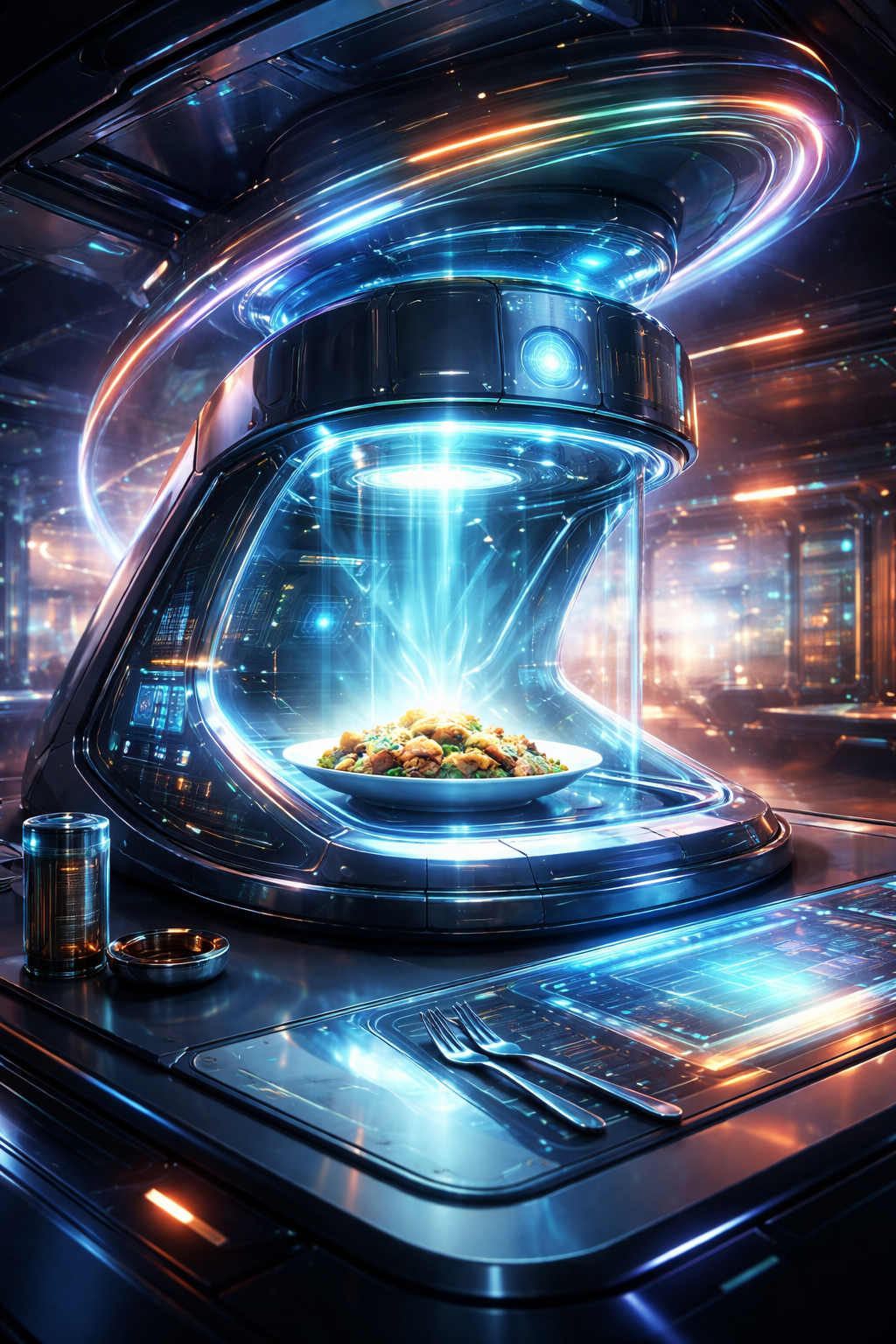
The Replicator Lag
They told us the replicator solved food.
That was the phrase on the briefing slide: Solved.
Calories correct. Macros balanced. Micronutrients within tolerance.
Push a button. Eat. Move on.
For a long time, I believed that’s what I was choosing—foods. Better ones. Cleaner ones. “Healthier” ones. I learned the menus, the substitutions, the workarounds. I argued about ingredients the way people argue about politics: confidently, emotionally, and usually beside the point.
It took a system failure for me to see what I had actually been interacting with.
The replicator didn’t fail because it made the wrong meals.
It failed because of lag.
No one talked about lag. It wasn’t on the slide deck. It didn’t fit into a nutritional table. Lag was the invisible variable—the time between synthesis and consumption, the quiet interval where things changed without announcing themselves.
The replicator printed meals that were chemically identical whether you ate them immediately or hours later. On paper, nothing was different. In the body, everything was.
At first, the effects were subtle. A sense of urgency after eating. A restlessness that felt like curiosity. Energy that arrived too fast and left too abruptly. I thought it meant I needed to move, to walk the corridors, to take another shuttle, to go somewhere that matched the internal tempo.
When the ship was loud—engines humming, rails vibrating, systems thrumming—I felt better. The noise covered the hum inside me. Motion gave the sensation somewhere to go. Stillness was harder. Quiet made everything sharper.
I didn’t think of this as a problem. I thought of it as preference. Or temperament. Or wanderlust.
So I adapted.
I learned which replicator outputs gave me “lift.” Which ones kept me upright. Which ones let me sleep if I exhausted myself first. I walked long distances through the ship to earn rest. I timed meals around movement. I treated energy like a resource that had to be burned off before it turned on me.
What I didn’t see was that I was managing volatility, not nourishment.
The ship’s medical logs were unhelpful. Everything was “within normal range.” The replicator logs were immaculate. No errors. No contamination. No violations. The system was doing exactly what it was designed to do.
That’s when the arguments started.
Someone suggested frozen meals. Someone else suggested flavor packs. Another proposed “enhanced bowls,” nutritionally dense and ready on demand. We debated tomatoes versus grains, spices versus stocks. We refined recipes the way engineers tweak parameters, confident that the right combination would solve the issue.
But none of those conversations touched the real constraint.
It wasn’t what the replicator made.
It was how it made it—and when it was eaten.
When I finally had access to a galley—an actual heat source, raw inputs, a pan, a plate—the difference was immediate and almost insulting in its simplicity. The same proteins. The same carbohydrates. The same basic materials. But cooked and consumed in one continuous motion.
No lag.
No accumulation.
No volatility.
The body recognized the difference before the mind did. The background hum dropped. The urge to pace softened. Sleep arrived without being chased. Not perfect sleep—just ordinary, unearned rest.
That’s when the grief hit.
Because the solution wasn’t portable.
The replicator was everywhere. The galley was not. The ship was built for convenience, speed, scalability. The galley required presence, time, and a stable place to stand. It required infrastructure.
I realized I wasn’t choosing between meals. I was choosing between systems of living.
One system offered infinite options but demanded constant regulation. It required me to interpret signals, compensate for swings, and organize my days around managing internal noise. It looked like freedom, but it functioned like a treadmill.
The other system was narrower. Slower. Less impressive. It asked for commitment to a place and a process. In exchange, it offered continuity.
That’s not an exciting trade when you frame it as food.
It becomes clearer when you frame it as life.
I had been confusing agitation with curiosity, volatility with vitality. I mistook the surge after eating as a call to action instead of a signal of overload. Movement felt like desire. Travel felt like meaning. Noise felt like relief.
When those things stopped working—when the surges turned into crashes, when the walking no longer produced sleep, when the hum got louder instead of quieter—I assumed I needed better recipes.
I needed a different protocol.
The replicator was never wrong. It just wasn’t designed for what I needed next.
Once I saw that, staying aboard stopped making sense. Not because I was failing, but because the environment could not support the solution without constant friction. Every meal would be a negotiation. Every day would require vigilance. The system would keep asking me to manage it.
I didn’t want to manage anymore. I wanted to live.
So I set a course back to where the galley was real, where raw inputs could go straight to heat and then to plate. Where eating didn’t require strategy. Where energy didn’t need to be burned off to be tolerated.
Leaving wasn’t dramatic. It was logistical.
The replicator would continue to function flawlessly without me.
I just wouldn’t.
That’s the part people miss when they argue about ingredients. They think you’re rejecting the technology, the convenience, the future. They think you’re being precious.
You’re not.
You’re choosing the system that lets your body settle into itself instead of constantly correcting course.
The replicator didn’t fail.
It revealed its limits.
And once you see that, the decision stops being about food at all.
WE&P by: EZorrillaMc&Co
 Travel in Life