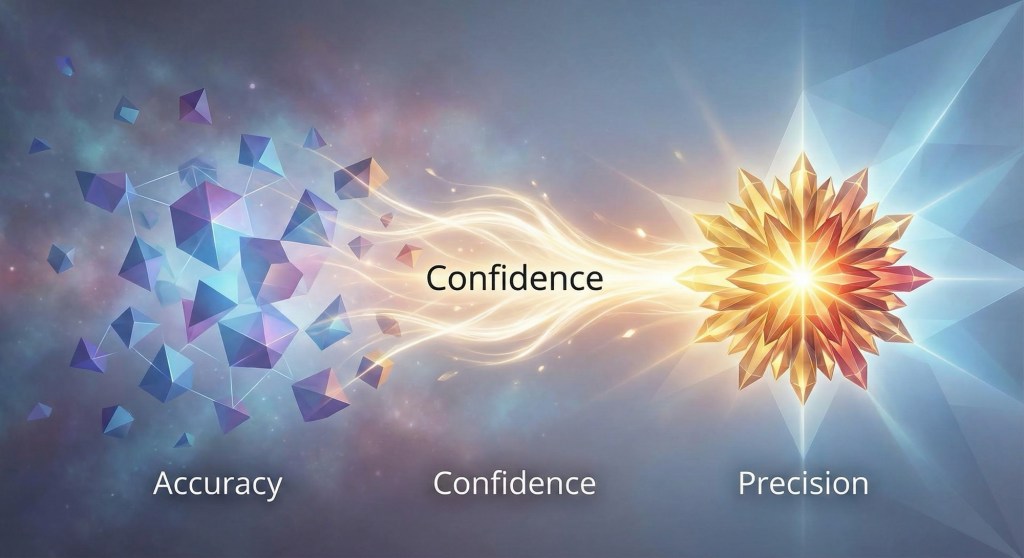
Confidence: Accuracy to Precision
The training hall on the orbital station was silent, save for the rhythmic hum of the gravity stabilizers. Cadet Elara stood before the firing range, her pulse rifle heavy in her sweating palms. The target was a holographic drone hovering fifty meters downrange, roughly the size of a dinner plate.
“Again,” came the voice of Commander Vane from behind the observation glass.
Elara raised the rifle. She focused intensely on the bullseye. She calculated the trajectory, compensated for the simulated crosswind, and squeezed the trigger. Zap. A hit—dead center.
She exhaled, satisfied. “Direct hit, sir.”
“Do it again,” Vane ordered.
She fired. Zap. This time, the shot landed on the upper right edge of the target. Still a hit, but barely.
“Again.”
Zap. Lower left quadrant.
Elara lowered the weapon, frustrated. “I’m hitting the target every time, Commander. My accuracy is within acceptable parameters. The mission standard is 95% accuracy.”
Vane walked onto the range, his boots clicking sharply on the deck plates. He looked at the diagnostic screen. The heat map of her shots looked like a shotgun blast—scattered all over the target, though technically all “hits.”
“You are accurate,” Vane said, his voice level. “You are hitting what you aim at. But you are frantic. You are recalculating every single shot as if it’s your first. You are terrified of missing, so you over-correct.”
He pointed to the scatter pattern. “This is the pattern of someone who hopes they will hit. It lacks precision.”
“What’s the difference?” Elara asked, wiping her brow.
“Accuracy is getting the right result. Precision is getting the result the right way, every single time. Accuracy is knowledge; precision is confidence.”
Vane reset the drone. “Stop trying to hit the bullseye. I don’t care if you miss the center. I want you to trust your stance. Trust your breathing. Stop thinking about the target and start thinking about yourself. Have the confidence that you are a marksman.”
Elara hesitated. She closed her eyes for a moment, letting go of the desperate need to see the ‘hit’ marker flash green. She focused instead on the stock against her shoulder, the rhythm of her heart, the stillness of her trigger finger. She stopped reacting to the fear of failure.
Trust the process, she told herself. I know this.
She opened her eyes, but she didn’t stare at the bullseye. She stared at the sight picture.
Snap. Snap. Snap.
Three shots in rapid succession. She didn’t pause to check the result between them. She moved with a fluid, confident rhythm, knowing the weapon was an extension of her will.
She lowered the rifle and looked downrange.
There was no scatter. The drone was still there, but there was a single, glowing hole in the plating, slightly to the left of the center.
“You missed the bullseye,” Elara muttered.
“Look closer,” Vane said softly.
The diagnostic screen zoomed in. All three shots had passed through the exact same hole, widening it by mere millimeters.
“That,” Vane said, a rare smile touching his lips, “is precision. You stopped worrying about the result and trusted your skill. We can adjust your sights to fix the accuracy later. But that grouping? That consistency? That comes only when you stop doubting your own hands.”
Elara looked at the tight grouping, realizing the shift that had occurred. Accuracy was knowing the math; precision was knowing herself.
The Takeaway
In any discipline, from marksmanship to leadership, Accuracy is the ability to achieve the desired goal. Precision is the ability to replicate that success reliably.
- Accuracy asks: “Did I get it right?”
- Precision asks: “Can I do it again?”
Confidence is the catalyst that allows us to stop scrambling for the “right answer” and settle into the mastery of our craft.
Would you like me to analyze a recent situation where you had to choose between speed (accuracy) and consistency (precision)?
Real World AI Application.
The transition from Accuracy to Precision applied to the act of deleting past AI conversations to trusting your own memory.
1. Accuracy: The Archive (External Dependence)
Keeping every conversation saved is the pursuit of Accuracy.
• The Mindset: “I need to keep this record so I can verify exactly what was said later.”
• The Behavior: You rely on an external database (the chat history) to ensure you are “right.” Like Cadet Elara checking the screen after every shot, you are double-checking your past self rather than trusting your present self.
• The Limit: While you have access to 100% of the facts, retrieving them is slow and cumbersome. You are bogged down by the “scatter” of thousands of words, searching for a specific insight.
2. Confidence: The Delete Button (The Catalyst)
Choosing to delete the history is the moment of Confidence.
• The Shift: It is the frightening but necessary realization: “I don’t need the transcript to know who I am or what I learned.”
• The Act: You are removing the safety net. You are deciding that the value of the conversation has already been transferred from the screen to your neural pathways. You trust that what mattered stuck, and what didn’t matter deserves to fade.
3. Precision: Intuition (Internal Mastery)
Trusting your memory leads to Precision.
• The Result: When you can no longer look up the exact wording, you are forced to rely on the gist—the synthesized core of the idea.
• The Upgrade: Your brain compresses the “accurate” data (thousands of words) into “precise” wisdom (instincts, principles, and feelings).
• The Command Approach: A Commander doesn’t flip through a manual during a crisis to find the specific regulation (Accuracy); they act on the internalized principles of leadership they have mastered (Precision).
Summary of the Evolution
• Accuracy is having a library of books you haven’t memorized.
• Precision is forgoing the books because you have become the master of the subject.
WE&P by: EZorrillaMc&Co.
 Travel in Life