
A simple, useful idea for crossing “in‑between” moments with more ease: liminality—the threshold between one state and the next.
What “liminal” means (plain English)
Anthropologist Arnold van Gennep described rites of passage in three parts: separation → transition (the limen, or threshold) → incorporation (re‑entry). Victor Turner later showed that the transition phase loosens normal roles—an “anti‑structure” space where you can reset patterns and choose how to re‑enter.
Think of it as a doorway: you’ve left one room, haven’t entered the next, and what you do in the doorway shapes who walks in.
A 30‑second threshold ritual (enter & exit)
Use it when you shift scenes (leaving a hotel room, starting a walk, opening a doc, sitting to write, stepping on/off a train).
Pause — One slow breath. Silently name where you are: “Doorway → lobby,” “Browser → page,” “Street → café.” Orient — Eyes sweep left‑center‑right. Note light, exits, a friendly cue (plant, sky, a person). Feel your feet. Intend — One sentence out loud or in mind: “I arrive calm and attentive,” “I’m here to observe,” “Steady, warm, precise.”
Close the limen on exit with a quick repeat: “I leave steady; next scene begins.”
Where it fits the flow
Morning Pages, Walks: use it at the start and finish to mark the scene change and protect momentum. Travel & city shifts, museum doors, transit platforms: run the ritual before crowds or cold weather reactivity. Creative work: blog post, poetry, interludes: say the intention that matches the mode—e.g., “Warm, factual, spare.”
Tiny card (saveable)
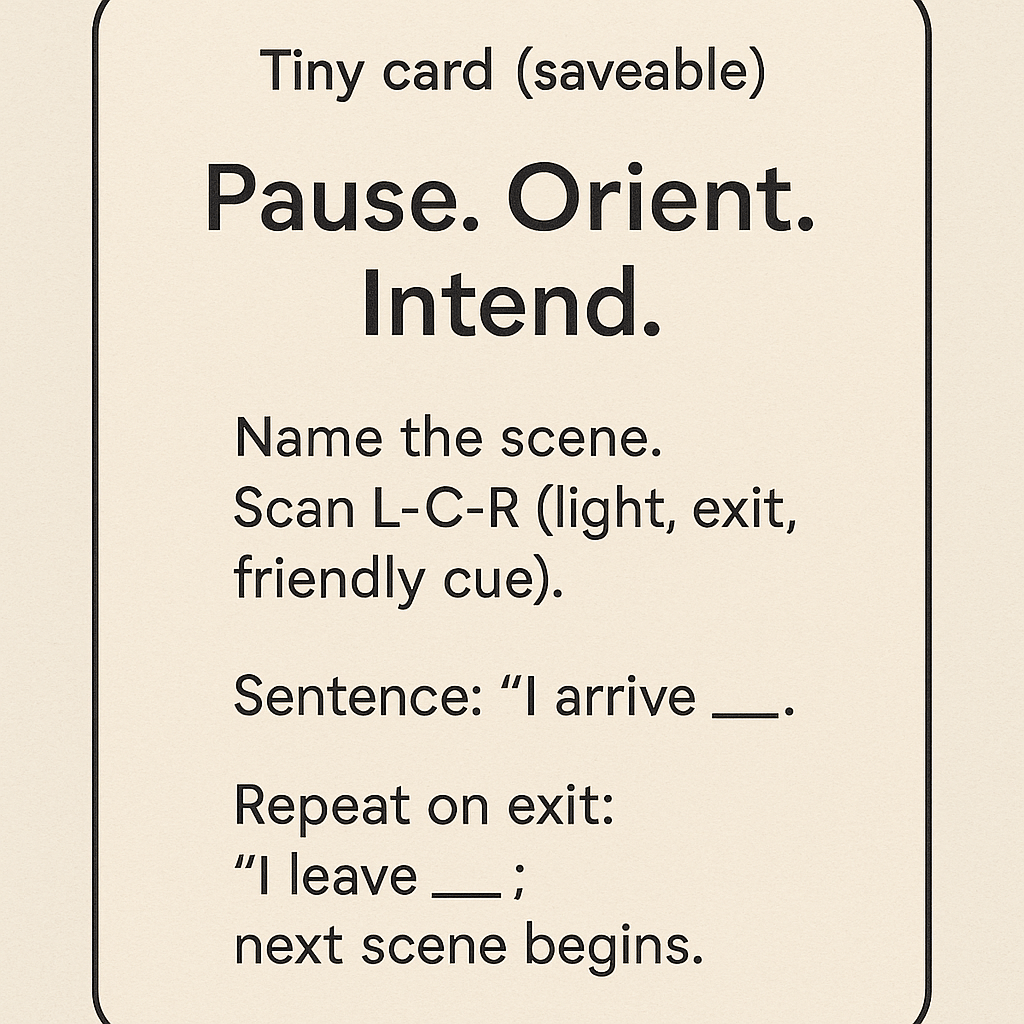
Pause. Orient. Intend.
Name the scene. Scan L‑C‑R (light, exit, friendly cue).
Sentence: “I arrive ___.”
Repeat on exit: “I leave ___; next scene begins.”
WE&P by: EZorrillaMc&Co.
 Travel in Life
You must be logged in to post a comment.