
Act I — The Engineers of Justice
Steel rose from the mud like conviction made visible.

Slogans clung to scaffolds, letters bleeding in the rain.
In offices lined with blueprints, the planners spoke of progress the way priests once whispered of grace—
as if salvation could be poured in concrete and measured in production quotas.
Every heartbeat was to be charted, every gesture made efficient.
They built not only factories, but a moral geometry where straight lines replaced doubt.
Even tenderness was scheduled—love rationed between shifts, promised as a reward for obedience.
The people moved through the grid like ink through tracing paper.
They didn’t live in cities; they inhabited diagrams.
And when the wind blew through those new avenues, it sounded almost like a hymn.
Act II — The Merchants of Meaning
The scaffolds came down, replaced by glass. Reflections multiplied until no one knew which image was real.

Billboards spoke in the language of salvation—“freedom,” “choice,” “you.”
Rebellion wore denim now, and every protest had a sponsor.
Factories still hummed, but their product was selfhood.
A new worker emerged: the consumer, laboring in mirrors, polishing identity until it shone.
Logos became flags, purchases confessions of faith.
They said history had ended; what remained was lifestyle.
Where once they were told what to build, now they were told who to be.
And they believed it—because believing felt like agency,
and the hum of the market was warm enough to pass for belonging.
Act III — The Architects of Amnesia
Then came the storms—literal and political. Buildings folded, currencies drowned.
While people counted losses, the blueprints were quietly redrawn.
The new architects spoke of resilience, as if erasure were healing.
They called it reform, recovery, modernization—each word a clean blade.
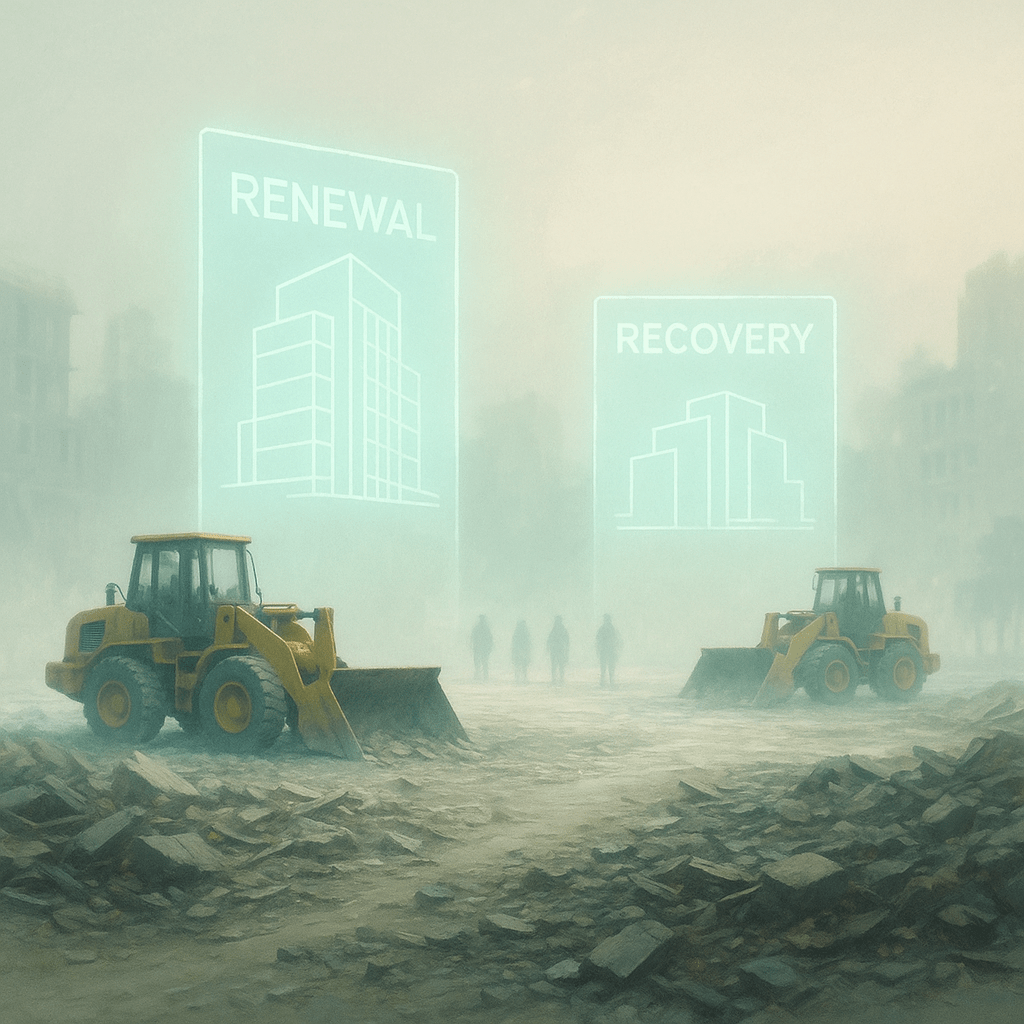
Hospitals sold to investors, schools renamed, histories rewritten in the past tense.
The rubble was cleared not to remember, but to forget faster.
Those who had nothing left were told they were finally free.
Every catastrophe became a chance to start over,
every silence, proof that the pain had worked.
And beneath the gleaming facades, the ground still trembled—
not from progress, but from all the shocks mistaken for beginnings.
Conclusion — The Circle of Design
Every age believes it is drawing the final map.
The engineers thought precision would save them.
The merchants thought meaning could be sold clean.
The architects thought forgetting was renewal.
But the lines keep shifting.
What we build to contain the world always ends up containing us.
And when the noise falls away, only the draftsmanship remains—
the faint outline of our intentions, still visible beneath the next design.
WE&P by: EZorrillaMC&Co.
Magnetic Mountain: Stalinism as a Civilization First Edition
by Stephen Kotkin (Author)
No Logo: No Space, No Choice, No Jobs 10th Anniversary Edition, Kindle Edition
by Naomi Klein (Author)
The Shock Doctrine: The Rise of Disaster Capitalism 1st Edition, Kindle Edition
by Naomi Klein (Author)
 Travel in Life
You must be logged in to post a comment.