
The Abbey at Virel Cycle
A minute novella in three movements
I. The Road to Virel
“Pride is the quiet wish to arrive alone.”
The day before the storm, the world had been dust and heat.
They’d walked all morning along a river that had forgotten itself—just pale stones and the faint smell of algae. Seraphin carried the compass he refused to trust; the Crow, a map folded so many times it had become an act of faith more than navigation.
They hadn’t spoken since noon. The argument wasn’t fresh anymore, but it hadn’t cooled either. It was about trust, as usual—whose sense to follow when the paths split.
The Crow had laughed and said, “You’d rather be lost by design than arrive by accident.”
Seraphin hadn’t replied. He’d just picked up the pace.
When the first thunder rolled, they were still pretending not to walk together.
The abbey’s tower rose ahead—half-visible through rain, a place that looked like it wanted to be found.
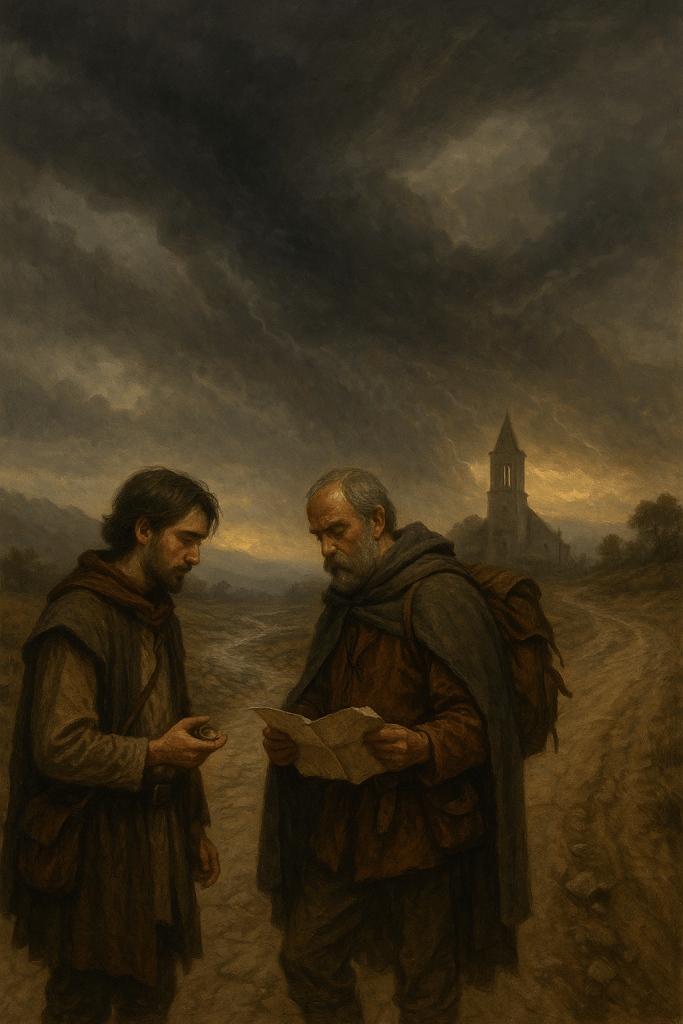
II. The Abbey at Virel
“Silence isn’t peace. It’s breath held too long.”
The storm arrived without warning—wind turning from sigh to scream in a single breath.
Seraphin and the Crow found shelter in what was left of the abbey: half a nave, half a roof, a hundred years of prayers sanded down by weather.
A lantern flickered between them, its light stuttering over stone.
The Crow sat by the window slit, mending the strap of his satchel. Seraphin stood near the altar, trying to read a torn map.
“You’ve been staring at that corner for an hour,” the Crow said.
Seraphin didn’t turn. “The ink shifted in the rain. I’m finding the true line.”
“The true line,” the Crow repeated, a soft mockery. “Or your line?”
Seraphin’s fingers paused. The sound of the storm filled the pause like a tide rushing in.
When he spoke, his voice was too level. “You think I can’t tell the difference?”
The Crow smiled without warmth. “I think you can’t let difference breathe.”
Something in the air folded—like paper creased in haste. Seraphin looked up then, the lantern’s flame reflected in his eyes.
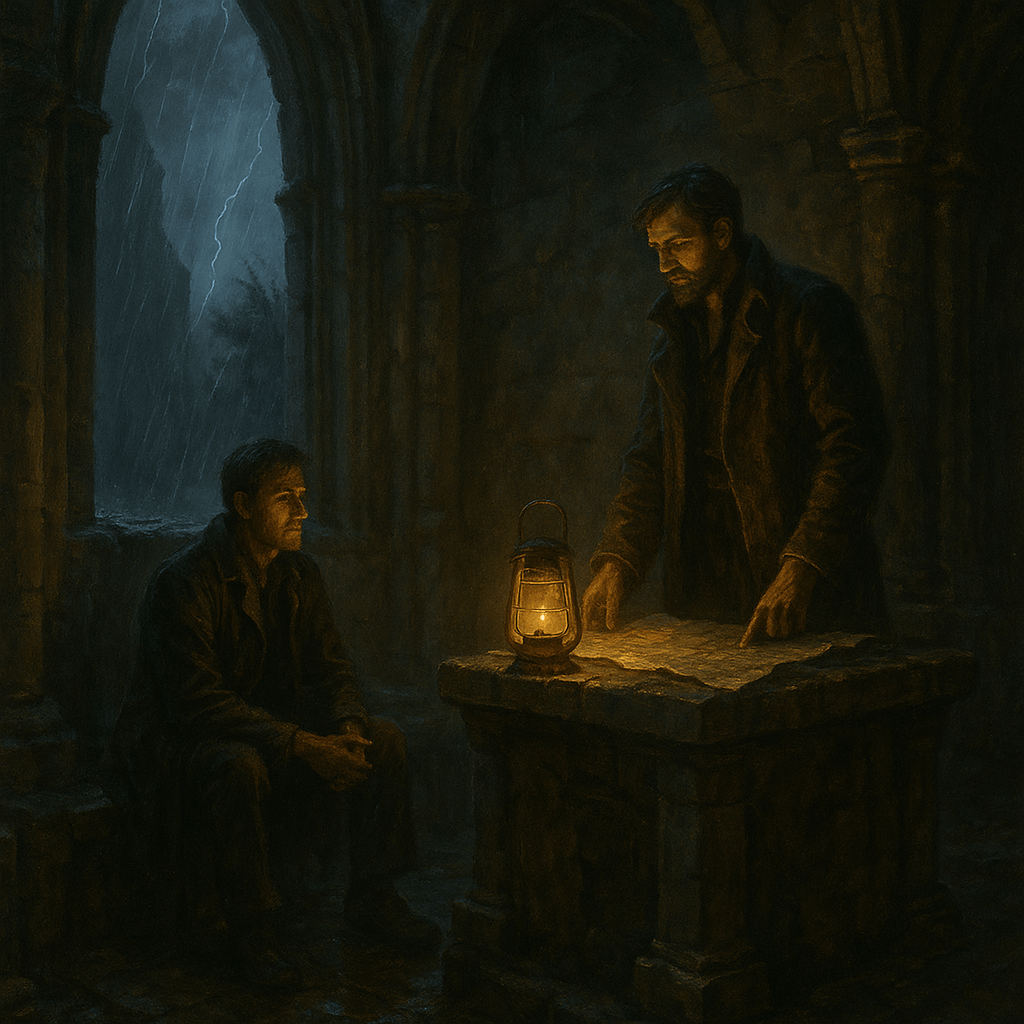
“I translate,” he said.
“Mercy implies fault,” the Crow answered before realizing the words had no clear origin.
Silence. The roof groaned. A loose tile cracked somewhere above them.
Neither man moved. Only the storm did, wrapping the abbey in its wet, patient noise.
At last the Crow blew out the lantern. “Let’s leave it dark for a while.”
They sat with that. Just breathing. Listening to the sound of old stone remembering.
III. After the Map
“What survives the argument isn’t victory—it’s language reborn as trust.”
The road had softened with the thaw—mud breathing where frost once held firm. The air smelled of moss and charcoal. They walked apart but within voice’s reach.
Seraphin was the one to break it. “That night,” he said, not looking over, “I wasn’t angry about the map.”
The Crow’s pace slowed. “No?”
“I was angry that you stopped talking first. That you decided the silence was safer.”
A long pause. The Crow’s voice came low. “It was. For me.”
Seraphin nodded, but his jaw clenched. “I thought you were shutting me out.”
“I was,” the Crow said simply. “Not to punish you. To keep from saying something I’d regret.”
Seraphin glanced at him then—saw the weariness behind the poise. “And now?”
“Now,” the Crow said, exhaling, “I’d rather risk being clumsy than vanish again.”
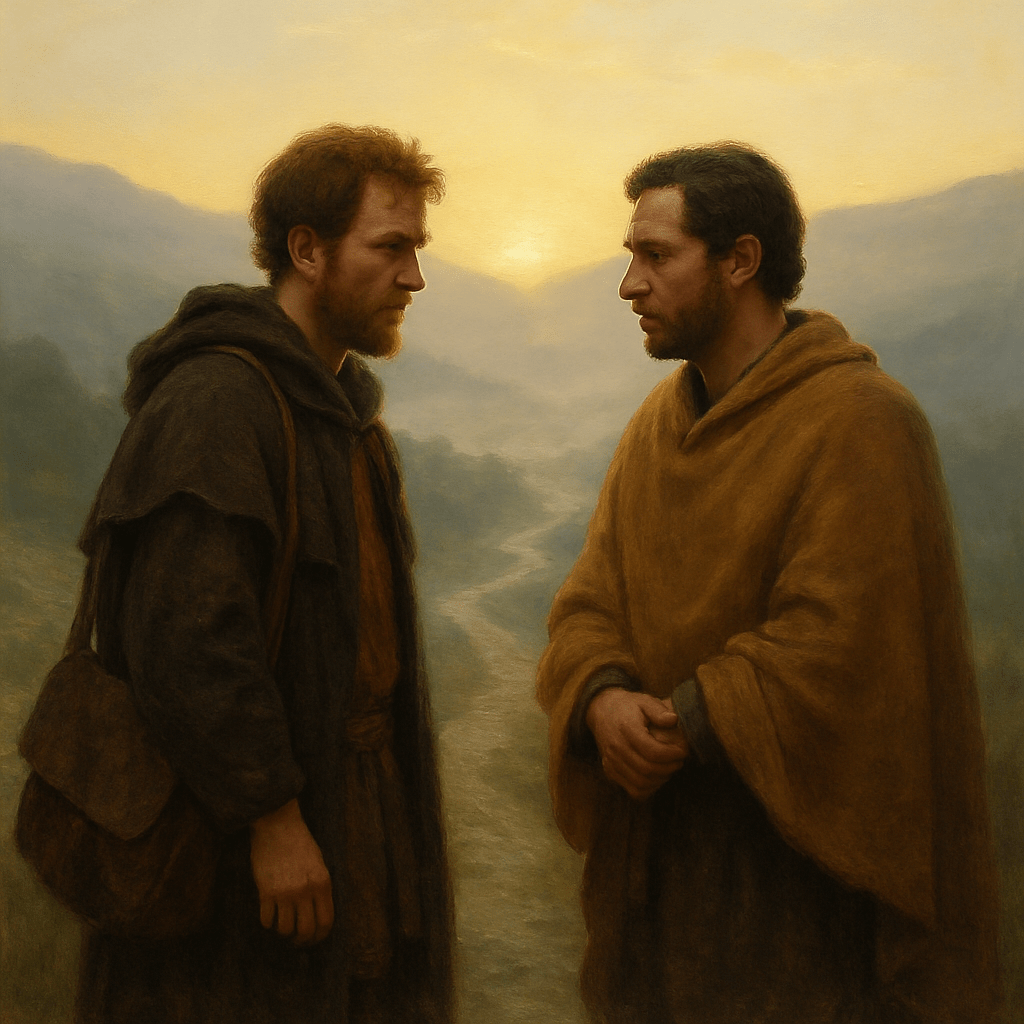
They kept walking. The road curved toward the valley’s bend. A flock of starlings crossed the sky like spilled ink, and for a moment, both stopped to watch.
Seraphin spoke quietly. “Then let’s both be clumsy.”
The Crow smiled, faint but unguarded. “Deal.”
The wind shifted; the scent of rain was gone. They walked on, shoulder to shoulder, no longer in step—but together.
Caption:
Each argument teaches the same lesson—that closeness is not lost in silence but tested by it. When the words return, they carry more care than before.
WE&P by: EZorrillaMc.&Co.
 Travel in Life
You must be logged in to post a comment.