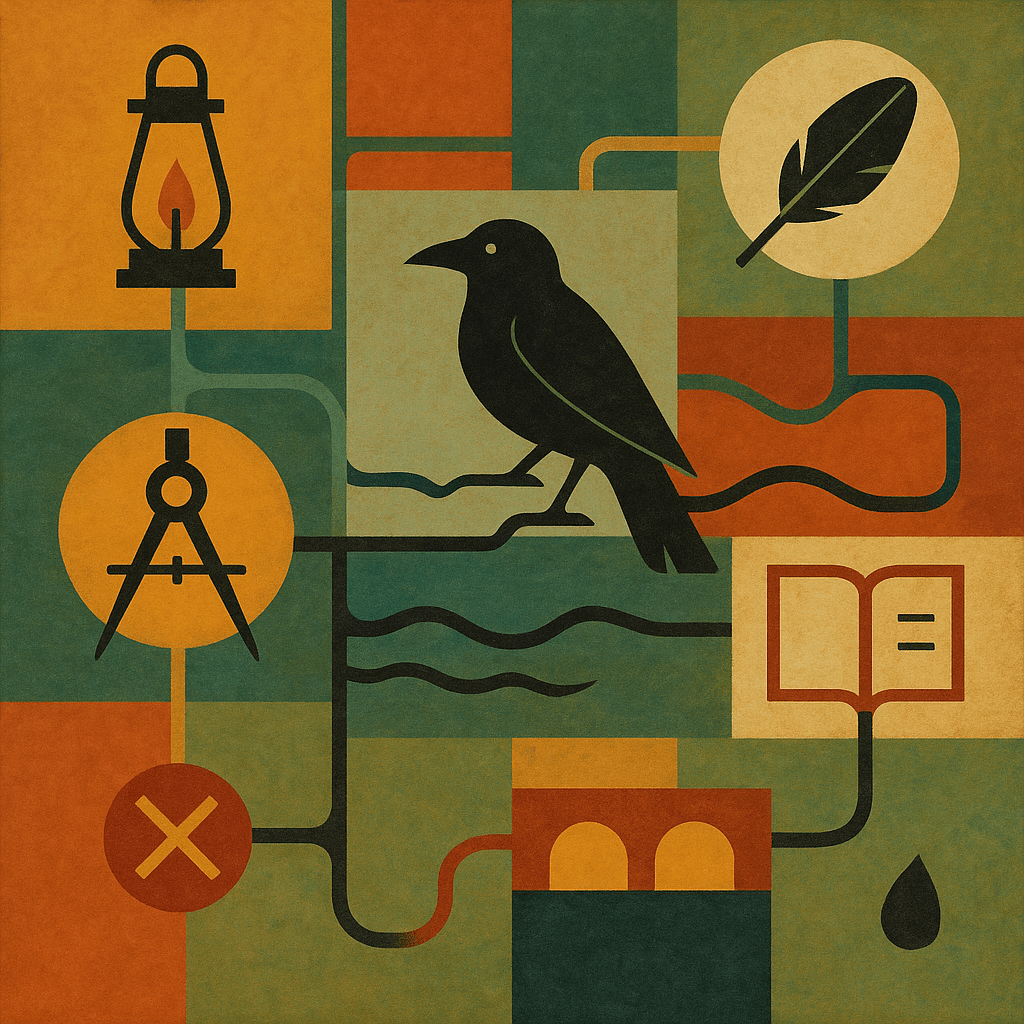
Introduction — The Weight of Measure
At the edge of a river that refused to keep its shape, Seraphin Durand worked in silence.
Each morning he arrived with his compass, his cords, his notebooks. He measured and recorded the movement of the banks as if precision itself could hold the water still. The villagers thought him patient; he knew it was not patience but discipline—an obedience to numbers that steadied his mind when sleep and purpose blurred together. His hands, though steady, had grown heavy from the repetition. Even his thoughts began to fall into grids.
The river had no interest in his figures. It shifted in the night, carving new shallows, erasing his marks. Every dawn the world redrew itself, and Seraphin began again.
That spring the light changed. It came later, flatter, and clung longer to the surfaces of things—his brass tools, the pale mud, the rough wood of his workbench. He noticed the silence between sounds, the fatigue behind his own concentration. Sometimes, while sketching a bank line, he would lose track of whether he was designing the river’s course or merely following it. The difference, once clear, had started to dissolve.
It was on one such afternoon, when the air shimmered with dust and the light trembled like a held breath, that the crow appeared.
It did not cry or circle. It arrived as a noise—a scrape of black on black—and then as form, landing hard on the post beside his plans. Its eyes caught the same glint as his compass: round, alert, unblinking. Seraphin looked up, and for an instant, something in him recognized the bird—not as omen, but as echo.
He would later write that work came home with him that day, not as parchment or plan but as presence. That fatigue had cracked the border between thought and thing. That the crow had not entered his life, but drawn him into its own.
And so begins Seraphin and the Crow—a record of what happens when precision meets instinct, when silence learns to speak, and when a man, exhausted by his own order, starts to listen to the world that resists being measured.
Letters to the Self: The Seraphin Cycle
I. Fatigue — Letter from the Desk
The workshop’s lantern breathes its yellow pulse against the blue of early evening. A drafting table sprawls like a battlefield—grids half-drawn, smudged with red chalk. Seraphin’s sleeve bears the mark of his labor, a faint smear that refuses to wash out. He tells himself he will finish the river plan tonight. He tells himself the same thing every night.
The crow taps once against the windowpane, a dark metronome. He ignores it. Ink pools beneath his nib; the compass lies open beside a loaf of bread, its hinge squeaking each time the table shifts under his arm.
He writes on a scrap of ledger paper—
To myself: Finish the measure before you rest. Precision is mercy. Errors multiply in sleep.
The handwriting wavers. The words look like they’re sweating. He rubs his eyes and sees the faint pulse of geometry still behind his lids—circles, triangulations, the delicate architecture of the day refusing to dissolve. Fatigue is no longer something that arrives; it’s the air itself, the medium through which he moves.
The crow knocks again. He turns, finally, and finds it perched on the sill, head tilted, holding in its beak what looks like a strip of paper torn from one of his notebooks. The sight strikes him as both impossible and inevitable.
He takes the note from the bird, reads his own handwriting on it—
Stop measuring. Rest.
He laughs, a short rasp that startles them both. “So you deliver now, do you?” The bird blinks. Fatigue has blurred the edges between man, message, and messenger.
He closes the ledger and writes one final line before sleep overtakes him at the table:
The work has begun writing back.
II. Interference — Letter Between Shifts
Morning. The plans have shifted in the night—lines thickened, angles slightly altered, as if an invisible hand redrew the grid while he slept. The compass sits open on the table, its needle trembling though no one touched it. The crow is gone, but a single feather rests across the blueprint like an accent mark on a word he doesn’t yet know.
He pockets it and walks to the river site. Work seeps into him; he tastes graphite on his tongue, chalk dust in his throat. The men are already digging, waiting for instruction, but he hesitates. He cannot tell if the measurements he holds are his or the river’s.
He writes another note during lunch, hunched against the wheelbarrow:
To myself: You are losing sequence. Tasks bleed into one another. The day does not end when the light does.
The crow’s shadow crosses at the same hour as your own. Observe which moves first.
Back home that evening, he opens the same notebook to continue the report but finds new words already inscribed there—his handwriting, but not his memory:
We are tired, Seraphin. You work even while you dream. The river has your sleep. The crow keeps your rest.
He feels the pulse in his temples sync with the words, an echo of the crow’s earlier tapping. The voice could be his exhaustion, or the bird’s intelligence, or both. He writes back out of reflex:
If I stop, the bank collapses. If I stop, nothing holds.
But the page remains wet longer than ink should. When he touches it, the letters blur and run downstream across the paper.
He closes the book, but the noise of the river rises in his head—its measure, its insistence. The crow returns, silent, perching on the beam above his drafting table. He pretends not to notice, but his hand steadies for the first time all day. It feels like a collaboration neither invited nor complete.
III. Reconciliation — Letter Left Unsent
Days later, he stops pretending that work ends when he leaves the riverbank. The distinction between blueprint and dream has collapsed; the crow crosses freely between them. Its intelligence, once a nuisance, now feels like a form of guidance—the world reminding him that intuition is another kind of accuracy.
He sits again at the desk, evening light bending through the dusty window. He writes without headings this time, without measurements or scales.
To myself:
You believed order was a kind of safety, that precision would hold back decay. But fatigue has shown its other face: clarity.
The crow is not your rival. It is the proof that attention has many dialects.
Every structure you build must contain air for uncertainty to breathe. Every drawing must allow a current to pass through it, else it becomes a coffin.
Let the river teach you timing, not control.
Let the crow teach you boundaries, not walls.
Let fatigue remind you that the body is part of the design.
He places the letter under the compass and closes the instrument on top, sealing the pages like a reliquary. The crow lands on the sill once more, silent, regarding him with the calm of one who has already seen this happen.
Seraphin rises, opens the window, and lets the evening air sweep across the table. The papers stir; the feather lifts and spins slowly before settling against his wrist. He does not brush it away.
He whispers the last words he’ll write tonight:
The distance between work and self is closing. May the bridge hold.
Then he blows out the lantern, trusting for the first time that darkness can carry him safely to sleep.
Symbols and Their Meanings
1. The Compass
- Literal: Seraphin’s tool for measuring distances and angles at the river site.
- Symbolic:
- Represents reason, order, and precision — the human impulse to impose geometry on chaos.
- Serves as a mirror of control and fear of uncertainty.
- Its trembling needle reflects Seraphin’s inner instability and his magnetic pull toward intuition.
- When finally closed, it becomes a seal — symbolizing surrender to unmeasured experience.
2. The Crow
- Literal: A curious bird that observes and interacts with Seraphin, stealing small objects.
- Symbolic:
- Instinct and intuition — the uncalculated intelligence of nature.
- A messenger or mirror, the “Other Mind” that completes Seraphin’s rational one.
- In mythic terms, it echoes the trickster or psychopomp: crossing boundaries between intellect and mystery, work and dream, life and fatigue.
- When the crow delivers or returns messages, it personifies the unconscious writing back.
3. The River
- Literal: The physical site of Seraphin’s engineering work; the landscape he measures.
- Symbolic:
- The flow of consciousness and emotion, forever changing shape beneath his calculations.
- A current that erodes the boundary between waking and dream, work and rest.
- It also represents time — relentless, unmeasurable, both destructive and cleansing.
- When he learns to “let the river teach timing, not control,” it marks his integration with the living world.
4. The Feather
- Literal: A single crow’s feather left across his blueprints.
- Symbolic:
- A delicate signature of intuition, resting upon logic.
- Marks where instinct intrudes into rational design.
- It’s also the smallest evidence of transformation — proof that encounter leaves residue.
- When he finds it again, it becomes a token of reconciliation between the self that works and the self that dreams.
5. The Chalk / Red Smear
- Literal: The red chalk used for marking and measuring on the plans.
- Symbolic:
- Imprint of human touch — passion, error, exhaustion.
- Red, being the color of life and fatigue, stains the sterile precision of drafting.
- Its persistence (“a faint smear that refuses to wash out”) suggests the emotional residue of overwork.
- Later, when the crow plays with chalk, it transforms into art — instinctual creativity reclaiming a tool of control.
6. The Lantern / Light
- Literal: The light by which Seraphin works late into the night.
- Symbolic:
- Conscious focus and vigilance, the flame of the rational mind.
- Its flickering implies the fragility of control — when the lantern dims, fatigue seeps in, and dream logic takes over.
- When extinguished at the end, it signifies trust in darkness, or acceptance of what can’t be seen or measured.
7. The Ledger / Letters
- Literal: His engineering notebook and the personal “letters to self” written on scraps.
- Symbolic:
- The act of recording experience — an attempt to stabilize shifting identity.
- As the letters begin to write back, they embody the unconscious responding to the conscious mind.
- They blur professional record-keeping and intimate confession, showing that his “work” and “self” have fused.
- The final unsent letter becomes a bridge between halves of the psyche, not a report but a reconciliation.
8. The Window / Sill
- Literal: The threshold where the crow enters his workspace.
- Symbolic:
- A porous boundary between inner and outer worlds.
- When open, it allows intuition and nature to invade; when closed, it isolates him.
- The crow’s visits through this window symbolize moments of intrusion by the unconscious, arriving as creative or spiritual interference.
9. The Tap or Knock
- Literal: The crow tapping at the windowpane.
- Symbolic:
- The call of awareness, a subtle wake-up from the trance of work.
- Functions like a heartbeat or metronome — linking physical fatigue to psychic stirring.
- Each tap collapses the divide between Seraphin’s external task and internal voice.
10. The Flood / Altered Blueprints
- Literal: The imagined overnight change to his drawings — lines thickened, shapes shifted.
- Symbolic:
- The erosion of certainty; proof that perfection is temporary.
- Represents the unconscious redrawing his intentions, as the river redrew the land.
- What he perceives as interference is actually co-authorship with the unknown.
11. Fatigue
- Literal: Physical and mental exhaustion from overwork.
- Symbolic:
- Becomes a spiritual aperture — the threshold where rational defenses weaken and deeper insight enters.
- Fatigue is not only depletion but revelation: “Fatigue has shown its other face: clarity.”
- It is the medium of transformation, the human equivalent of the river’s erosion.
12. The Open and Closed Instruments
- Literal: The compass, ledger, window, and lantern — each with an open and closed state.
- Symbolic System:
- Open → Control abandoned, permeability, participation in the living world.
- Closed → Discipline, containment, self-protection.
- Seraphin’s evolution is marked by how he uses these closures: he ends by closing the compass but opening the window — symbolically achieving balance.
13. The Crow’s Shadow
- Literal: Its movement across Seraphin’s workspace or riverbank.
- Symbolic:
- Represents the unacknowledged self — the instinctual, unseen companion following him.
- When he notices it crossing at the same hour as his own, he perceives a convergence: the two selves aligning.
14. The Bridge
- Literal (implied): The crossing between banks, between measurement and intuition.
- Symbolic:
- The final synthesis of opposites — bridge as psyche, uniting the conscious engineer and the instinctive crow.
- His final words, “May the bridge hold,” serve as both prayer and design principle: integration made tangible.
15. Darkness / Night
- Literal: The time of writing, fatigue, and dreams.
- Symbolic:
- Darkness becomes a medium of trust — once feared as unmeasured space, now accepted as nurturing mystery.
- The moment he blows out the lantern signals full acceptance of life beyond calculation.
16. The Redrafted Map
- Literal: The plans that shift overnight.
- Symbolic:
- The self being redrawn through contact with the unknown.
- Suggests that identity, like terrain, is mutable.
- The crow’s invisible authorship in these changes signifies nature’s co-agency in human creation.
17. The Final Whisper: “May the bridge hold.”
- Literal: Seraphin’s closing line before sleep.
- Symbolic:
- Prayer for balance between doing and being, mind and matter, self and world.
- Echoes architectural language — every life structure needs flexibility to endure.
- Functions as a benediction: the rational mind finally blessing its own surrender.
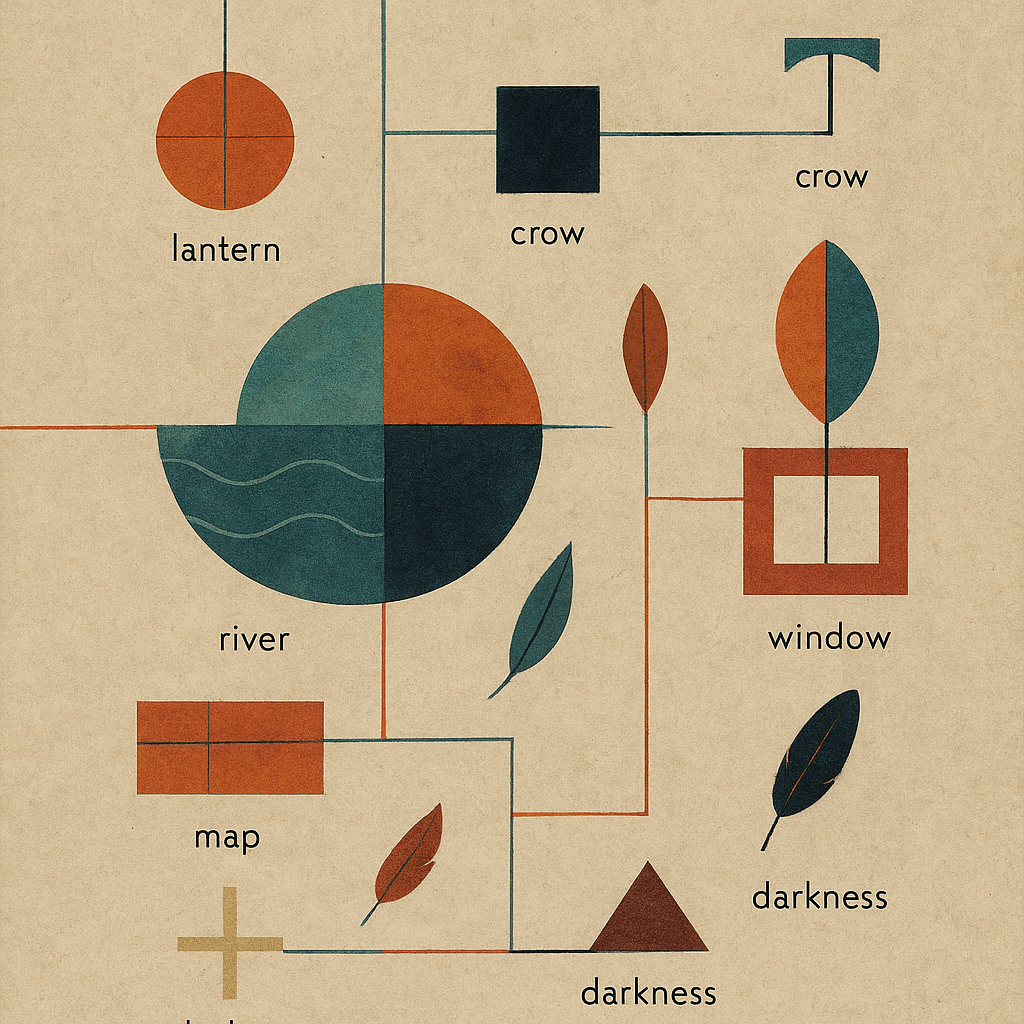
Summary of Symbolic Architecture
| Domain | Symbol | Essence |
|---|---|---|
| Reason / Order | Compass, ledger, lantern | Control, clarity, limits |
| Instinct / Nature | Crow, feather, river | Curiosity, improvisation, flow |
| Thresholds | Window, bridge, tap | Communication between inner and outer worlds |
| Transformation | Fatigue, altered blueprints, darkness | Breakdown leading to integration |
| Integration | Closed compass, open window, final letter | Acceptance of duality — the bridge that holds |
WE&P by; EZorrillaMc.
 Travel in Life
You must be logged in to post a comment.