
The Courage to Be Seen
On Learning to Stop Carrying What Isn’t Mine
For much of his life, he mistook attentiveness for responsibility. If someone was upset, he assumed he’d caused it—and set out to fix what was never his to fix. The Courage to Be Disliked helped him name that reflex and begin the slower work of releasing it: learning where his task ends, and someone else’s begins.
As a boy, he was told, “Look what you did to your mother.”
He looked—not at the words but at her face—and learned what silence could demand. His father’s tone made the verdict final. A woman’s sadness became his fault. A boy’s confusion became responsibility.
In school, he would befriend his enemies. It seemed safer to manage danger than to face it. If someone might hurt him, he’d make them laugh first. Peace at any cost. Praise became safety; disapproval, threat.
He carried that lesson forward like a family heirloom. In work, he became reliable—the one who anticipated problems before they formed. Responsibility was rewarded; guilt was quieted through competence.
Years later, surrounded by ledgers and order forms, he still kept watch for the smallest change in someone’s tone. The habit had turned into a reflex. He believed success meant preventing disappointment. The world seemed complicated because he was trying to hold every part of it.
When the work was done and the noise eased, he began to write. The page offered a different kind of task—one no one could share or misread. Still, the old reflex followed him there. Each sentence felt like a risk of disapproval.
Then came the book—The Courage to Be Disliked.
He read the philosopher’s exchange with the youth and paused at the idea of separation of tasks.
You are responsible for what you choose; others are responsible for their responses.
It was simple, almost too simple. But it explained a lifetime.
He began to test it in small ways.
When someone frowned, he waited.
When someone misunderstood, he didn’t explain twice.
At first it felt like neglect; then it started to feel like peace.
He learned that freedom wasn’t the absence of care, but the end of control.
He learned that belonging didn’t come from fixing people, but from walking beside them.
He learned to stop confusing attentiveness with ownership.
Now, at a desk lit by a single lamp, he writes at night. The house is still. No one’s face to read, no one’s tone to interpret. Just the sound of the pen moving—deliberate, unhurried.

Morning
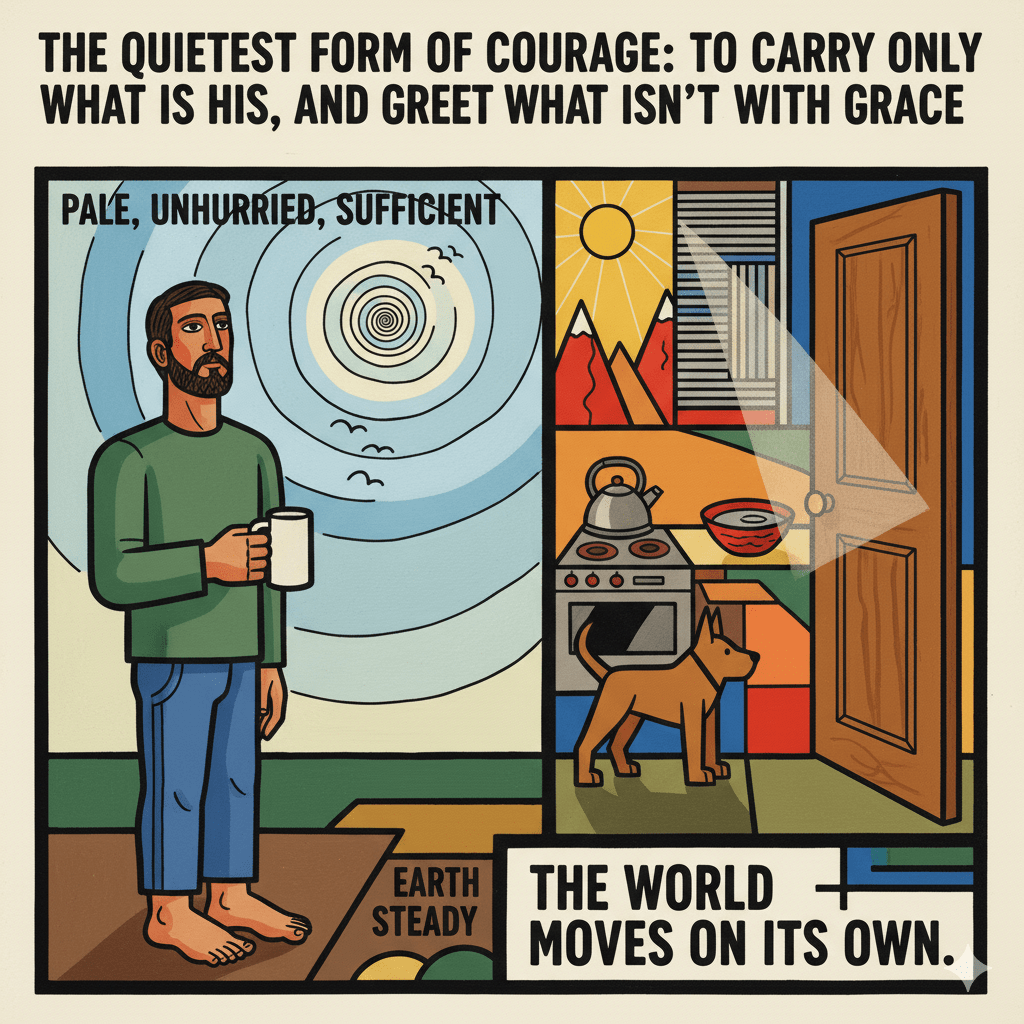
By morning, the desert light slides through the blinds. He pours water for the dog, sets the kettle on, opens the door. The air is cool, edged with the day’s coming heat. The street is empty except for the slow rise of birdsong.
There is nothing to repair. No expression to decode. The world moves on its own.
He steps outside barefoot, mug in hand, and feels the earth steady beneath him.
The boy who once looked to his mother for cues now looks only at the sky—pale, unhurried, sufficient.
The man he became has learned the quietest form of courage:
to carry only what is his, and greet what isn’t with grace.
WE&P by: EZorrillaMc.
The Courage to Be Disliked: The Japanese Phenomenon That Shows You How to Change Your Life and Achieve Real Happiness Kindle Edition
by Ichiro Kishimi (Author), Fumitake Koga (Author)
The Courage to Be Happy: Discover the Power of Positive Psychology and Choose Happiness Every Day Audible Logo Audible Audiobook – Unabridged
Ichiro Kishimi (Author), & 5 more
Understanding Human Nature
by Alfred Adler
 Travel in Life
You must be logged in to post a comment.