The Quiet Compass: A Guide to Awareness and What Lies Beyond
Part I — The Approach: Waking Without Drama
- Begin with the Deck You Have.
Don’t hunt for new cards; turn over the ones already in your hand. Awareness starts by noticing your patterns — the recurring storylines, the arguments on loop. Write them down. Not to fix them, but to see the shape they make. That’s consciousness in its simplest form: seeing what you’ve rehearsed. - Honor the Ruins.
Every broken dream is a civilization in miniature. Grieve properly. Civilization evolved by burying its failures in ceremony; you can too. Give loss a name, a candle, a paragraph in your journal. That act metabolizes pain and prevents spiritual scar tissue. - Relearn Silence.
Modern life trains noise; mindfulness trains listening. Practice one conversation a day where you say less than you want to. Let silence do the translation. Awareness thickens in the pause after impulse. - Remember the Body Is Not an Accessory.
Breathe like it matters, walk without a podcast, eat without multitasking. Your nervous system is older than your ideas. The body stores history; awareness means reading its archives. - Practice Disciplined Wonder.
Curiosity without boundaries becomes addiction; control without curiosity becomes dogma. Balance them. Ask questions that humble you but don’t unmoor you. Example: What might this moment be teaching me about patience? Not: What’s wrong with me again?
Part II — The Climb: Living Mindfully
- Detach Without Disappearing.
Mindfulness isn’t exile. It’s the ability to stay near the heat without burning. Practice presence during discomfort: when criticized, breathe once before answering. When praised, breathe once before attaching. That gap is freedom. - Name Your Propaganda.
We all broadcast to ourselves. Notice the inner slogans — I’m behind, I should be further along. Identify who authored them. Awareness grows through counter-advertising: writing new headlines in your own font. - Choose the Next Dream, Not the Old One’s Ghost.
After loss, the mind builds replicas. Resist the museum of “what could’ve been.” Ask instead: What do I value now that I couldn’t see then? Rebuilding isn’t restoration; it’s translation. - Live as a Good Ancestor to Yourself.
Picture the person you’ll be in five years reading today’s journal. Will they thank you for your honesty or your pretense? Awareness matures when the future self becomes part of the conversation. - Hold Gratitude Lightly.
Gratitude isn’t cheerfulness. It’s a form of accuracy — seeing what is still working. List one thing per day that is unearned yet present. Awareness without gratitude curdles into cynicism; gratitude without awareness dissolves into denial.
Part III — Beyond Mindfulness: The Spacious Mind
Mindfulness is not the summit; it’s the clearing. Beyond it lies something quieter and stranger: participation.
- Let Thought and Emotion Reunite.
Civilization split them centuries ago — reason on one side, feeling on the other. Integration means letting intellect serve empathy. When you understand something, check if you also feel it. If not, keep listening. - Trade Identity for Continuity.
Awareness names you; transcendence dissolves you. Instead of asking Who am I?, try What am I becoming through this? Roles are temporary scaffolds. Continuity is the current underneath. - Cultivate Creative Service.
Use your clarity to build, write, teach, or repair something. Awareness that doesn’t express turns sterile. Service isn’t moral obligation; it’s circulation — energy kept moving. - Trust Complexity, Seek Simplicity.
The goal is not to resolve paradox but to rest within it. Say “both” more often. Civilization advanced when it allowed multiplicity — you can too. Simplicity emerges when you stop amputating contradiction. - End Each Day Like a Historian.
Review the evidence: where attention went, where kindness hesitated, where wonder flickered. Awareness grows by record-keeping. But after review, close the book. Let the next page arrive unplanned.
Part IV — A Short Epilogue
You don’t “reach” this level. You circle it. Civilization has been doing the same dance — from faith to reason, from empire to fracture, from noise to quiet — for millennia. We simply practice it in miniature.
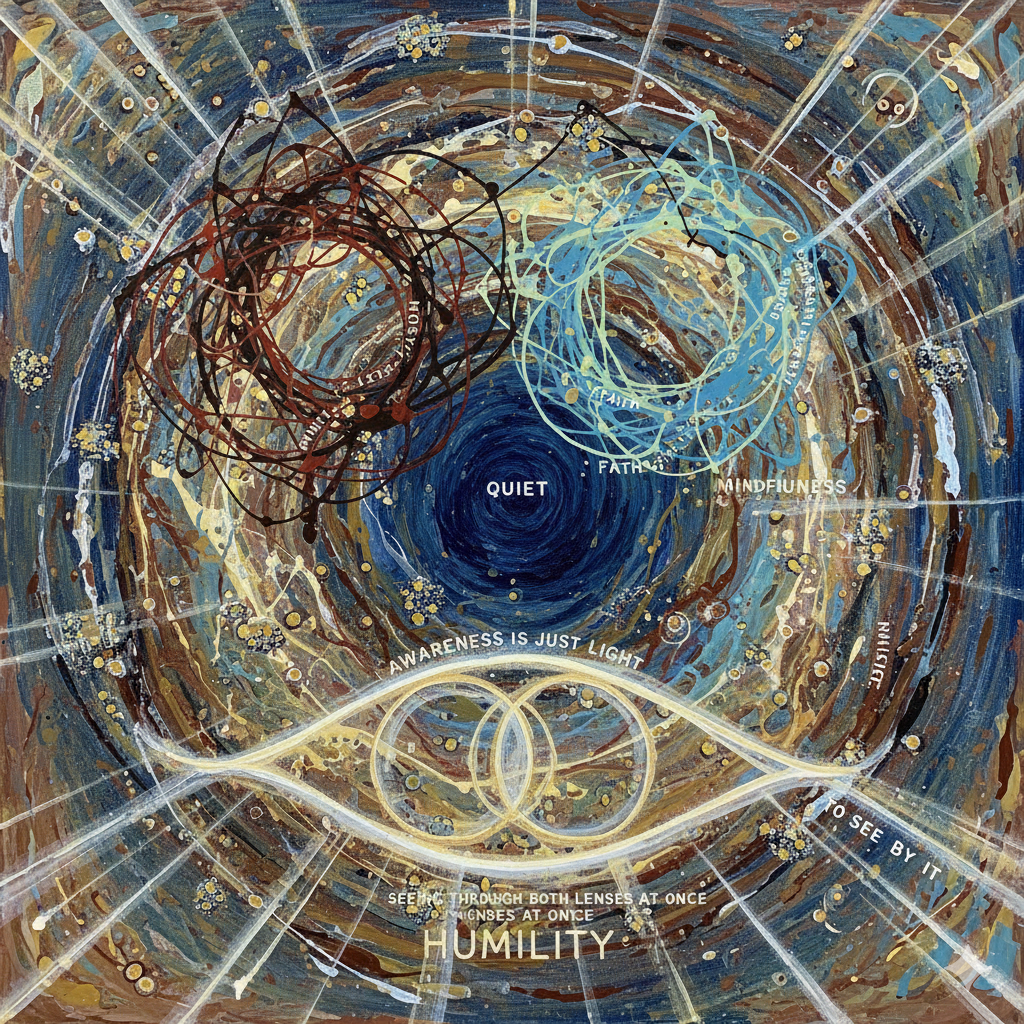
Going beyond mindfulness isn’t an escape from the world; it’s falling back into it with eyes open. You start seeing through both lenses at once: the infinite and the immediate, the personal and the historical.
The trick is humility — not the shrinking kind, but the clear kind. Knowing that awareness is not ownership. It’s just light.
And like light, the point isn’t to hold it. It’s to see by it.
WE&P by: EZorrillaMc.
 Travel in Life