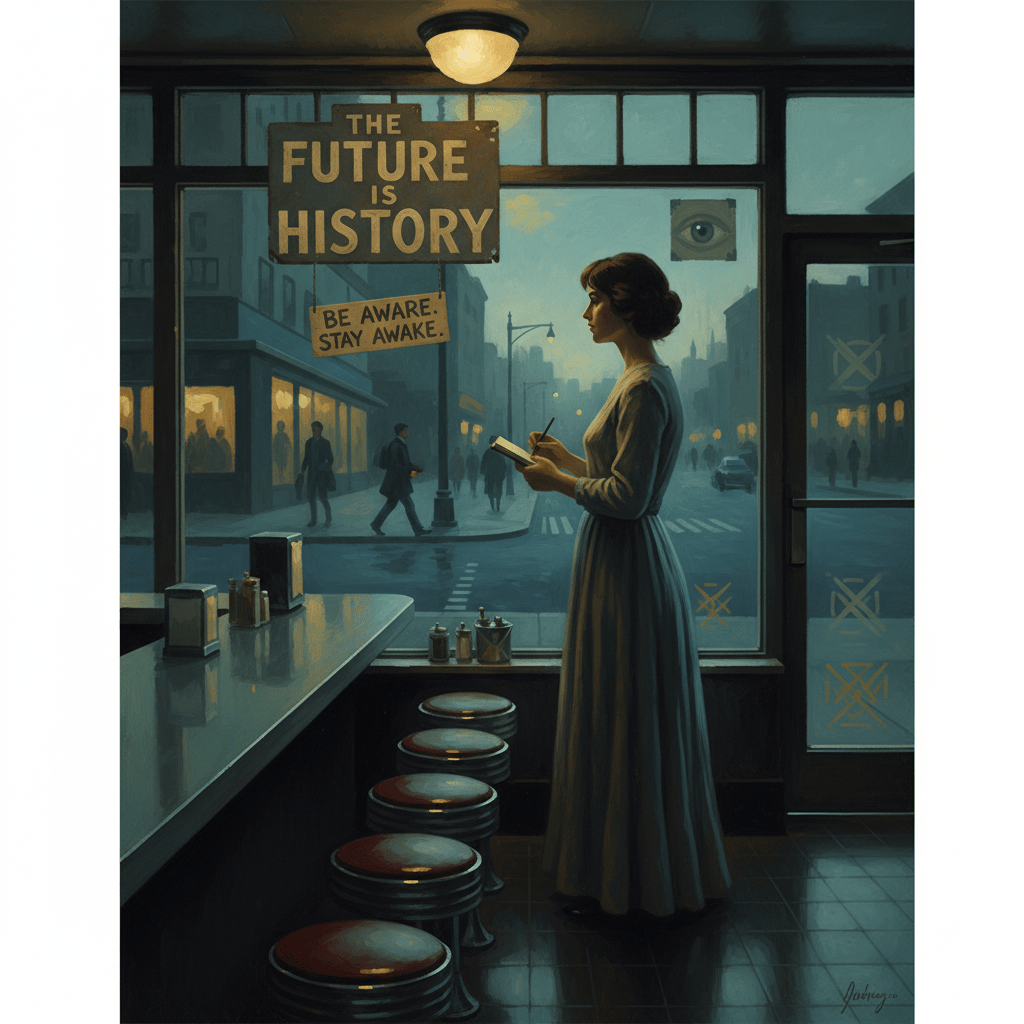
Prelude — Mindful, Not Fearful
A good place to stand is mindful, not fearful. Gessen’s message in The Future Is History is not one of despair but of vigilance—an appeal to awareness as an active moral stance. Systems can be bent back toward openness if enough people remain awake to the drift. Simply noticing patterns, refusing numbness, is already a quiet act of repair.
Awareness is the hinge between perception and responsibility. It begins modestly: a pause before repeating an unverified claim, a question asked amid certainty, a refusal to let fatigue define one’s reality. These gestures may seem small, yet they mark the boundary between citizen and spectator.
I. The Drift
Tyranny rarely returns by proclamation. It re-enters through drift—incremental concessions mistaken for pragmatism. A rule is bent for efficiency; a lie is excused as patriotic; silence is rationalized as prudence. Each step feels trivial until the direction becomes undeniable.
Gessen’s account of post-Soviet Russia shows how exhaustion, not ideology, becomes the handmaiden of authoritarianism. When faith in reform collapses and cynicism passes for sophistication, societies yield without realizing it. Fatigue becomes complicity; adaptation, a kind of surrender.
Democracies, too, decay less from assault than from attrition. Freedom is not a monument but a muscle—it must be exercised to stay responsive. The true peril lies not in crisis but in habituation: when erosion feels like normal weather.
II. The Inheritance of Attention
Attention is a civic inheritance that must be renewed, not assumed. It is learned through example—how elders listen, how teachers question, how communities remember.
Authoritarian systems thrive on amnesia. Erase the memory of terror, efface the moral costs of collaboration, and history becomes a blank script ready for repetition. Attention, by contrast, is continuity: the unbroken thread of memory that binds responsibility to awareness.
To teach history honestly is to preserve moral orientation. Memory is not nostalgia; it is an ethical instrument, reminding a society what forgetting costs. The act of remembrance becomes a collective resistance to the erasure of meaning.
III. The Re-Seeing
Re-seeing is more demanding than opposition. It requires looking at what appears familiar and perceiving its constructed nature—asking who defines “normal,” and to what end.
Democracy is not a machine that runs on autopilot; it is an ongoing conversation that survives only through participation. Every act of discernment—every refusal to reduce complexity, every effort to bridge distorted narratives—reclaims a portion of shared reality.
To re-see is also to resist the temptation of despair. Declaring that “nothing can change” absolves one of engagement. The harder discipline is to keep seeing until possibility re-emerges from what once seemed fixed.
IV. The Bending Back
Systems do not right themselves; they are bent back into shape by human persistence. Renewal rarely arrives in spectacle. It begins in granular acts: a journalist insisting on accuracy, a teacher refusing to sanitize, a citizen voting without illusion yet without apathy.
These are the quiet mechanics of resilience—the civic ligaments that keep a body politic from collapse. Change gathers first in the periphery: in local trust rebuilt, in dialogue reopened, in dignity restored to public life. Gessen’s lesson is that vigilance, to endure, must be communal; no one can sustain awareness indefinitely in isolation.

Coda — Keeping Watch
So we return to the beginning: a good place to stand is mindful, not fearful. Power will always tempt distortion, and fatigue will always invite retreat. Yet watchfulness—lucid, steady, and shared—remains the foundation of freedom.
To keep watch is not to live in dread but in disciplined attention. Awareness, multiplied across citizens, becomes a counterforce to decay.
Democracy, like consciousness itself, renews each time someone chooses to see—and to keep seeing.
The Future Is History: How Totalitarianism Reclaimed Russia
by Masha Gessen
WE&P by: EZorrillaMc.
 Travel in Life
You must be logged in to post a comment.