Finding Purpose
—
The first time Mateo feels the weight of leadership is at the family table, where the salad sits wilting beside the salt and the arguments spring like sparks from flint. An aunt pounds her palm about justice. A grandfather folds his hands about duty. A cousin praises the good fight; an uncle warns against the wrong war. Forks clink, jaws set, glances flare. Mateo’s chest tightens, a small drumbeat under his shirt. He studies the hands: fists like punctuation, fingers like question marks, knuckles whitening on the edges of belief. No one is cruel, exactly—only convinced. He senses that conviction can be a shoreline or a cliff.
After dinner, the house quiets into the hum of appliances and distant traffic. He stands on the porch and watches a dog lead its owner down the block, tail high, decision made. The night air cools the heat behind his ears. Choice, he decides, is not a switch but a small hinge, turning doors that change the rooms behind them.
At school, two invitations arrive the same day. Debate team: sharpen wits, win trophies. Astronomy club: borrow a telescope, whisper at the sky. He stalks the hallway with both flyers in his pocket, paper edges nibbling his fingertips. To choose feels like disowning a version of himself. In the restroom mirror, his reflection negotiates. The boy who argues can protect his family in the marketplace of ideas; the boy who star-gazes can aim the family’s compass toward a larger north. His stomach hollows with the ache of almost.
He shadows his older cousin, Leo—golden-browed, student leader, shoulders squared like a promise. Leo shows him the backstage of charm: a checklist of names, a catalog of smiles. “You practice sincerity until it’s real,” Leo jokes, but the laugh lands crooked. Later, when the hallway empties, Leo sits with his back to the lockers and rubs his eyes. “Sometimes I’m selling what I don’t buy.” Mateo hears the quiet scrape of confession. Self-deception, he realizes, is a room with mirrors on every wall; you can mistake reflections for exits.
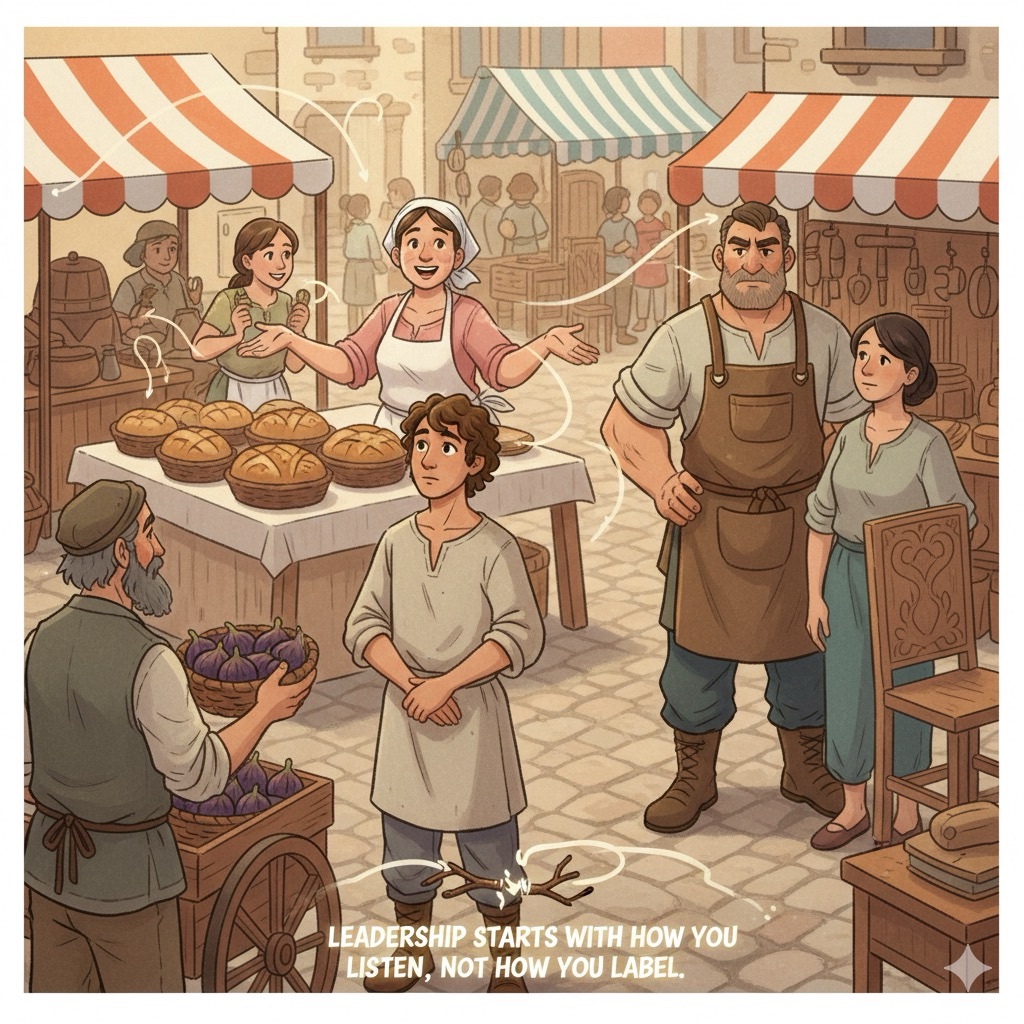
On Saturday, the town square blooms with bargaining. Vendors lean into their stalls, palms open, eyebrows lifted into friendly arches. A baker tells a story with her hands, and the price of bread softens. A carpenter sets his jaw like a level; buyers straighten. Communication here is choreography: a tilt of the head, a pause, a patient silence that lets someone else finish their thought. Mateo practices it with the fig seller, asking a question and then not talking. The man’s shoulders settle. Mateo feels the twig-snap of insight: leadership starts with how you listen, not how you label.
Back home, his mother sets a mug of tea near his elbow and says nothing for a while—only warmth rising like a small fog. Her quiet is not absence; it is attention. He speaks about the two flyers and the fear of closing doors. She considers, then touches the rim of the mug with one finger and says, “You’re allowed to carry more than one cup at a time. But when you drink, you choose.” He smiles, because this answer does not free him from choosing; it frees him to choose again.
He picks astronomy and, reckless with curiosity, he also applies for captain on a group project. The team nods when he speaks, and he thinks nodding means agreement. It means polite endurance. On the second day, a teammate, Nia, misses a deadline. He assumes laziness and pushes harder. Her eyes flinch. The project wobbles. Only when he apologizes—mouth dry, shoulders low—does Nia tell him her hands shake when she presents, that silence for her is not refusal but fear. The apology is a key; the room opens. They reshuffle tasks. The project steadies. He learns the soft law of repair: authority is measured in how you mend, not how you march.
One evening, the astronomy club drags a telescope to the school roof. Mateo leans into the eyepiece, the cool metal kissing his brow. A gas giant hangs there like a lantern in long darkness. He feels small, yes, but not diminished—more like threaded. The stars do not shrink his family’s quarrels; they frame them. If history is a night sky, then a leader is not the brightest star but the hand that points and whispers, look, and sets a circle of people humming toward the same constellation.
The next dinner detonates. Elections loom; old hurts uncoil. Voices stack and crack. The grandfather invokes sacrifice. The aunt invokes solidarity. The uncle lists numbers. The cousin mutters that numbers lie. Mateo’s throat prickles; his heartbeat scurries. He senses the gravitational tug to take a side for sport, to win the point and lose the people. Instead, he names what he can see without judgment. “Nonno,” he says, “you taught us to keep promises.” “Tía,” he adds, “you remind us not to forget the ones outside.” The room doesn’t melt, but its ice shifts. The argument breathes. He’s not a referee—he’s a steward of tone.
Word gets around that Mateo can “handle a room,” and a youth political group invites him in. Joining would tuck him neatly beneath one family banner. Declining would be read as cowardice by another. He walks to the roof again, empty sky this time, and listens to his breath. He thinks of Leo’s tired grin, of Nia’s shaking hands, of the square where silence buys truth. He asks himself the question he’s been dodging: Who do you become when no one is watching? The answer is not a sentence so much as a posture. He decides to help the group host forums where competing voices meet, not to become the voice that drowns the others. It is not neutral; it is deliberate hospitality.
At their first forum, the microphones squeal, the folding chairs wobble, and the clock is a tyrant. People arrive armored. Mateo names the rules plainly—speak for your ideas, not against a person; tell stories, not slogans; argue as if your opponent will be your neighbor tomorrow, because they will. He invites a veteran to sit beside an activist and asks them both about who they love and what they fear before anything else. Shoulders descend. Jaws unlatch. They still disagree, gloriously, but their words stop drawing blood and start drawing breath.
Months unspool. The family notices. The aunt brings a casserole to the grandfather’s birthday; the grandfather compliments her spice. Leo steps back from roles he wore like weights and chooses one he can carry without folding. Nia presents to a small crowd and keeps her hands still by gripping a pen like a baton. The town square glows at dusk; bargains sound less like skirmishes and more like songs.
One night, a storm prowls the neighborhood. Power flickers, dims, returns. The family gathers by candlelight, shadows swaying, faces warmed at the edges. Someone asks—half-teasing, half-earnest—what makes a good leader, then? Mateo looks around at this unruly constellation and feels the answer land like a steadying hand between his shoulder blades: A good leader chooses, repairs, listens, and points to something larger than themselves. He does not say this. He simply reaches for the matches, lights another candle, and passes the flame.
WE&P by: EZorrillaMc.
 Travel in Life
You must be logged in to post a comment.