
The Walk Back
Kyra left Engineering with the faint fatigue of routine still clinging to her. In the corridor, she nearly collided with Lieutenant Marrek—communications officer, sharp-witted, always carrying that quiet confidence she admired.
“First day as team leader,” he said, smiling. “Still standing.”
“Barely,” she admitted, though her voice carried more warmth than defeat.
He fell into step beside her. “I could walk you back to your cabin. Celebrations don’t have to end just because the shift did.”
Kyra hesitated, then nodded. “All right. But just the walk.”
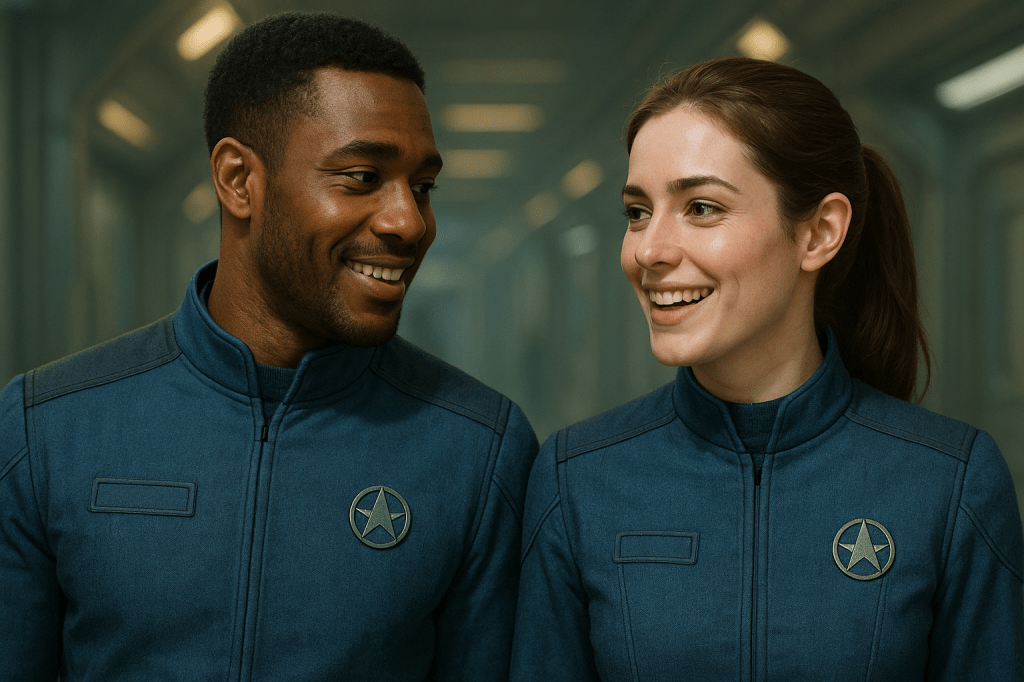
They moved together through the narrow arteries of Dauntless, the hum of the ship surrounding them like a second heartbeat. She was aware of him at her side, of his easy presence, of how unthinkable this would have felt only weeks ago.
At her door, he lingered. “I could come in. Just to talk.”
Her pulse quickened, but she shook her head gently. “Not tonight. I need… I need to breathe on my own for a while.”
He studied her, then gave a small, respectful nod. “Another time, then.”
When the door sealed shut behind her, Kyra leaned against it, breath catching in something like laughter. How quickly the orbit shifts when the mass changes. How quickly the world treats you differently when you treat yourself differently.
Her Quarters
Her cabin was small, like all junior officers’ quarters, but tonight it felt expansive. A single bunk hugged the wall, as narrow as a thought but as steady as a vow. A desk bore her datapads stacked in uneven towers, silent like sentinels waiting for orders.
The overhead light glowed dim and golden, turning steel walls into something almost tender. The air smelled faintly of metal and recycled oxygen, a reminder that life here was not natural but engineered, sustained like a fragile equation.
There was a rhythm to the space: chair and desk, locker and bunk, light and shadow. Repetition gave it coherence, polyptoton made it echo—living in a cabin, but making the cabin live; controlling the space, but letting the space control her.
The room was both prison and promise, as confining as a box and as liberating as an open page. Each corner carried the weight of discipline, but each surface invited her to imagine what could be written upon it.
For the first time, she saw it not as where she was placed but as where she belonged.
She sat on the edge of the bunk, the thin mattress creaking beneath her like an old ship groaning against gravity. She let herself smile—small at first, then broader.
Life on a warship was precarious, always on the edge of fracture. But in this cramped cabin, she felt the symmetry of change. She had changed, and the world had changed with her, as inevitably as tides follow the moon.
Tonight, alone, she was not diminished. She was defined.
The Drill
The next morning, Engineering buzzed with the same steady rhythm as the reactors they tended. Kyra arrived early, datapad in hand, already reviewing overnight logs. No anomalies, no malfunctions, no hidden fractures in the systems—Dauntless was running smooth.
Her team drifted in one by one, greetings casual, familiar. Kyra felt the difference in how they glanced at her now. It wasn’t deference—it was inclusion. She was no longer the quiet background figure. She was the axis they orbited.
Chief Patel approached, expression neutral but eyes alert. “Lieutenant, Command’s scheduling a surprise readiness drill for today. Fire containment, simulated reactor breach.”
Kyra’s pulse ticked upward. A test. Not of systems, but of her.
“Good,” she said, more firmly than she felt. “Better we burn in simulation than bleed in reality. Prep the teams. I’ll take lead.”
The klaxon shrieked. Drill: Containment Failure – Reactor Compartment Delta.
The air seemed to sharpen. Engineers snapped to motion. Kyra barked orders before hesitation could creep in:
“Serano, seal off conduits! Patel, re-route plasma feeds! Juno, you’re with me—suppressant systems, now!”
They moved like pieces on a board, each fitting into a pattern she’d rehearsed in her mind a hundred times. The simulated alarms blared red across every console, warning of overload, of fire, of cascading failure.
Kyra’s voice cut through like a metronome, steady, unwavering. She gave orders, received updates, adjusted vectors. She didn’t try to do it all herself—she trusted them, let their strengths cover her blind spots.
“Suppression engaged!” Juno shouted, fumbling but holding steady under her gaze.
“Containment sealed,” Serano confirmed.
“Reactor stabilized,” Patel finished, almost smug.
And then—the alarms silenced. A final chime declared: Simulation complete. Success.
The air released in a collective exhale. Sweat gleamed on foreheads, shoulders sagged, but smiles crept across faces.
Patel looked at her, half-grinning. “Not bad, Lieutenant. Clean run.”
Kyra let herself smile back. “Clean, but not perfect. Patel, your re-route lagged five seconds. That’s long enough to cook a compartment if it had been real. Serano, excellent timing on your seals. Juno—clumsy, but effective. We’ll run suppressants again this week until you’re smooth.”

Her critique didn’t sting; it steadied. The team nodded, listening, not defensive.
The Debrief
Later, she filed the official drill report. Her words were clinical, precise: Team responded promptly. All systems contained. Minor timing issues noted. Corrective drills scheduled.
But in her private notes, she wrote something else:
Teamwork is not the absence of error but the balance of strengths. Each weakness is a gap waiting to be filled by another’s skill. Leadership is not about erasing flaws but about aligning them into function.
She leaned back in her chair, considering. The drill had not been about engineering systems—it had been about human systems. And they had worked.
Reflections
At the end of shift, the team gathered in the lounge for routine downtime. Conversation was light, laughter easy. Kyra watched them—Patel’s dry humor, Serano’s restless energy, Juno’s cautious eagerness—and felt a strange warmth.
This wasn’t simply her team. This was her crew.
As they toasted with recycled coffee and off-duty jokes, she realized something profound: She didn’t have to be Aras. She didn’t have to be loud, or brash, or commanding in the way others were.
She only had to be consistent, clear, and steady. The ship itself had taught her the lesson—power wasn’t in the blinding burst but in the continuous flow, as quiet and unrelenting as a reactor’s heartbeat.
When she finally left for her quarters, the thought stayed with her: Leadership isn’t about being the brightest star. It’s about keeping the constellation together.
The Ready Room
Captain Harlan Iceni stood at the viewport of his ready room, hands clasped behind his back, watching the stars drift as Dauntless coasted between jump points. The stars looked serene, indifferent, but he knew serenity was a lie. Space was always waiting to kill the careless.
First Officer Linden entered quietly, datapad in hand. “Captain. Next jump plotted for 0300. Navigation confirms alignment, but…” She hesitated. “The region ahead is unmapped. Not just poorly charted—unmapped.”
Harlan turned. “Meaning anything could be waiting. Hostiles, anomalies, nothing at all.”
“Exactly,” Linden said. “The crew’s ready, but morale is stretched thin. Auxiliars are running hot—working triple shifts just to keep us supplied. We’re burning through raw materials we can refine. We can’t keep this up indefinitely.”
Harlan moved to his desk, the light casting sharp shadows across the scars in the wood grain. He didn’t sit; he rarely did in moments like this.
“How bad is it?”
“Bad enough,” Linden admitted. “Ore extraction from the last system came up short. Our fabricators are cannibalizing stock just to keep weapons and drives stable. At this rate, we’ll have to start stripping non-critical systems for parts. If we don’t find resupply soon, the fleet will grind itself to pieces.”
Harlan exhaled slowly. The words carried weight, more than he let show. A fleet without material wasn’t a fleet—it was a coffin.
“And if we stumble into Syndicate space while limping?” he asked.
Linden’s expression tightened. “Then they’ll tear us apart before we can fire a shot. Syndicate intel suggests patrol fleets still sweep the border regions. Their logistics are strong. They could outlast us in attrition.”
The silence stretched, filled only by the faint hum of the ship’s systems.
Finally, Harlan spoke. “Then we don’t stumble. We move with precision. We show strength even when we bleed weakness. The fleet has survived worse.”
Linden shifted, studying him. “Sir… do you expect hostilities?”
“Always,” Harlan said flatly. “Hope is not a strategy. The next system could be empty, or it could be bristling with Syndicate teeth. We prepare as though it’s the latter.”
She nodded, but her eyes lingered. “And if it isn’t Syndicate? If it’s someone else?”
The thought hung in the air like a half-drawn blade. First contact. Unknowns beyond the Syndicate’s iron grip.
“That,” Harlan said, his voice quiet but sharp, “is the one thing I expect least of all, and therefore must prepare for most.”
The Weight of Command
He moved to the wall display, bringing up fleet readiness reports. A sea of green, yellow, and the occasional red filled the screen.
“Engineering’s stable,” Linden noted. “Lieutenant Kyra Danel ran a flawless drill yesterday. Her team’s performance suggests cohesion. If systems fail, she and her people can respond.”
Harlan’s mouth twitched, not quite a smile. “Good. She’s one of those hidden talents the fleet likes to bury until crisis forces them into the light. We’ll need more like her if we’re to hold together.”
He gestured at the glowing system schematic. “But readiness drills don’t win wars. Resources do. Without ore, without fuel, without food—we are dust in the void. Auxiliars can’t conjure something from nothing.”
Linden’s voice dropped, candid now, stripped of formality. “We’re not just running low, Captain. We’re running out. Two more jumps at this pace and we’ll be starving the reactors.”
The words settled heavy in the room.
Resolve
Harlan finally sat, leaning forward, elbows on the desk. “Then we gamble. Every commander in history has reached the point where logistics strangles strategy. The question is whether we die clinging to rationed scraps… or whether we seize what we need.”
“You mean raiding Syndicate depots.”
“Or worse,” Harlan admitted. “If the next system has resources, we take them. If it has Syndicate presence, we fight or steal and run. And if it has someone else…” He let the thought linger. “Then we decide whether they are friend, foe, or food.”
Linden gave a humorless chuckle. “That’s one way to put it.”
“It’s the only way,” Harlan said. “Survival isn’t about ideals. It’s about material. If we can’t resupply, we’re not a fleet—we’re debris.”
For a long moment, neither spoke. The stars outside burned in silence, uncaring.
Then Harlan straightened, the decision already shaping his voice. “Inform the fleet. All departments prepare for full readiness on exit. This will not be a routine jump. We’re hunting resources—and trouble.”
Linden tapped her datapad, acknowledging. “Understood. And Captain?”
He raised an eyebrow.
She hesitated, then said quietly, “The crew believes in you. Even when the odds are this bleak. Don’t forget—they’ll follow your certainty, not your doubt.”
Harlan’s gaze returned to the viewport, to the infinite dark ahead. “Then we’ll give them certainty. And if the universe means to test us, we’ll make sure it regrets trying.”
WE&P byEZorrillaMc.
 Travel in Life
You must be logged in to post a comment.