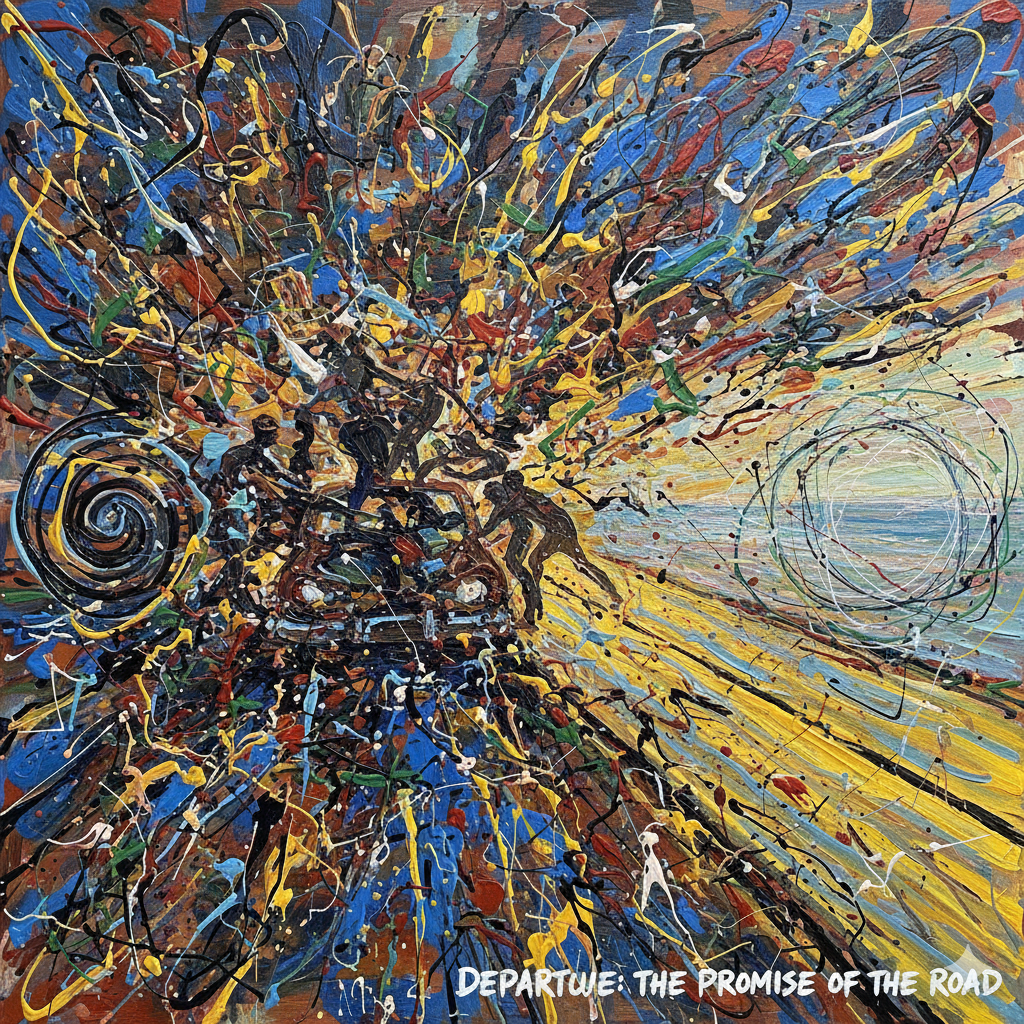
(Installment 1)
The sedan was more a question than a car. Its paint had once been a confident blue, now faded into something between denim and sky, with a dent over the rear wheel like a dimple earned in a fistfight. It wasn’t much, but it was theirs, and it was about to carry five friends in their early twenties from New York to Los Angeles.
Packing it became its own trial. Mae crouched with a roll of tape and a stack of labeled boxes, brow furrowed in the late-morning Queens light. Every blanket, book, and bag passed through her quiet system of order. Jin hovered with his phone, flicking between map apps and the color-coded spreadsheet he’d built, full of ambitious estimated times of arrival. Nico argued with the laws of physics, insisting the sleeping bags could compress further if you just believed. Sera slipped a battered notebook into the door pocket like contraband. And Lukas, restless and bright-eyed, slid a Polaroid into the glove compartment: the five of them crammed into a booth at Connie’s Diner, grease-shined grins under Mae’s tidy caption—To the edge of America and back.
“Back?” Nico teased, still wrestling the guitar case.
“Back,” Mae confirmed. “Assuming we don’t implode.”
The word implode lingered as Jin clapped his hands. “Seatbelts. We’re already forty-three minutes behind departure.”
Sera smirked. “I didn’t know friendship came with a stopwatch.”
“Everything comes with a stopwatch,” Jin muttered, though softer than he meant.
They laughed—brittle at first, then fuller. New York peeled away behind them: bridges, tolls, steel ribs giving way to suburbs and stretches of road that smelled faintly of possibility. Lukas grinned at the horizon. “We have horizons,” he declared.
Jin corrected him without looking up. “We have a schedule.”
Mae kept her eyes on the road, fingers tight at ten and two. The check-engine light blinked orange, but she refused to translate it.
Pennsylvania greeted them with rolling hills and a sudden silence under the hood. The sedan coughed, shuddered, and surrendered, coasting onto the shoulder with a sigh. Tractor-trailers howled past, rattling the doors. For a breath no one moved. Then five phones lit up, each voice rising in a different register.
“Call roadside assistance,” Jin ordered.
“It’s just the battery,” Nico countered. “We can fix it.”
“Or belts. Cars have belts, right?” Sera scrolled frantically. “Or gaskets. Whatever gaskets are.”
Mae turned the key. Click. The useless sound made her throat tighten. She’d been the one to wave off the idea of a pre-trip inspection. Fine in spirit, she’d said. Spirit didn’t tighten bolts.
A pickup pulled up behind them. A woman with a silver braid and hands like rope stepped out, waving casually as if greeting neighbors.
“Battery?” she called.
Every parental warning about roadside strangers lined up like wagging fingers. Mae hesitated. “Probably,” she admitted.
“You got cables?”
Nico dug a tangled nest from the trunk. The woman laughed once, quick and bright. “That’ll do.” She clipped, grounded, coaxed the engine back to life with hands steady as weather.
“Try not to stop till you buy a new one,” she advised. “Batteries die far from home.”
“Why’d you stop?” Jin asked, blunt as a blade.
The woman shrugged. “Because someday it’s me. And because you looked like the kind who’d stop for me too.”
She waved off their offers of cash, accepted two protein bars as tribute, and drove away. Her taillights vanished, leaving silence louder than the engine.
“It’s weird,” Lukas murmured. “All the stories say don’t trust anyone. Then someone saves you without asking who you are.”
“Not weird,” Mae said. “Human.”
“Risky,” Jin muttered, but without conviction.
They limped into a box-store lot, bought a new battery, and begged a clerk with chipped black nail polish to show them how to swap it. Grease smeared Sera’s cheek; Nico lifted the dead battery like a trophy.
“Look at us,” Mae said, smiling. “Hands. Doing things.”
Jin surprised himself by laughing. “Horizon two: embodied competence.”
That night in a motel that smelled faintly of chlorine, they ate pizza cross-legged on the floor. The argument arrived anyway, blooming from the question of whether to have stopped for the stranded driver.
“I didn’t want to be late,” Jin insisted. “That’s not cowardice. That’s math.”
“It’s also fear,” Sera said gently. “Time forgives nothing, so we start forgiving nothing.”
Mae admitted, “I hated how helpless it felt, needing someone. I hated that it was true.”
Nico traced circles in condensation. “I hate how many of my instincts come from the internet. Catastrophe plays in my mind like a video clip. But today I touched a battery. I felt real.”
“I want us to be the kind of friends who stop,” Lukas said. “Even if it costs us.”
The air conditioner rattled. Trucks roared by outside. Inside, they carried both the ache of conflict and the fragile glow of having said the unsayable.
Indiana brought sameness: rest stops, vending machines, green signs repeating like incantations. Then they saw him—a young man pacing by his car, hood open, phone held high like a divining rod.
Mae flicked the blinker. Lukas leaned out the window with a grin. “Bad day?”
“Ran out of gas,” the man confessed, voice fraying. “Supposed to be at an interview. Thought I had enough.”
“Where’s your can?” Nico asked.
The man flushed. “Didn’t—have one.”
Nico and Lukas detoured two miles back, bought a red plastic can, and returned to pour salvation into the tank. The man’s relief was raw. “I didn’t know people did this anymore.”
“We’re bringing it back,” Sera said. “Like vinyl.”
As they merged onto the highway, silence filled the car like bread rising. Jin stared at his hands. “I was wrong,” he admitted. “Sometimes the equation is just presence.”
Nobody argued.
By Illinois the treaties grew fragile. They sat in a diner where the waitress poured coffee without asking, menus laminated against catastrophe. Jin lined up his cutlery with surgical precision.
“You okay?” Mae asked.
“We’re sixty-eight minutes behind,” he said.
“Behind what?” Sera asked.
“Behind reasonable progress.”
“Reasonable,” Nico echoed. “Soft law.”
Lukas twirled a fork. “We helped that guy. He’ll make his interview. That has to count.”
Jin misheard kindness as accusation. “I didn’t say it didn’t count. I said we can’t save everyone. We’re not saints.”
Sera’s smile flicked, brittle. “We can be somebody’s. That’s the point of being alive.”
“You narrate your goodness,” Jin shot back. “Sometimes it feels like theater.”
The word landed like a slap. Sera’s voice flattened. “If I don’t say who I am, people say it for me. The version they write makes me want to leave my own life.”
Jin flushed, words turning to stone in his mouth. “I’m sorry,” he forced out. “I want us to make good choices. Not just look good.”
“We’re arriving all the time,” Lukas murmured. “We just don’t recognize the cities.”
Mae pressed her hand to the table. “New rule. When we’re scared, we name the fear first. Before we name each other.”
Silence spread, not punitive but cool. Nico lifted his cup. “To naming the fear first.”
They ate the rest of their breakfast in peace fragile as glass.
By late afternoon, Missouri stormed them. Rain hammered the windshield, thunder dragged iron across the sky. Visibility shrank to a coin. Mae eased them into a motel lit by buzzing neon, the clerk sliding five keycards across like an occult hand.
The room smelled of damp carpet and soy sauce from their takeout cartons. Whiskey softened nerves, and conversation cracked open.
“I keep thinking I’m derivative,” Nico confessed. “I don’t write code, I arrange it. A counterfeit of a counterfeit.”
“You’re building bridges with other people’s steel,” Mae said. “The cars still cross.”
“I want to forge,” he whispered.
“You will,” Lukas said. “We’re a foundry. We heat, we hammer, we cool.”
“My mother prays I’ll marry a man,” Sera said quietly. “She calls my loves confusion. She cooks for whole parishes, but she won’t cook for me if I bring her the wrong name.”
Mae reached for her foot, squeezed once. “I believe you. That’s the price of admission.”
Jin exhaled, words rusty. “I think lanes protect us. But lanes become cages. Then I wonder why you don’t thank me for the bars.”
“You make the world solid,” Nico told him. “Solid is a miracle.”
“Solid is avoidance,” Mae countered, though softly.
The storm roared. The power flickered out, forcing honesty to glow by itself.
“I don’t know what I believe,” Mae said. “I believe in lists and keeping promises. I want that to be enough.”
“Maybe faith is just consenting not to be project manager all the time,” Sera said.
Mae laughed, a small bright sound. “Then maybe I could believe.”
The room filled with silence shaped like prayer.
Crossing Lines
(Installment 2)
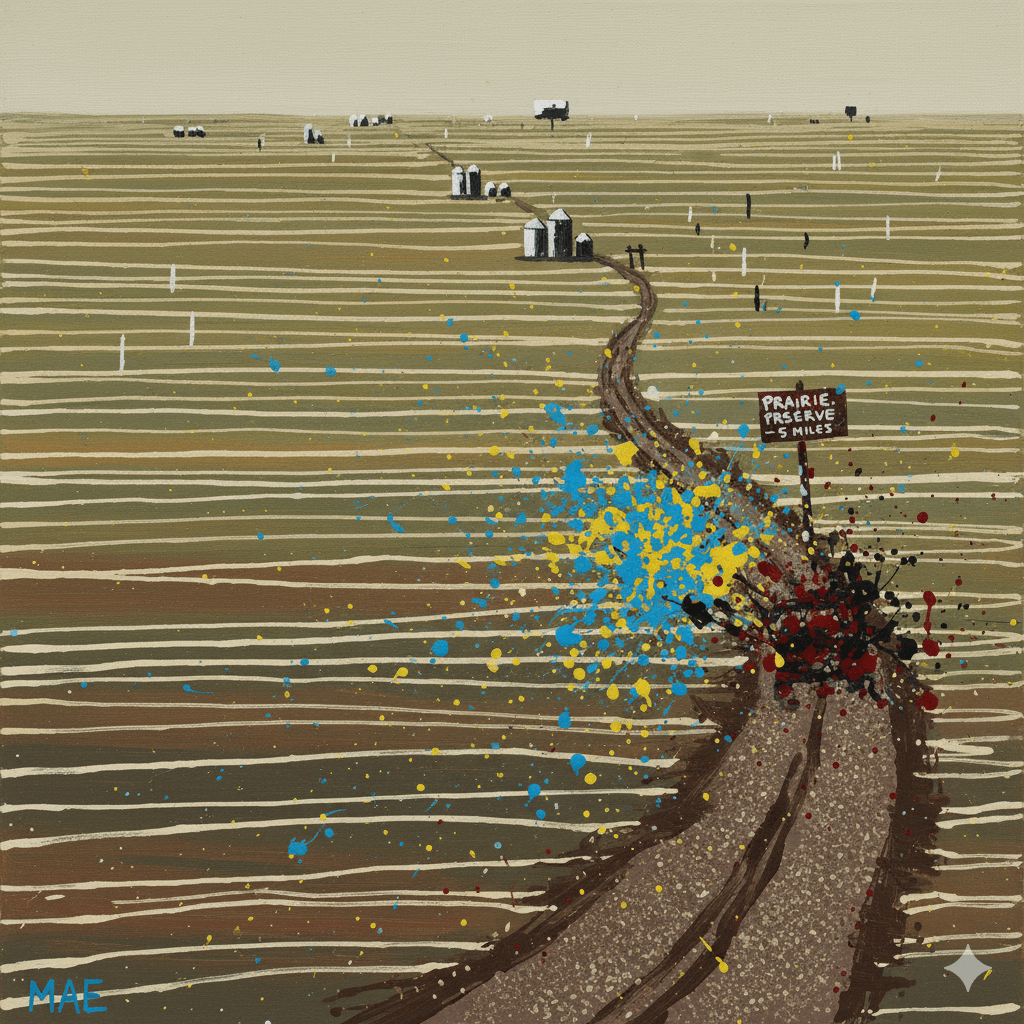
Kansas unrolled like a sigh. Fields so wide they felt like unmade beds, silos dotting the distance, billboards promising fireworks and salvation. By midmorning the monotony pressed against the car windows like fog.
Then Mae saw a hand-painted sign: Prairie Preserve – 5 Miles. She flicked the turn signal without asking.
“That wasn’t on the route,” Jin said, startled.
“It is now,” she answered, steering them down a gravel road.
The sedan shuddered and creaked, then settled into the lot beside a weathered trail sign. They stepped into tallgrass that hissed and bent with the wind, and suddenly the world widened beyond argument.
Sera stopped first, eyes tilted skyward. “It’s a cathedral,” she breathed. “No roof but sky.”
Nico lay on his back, hands laced behind his head, grinning at a hawk drawing invisible geometry above them. “This beats any app I’ve ever downloaded.”
Jin, usually narrating distances and minutes, sat cross-legged in silence. His shoulders dropped. His jaw unclenched. Even his breathing sounded surprised.
Mae crouched beside a patch of wildflowers, her hand hovering but not picking. All her lists and labels felt unnecessary here. The world didn’t ask to be organized—it asked to be noticed.
Lukas pressed his palm into the earth, closing his eyes. Screens had fed him images for years, sweet but thin. Here was fiber, heavy and nourishing. He thought, I’ve been starving while surrounded by food.
When they walked back, Sera wrote in her notebook: We are a species that forgets to touch. She tore the page and folded it into the map book beside Mae’s rules, as if both belonged in the same scripture.
Colorado rose like a promise they weren’t sure they’d kept enough vows to deserve. The air thinned; mountains shouldered the sky. The sedan wound switchbacks that made Nico mutter prayers in three languages.
At a scenic overlook, Mae pulled over. Lukas offered to take the wheel.
“Rotation says it’s not your turn,” Mae reminded him.
“I’ve got it,” Lukas said, too brightly.
The first curve was fine. The second, tighter. The third—brake lights flared on a truck ahead, gravel spat under the tires, and the sedan skidded sideways.
Mae shouted. Jin lunged toward the wheel. Sera’s gasp scraped raw. Nico swore. The car lurched back onto asphalt, tires clinging, the guardrail flashing past like a steel parent yanking them back from the edge.
Silence filled the cabin, thick as smoke. Lukas’s knuckles were white on the wheel. His throat worked.
“I’m sorry,” he said before anyone could start. “I wanted to feel capable. I didn’t want to ask.”
Mae’s voice was steady, anger buried in steel. “We set rules so we can rest inside them. You broke that.”
“If you mess up,” Sera said, trembling, “say it first. Don’t make us drag it out.”
Nico shoved a water bottle into Lukas’s hand. “Drink. Whatever else we do, we keep each other alive.”
Jin exhaled hard. “I prosecute because I’m afraid. But you don’t get to gamble with all of us just because you feel small.”
They pulled into a turnout. The map book sat open on the dash, waiting like an elder. Mae picked up the pen and wrote: When you feel unworthy, ask for a bigger job, not a more dangerous one.
Lukas nodded, shame heavy but honest. “I’ll hold to it.”
They folded the page back into the book beside Sera’s prairie line. Two truths side by side: the rules of repair, and the reminder to touch.
Descending out of the mountains, the light grew honey-thick. Shadows leaned westward, racing ahead of them. The guardrail glittered once in the rearview, then vanished.
New Mexico met them with heat and horizon. Mesas rose like ancient witnesses; the air thinned again, not with altitude but with starkness. They were looking for a gas station, a bathroom, maybe peaches. Instead they found noise and light.
Down a dusty track, speakers throbbed between trucks, tarps flapped like banners, and welded sculptures blinked glass eyes at the sun. A woman with a clipboard waved them in as if they were expected.
“What is this?” Sera asked.
“Desert convergence,” the woman replied. “Art, barter, burn. Leave no trace but leave changed.”
“We didn’t buy tickets,” Jin said, uneasy.
“Donations,” she said, pointing to a coffee can painted with stars. “Or carry water. Live.”
Nico grinned. “We’ll live.”
They slid into the festival like coins dropped in a fountain. Dust streaked their faces. Strangers offered glitter, advice, food. Dogs trotted like they owned the place.
Nico found a man crowned in LEDs, tinkering with open-source synths. Ten minutes later, Nico’s hands were coaxing frequencies into songs. “Creation, not assembly,” he whispered, grinning like he’d discovered oxygen.
Sera found the poets under a tarp. She read her prairie line—We are a species that forgets to touch—and someone whispered, “Say it again.” She did, and it became a door instead of a warning.
Mae drifted to the logistics tent, clipboard in hand, assigning volunteers to trash patrol and shade duty. She felt something close to faith: a temporary city choosing to care for itself.
Jin resisted until a twelve-year-old shoved zip ties into his hands. “We’re anchoring shade walls before the wind has opinions,” the kid explained. By the second wall, Jin was smiling despite the dust in his teeth.
Lukas did everything: painted a wish on a wooden plaque, bartered peanuts for a copper ring, stumbled into a pop-up library in a pickup bed. He read two pages, closed the book, and felt wonder press against his chest.
At dusk, they joined a circle where a fire tender smeared ash on her cheeks and asked, “Where do you think meaning comes from?”
A mechanic answered: “From fixing what my father couldn’t.”
A teacher: “From making space where kids can be complicated.”
A man wiping tears: “From not drinking today.”
Lukas said, “From choosing it together. Meaning is what we make when we agree each other matters.”
“It’s fragile,” someone warned.
“And resilient,” Sera added. “Like skin.”
As the sun tilted, someone yelled, “Wind!” Tarps snapped like mouths. They ran to anchor edges, saving art from its own flight. Jin drove rebar into the ground with relief at a problem that respected muscle. Mae counted heads, Nico tied knots, Sera steadied a stranger’s sculpture. For once, competence felt communal instead of competitive.

Night came. A sculpture of driftwood and glass caught fire, flames whispering the old story: everything changes, you can dance with that if you’re brave. They stood shoulder to shoulder, watching the structure collapse into light.
“Temporary city,” Mae murmured. “Permanent lesson.”
Jin spit dust, grinning. “I still hate grit. But no one asked for credentials to be human.”
They left after dark, pockets full of copper, ash, words, and silence. At the donation can, Mae folded in a few bills and an index card: Thank you for teaching us a grammar we already knew.
“Come back next year,” the woman said.
“Maybe with better knots,” Jin offered.
“Bring yourselves,” she answered. “That’s the currency.”
They drove off under a sky littered with stars, the desert humming as if it approved.
Crossing Lines
(Installment 3 — Finale)
Arizona didn’t seduce; it refined. The light pared everything to edges, the heat enforced honesty, distances unrolled until clocks lost their manners. They followed a sign for a scenic turnout because even exhausted bodies want beauty to interrupt them, and the lot delivered: a lip of land, a view so wide the mind had to widen or snap.

They climbed out stiffly, counted to five because bodies like rituals, and drifted toward a dry wash that braided the plain like a sentence with too many commas. Ten minutes, they told each other—fifteen at most. The heat felt manageable in the confident way a match flame feels manageable until you remember the concept of wind.
“Feel how loud the sky is?” Sera said, shading her eyes. The horizon had arranged itself like intention.
“Fifteen,” Jin agreed, bargaining with reality. “We keep the car in sight.”
They didn’t, not for long. The wash wandered, split, recombined, played the old desert game of sameness. A breeze moved through the juniper like a rumor; sand hissed in small, determined rivers. The landmarks they thought they were making were too clever by half. At the first branch Sera said left, at the second Lukas said right, at the third nobody said anything because the car was already an idea behind them.
“We’re fine,” Jin said with the sharpness of someone trying to build a raft out of tone.
“Name the fear,” Mae answered, not looking up from where she tested the firmness of the sand with her shoe.
“That we’re idiots,” he said, too quickly.
“That we’re mortal,” Sera corrected, gently.
They backtracked, then forward-tracked, then stood still long enough to hear their own blood. A vulture drew circles above them, impartial as math. The sun pressed its hand against the back of their necks and held it there.
“We passed that snag,” Nico said, pointing. “We joked it’s a ballet dancer drying her hair. I remember because I wanted to argue she was doing tai chi.”
Mae closed her eyes briefly, filing that memory under useful, improbable. “Then we’re not lost,” she said. “We’re misaligned. We can repair misalignment.”
They moved in measured segments, five minutes walking, one minute in the stingy shade, water rationed like vowels. When the panic swelled, Mae spoke softly about bread recipes she’d learned from her grandmother, proofing times and the way dough remembers your hands. Sera recited the beginning of a poem and stopped before the end because suspense kept oxygen honest. Nico pointed out a beetle hauling a seed twice its size and dubbed it Gary, as if naming courage made it contagious. Jin counted their breaths in sets of eight and didn’t call it control, only cadence. Lukas apologized once, then shut up and conserved remorse like water.
“I almost left in Missouri,” Sera said, sudden, the truth finding its moment. “Called a bus, disappeared. I didn’t because the rain made Mae look like someone who would invent umbrellas with me.”
They kept moving. The desert did not applaud. That felt correct.
At the juniper—the ballet dancer with wind-broken hair—they pivoted, then at a rock that resembled a kneeling dog they pivoted again. The car slid back into the world like a door finally willing to identify as a door. They did not cheer. They placed their palms on the hood, reverent, burning fingers lifting and dropping in little dances of pain and gratitude.
Inside, the AC staged its imperfect mercy. They drank water too fast, then slower, then with the kind of attention you reserve for a lover who almost left. Mae rested her forehead on the wheel and let out one small laugh, a pressure valve’s sigh.
“We didn’t deserve that,” Jin said, which in his mouth meant: we were careless and were shown mercy anyway.
“Deserve is a hallway with mirrors,” Sera replied. “We walked out of it. That’s enough.”
They drove on to a town that looked assembled from postcards: neon saguaro, a motel shaped like a memory, a window serving burritos through a suspicious slot. The room’s AC rattled like steadfast doubt. On the little table, the map book waited like a modest altar.
Mae wrote while speaking: “No walking out of sight of the car without water. When overwhelmed, we slow until we can count the steps. When wonder calls us off the path, we buddy system.”
Sera added: “When someone names a fear, we believe them before we fix them.”
Jin printed, blocky and careful: “We practice dignity, not speed.”
Lukas turned a page and drew a vulture, wings wide, head cocked—a judge resigned to compassion. Beneath it: All honest hungers welcome.
They ate on the hood while dusk softened everyone. A kid on a skateboard failed his ollie eight times and then didn’t. Somewhere a trumpet practiced scales that kept almost becoming a song. The burritos were too big and perfect anyway.
“Tomorrow we reach the ocean we promised each other,” Mae said.
“Or it reaches us,” Sera said, chastened by desert, newly fluent in humility.
“I want LA to not be a tally,” Jin admitted. “I want it to be a mirror.”
“It’ll be both,” Nico said. “We’ll see what’s stuck to us and what we dropped.”
Lukas looked at them—salt-dusted, sunburned, eyes bright with the knowledge of having nearly messed up the un-fixable—and didn’t take a photo. Memory had weight again; he could feel it in the wrists.
At three a.m. he woke into the metal-tasting quiet and stood in the parking lot watching heat lightning rehearse. Mae padded out in a hoodie, hair a polite disaster. They stood like two handles on the same mug.
“Thank you for the rules,” he said.
“Thank you for breaking them in interesting ways,” she said, then softened. “Thank you for repairing.”
They went back in without saying anything worth writing down. The horizon thought about lighting up and then did.
By late morning the desert thinned into farmland, then thickened again with freeways layered like arguments. Los Angeles appeared first as rumor, then as air with opinions, then as palm trees doing their punctuation trick. The freeway lanes braided and unbraided as if governed by gods and municipal budgets. Mae drove in a trance that wasn’t sleep, the kind a pilot lives in while instruments hum. Jin didn’t time-check even once. Nico pressed his forehead to the glass and made cloud animals out of exhaust. Sera wrote two words and crossed out seven. Lukas held the map book closed with his palm, as if it might try to leave.
They found the coast by smell: salt and something metallic, like coins in a fountain. Mae parked where pavement confessed to sand and they spilled out the way laughter spills when someone tells the truth by accident.
The Pacific spoke the same sentence it’s been speaking since names were invented: in, out, in, out, no verb but be. Nico ran heedlessly, socks and shoes forgotten, and the water seized his ankles and made his bones remember cold. Jin stood at the bumper, hands on the roof like a man steadying himself on a familiar altar, and let the fact of horizon move through him without filing it anywhere. Sera stepped into the surf and wrote: We crossed a continent but really we crossed each other. She folded the page once and buried it in the tideline where words get translated into salt. Mae took off her shoes as if undressing for a medical procedure, walked to the lip of the water, and cried in a way that cleaned without hollowing. Lukas lifted his phone, framed them—all five, a chord about to resolve—then lowered it because pixels would be an insult.
They came together where the foam frayed. The wind tried to steal their sentences and succeeded half the time.
“So this is it,” Nico said.
“This is one it,” Mae answered.
“I wanted it to not be a tally,” Jin said. “It isn’t. It’s a mirror. We can see what we brought. What we lost.”
“What did we lose?” Sera asked.
“Some illusions,” Jin said. “Which might be the only diet that works.”
Lukas looked at them and felt an ache that finally had nothing to do with fear. “We’re still here,” he said. “That’s the headline.”
They didn’t clap. They let the horizon write itself on their retinas and their pulses. When the cold made their feet honest, they returned to the car and opened the glove compartment. The Polaroid from Queens winked up—five faces crammed together, grins loud, grease haloing everything. Mae laid the map book beside it. The pages were freckled with grease and raindrops and a smear that might have been peach juice. Together they read their own handwriting out loud—not ceremony so much as remembering.
“Name the fear first.”
“Name the boundary second.”
“Name a repair third.”
“Admire even when angry.”
“Don’t walk out of sight without water.”
“Dignity before speed.”
“And this,” Sera said, turning the page. “We are a species that forgets to touch.”
She underlined forgets twice and added: We remembered.
They didn’t sign it. Their fingerprints already had.
They drove inland as the sky bruised gold. Traffic held its multitudes; the city didn’t tilt its head to listen. In a little diner with dates on the pie chalkboard and a waitress who called everyone honey, they ordered grilled cheese and coffee as if nourishment needed rehearsal. The cook rang the bell; a song from their freshman year slid out of the speakers like a letter from another self.
“What now?” Nico asked, dunking fries in his milkshake like a man at peace with his gods.
“Now is the point,” Mae said. “Not next.”
“I’ll still make spreadsheets,” Jin warned, almost shy. “Just fewer. Or with bigger margins.”
“Margin is where poems happen,” Sera said, and stole one of his fries.
Lukas opened the map book to a blank page and didn’t write anything in it. The restraint felt like writing of another kind.
They wandered out into an evening that had chosen to be merciful. In the motel room they rented because none of them wanted the last scene to happen too quickly, they fell onto beds with laughter and sighs and the small sounds people make when their bodies finally understand they are safe. The TV offered a parade of shows that felt like echoes; they left it off.
Later, in the hush that arrives after the day’s theater has struck its set, Mae said into the near-dark, “When I make lists now, someone stop me if I start believing they can love me back.”
“I’ll stop you,” Sera said. “And then I’ll ask you to make one for the pantry anyway.”
“Compromise,” Jin said. “My favorite illicit substance.”
“Tomorrow,” Nico murmured, “I want to fix something for a stranger without telling anyone.”
“You just told us,” Lukas said, smiling.
“I’ll fix something else,” Nico said, and they believed him.
Sleep came like an agreement signed without lawyers. Morning arrived with truck brakes and a gull that had none. They ate at a bakery where the croissants flaked like theological arguments and the barista drew a little wave in the milk foam of Mae’s latte. The city was itself—ambitious and contradictory and uninterested in being decoded by out-of-towners. That felt right. Not every place has to be a metaphor. Some can just be a place where you keep a promise to visit the ocean together.
They would turn east soon enough, the car aimed at the long unraveling. Jobs were waiting, and parents with questions, and rent, and the litany of headlines that tried to flatten experience into outrage. The digital world would sing its sweet, thin songs. Some afternoons would disappear to scroll. Some evenings would vanish into worry. That was also life.
But something had been interleaved that wouldn’t unweave easily. When one of them hesitated at a crosswalk of decisions, another would remember: name the fear first. When speed tried to pretend it was virtue, dignity would clear its throat. When wonder called, no one would go alone. When a stranger needed a battery or a gas can or the grammar of being seen, the five would feel their hands twitch toward doing. When the itch to litigate each other’s souls rose, someone would admire out loud before sharpening a tool. When loneliness crept in like a clever draft, a group text would ping with a photo of peaches or prairie or a vulture sketched on a napkin.
The extinction of experience would keep trying. It always does. But five people in a blue sedan had interrupted it for a while, insisting on skin and soil and the solvable problems of tarps in wind. You couldn’t scale that to a platform. You couldn’t monetize it without killing it. You could only rehearse it until it felt like your native tongue.
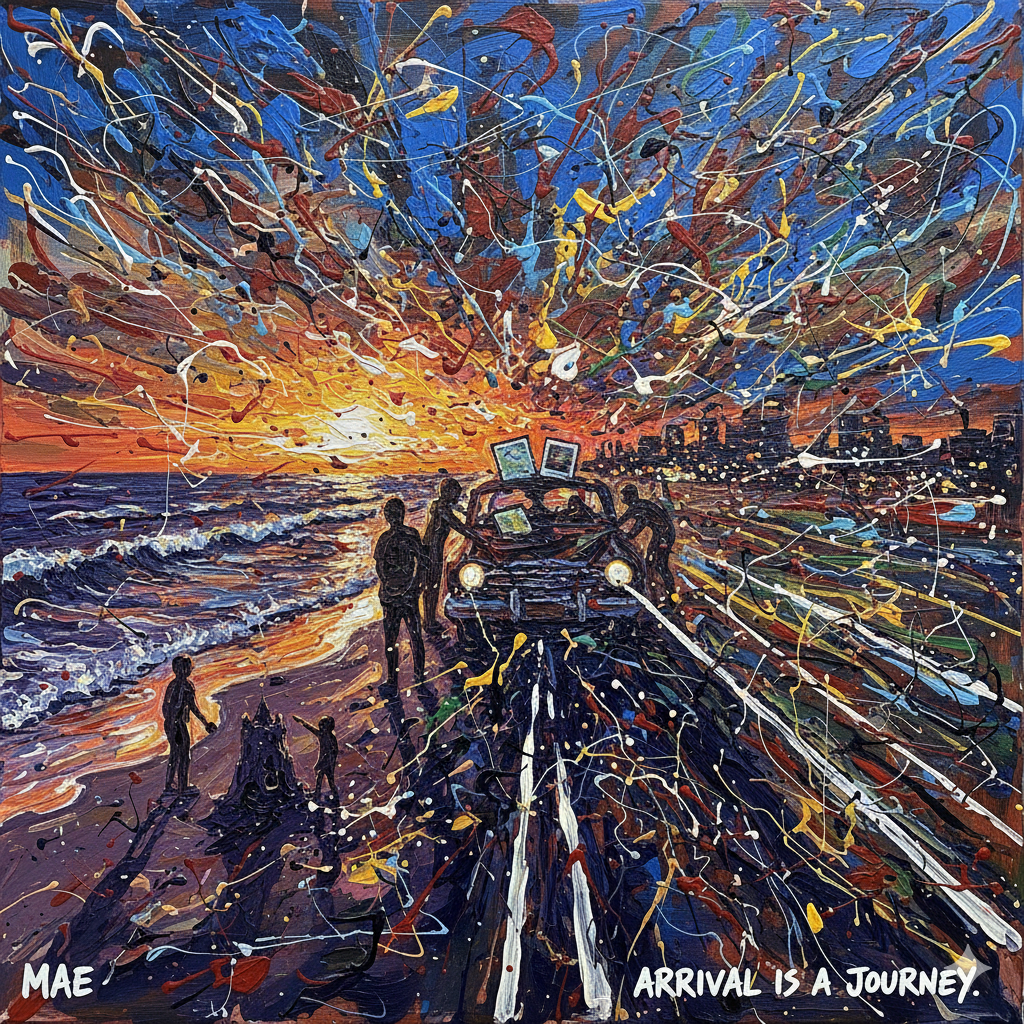
On their last evening in Los Angeles, they returned to the beach not because you can repeat a moment but because you can stand where it stood. The tide had a different mood; the light wrote a different letter; they were already different again. They walked without talking far enough for the noise to soften. Lukas collected three stones, pocketed two, and tossed one back ceremonially without inventing symbolism. Mae inhaled and felt the spreadsheet in her chest loosen a column width. Jin timed nothing. Sera wrote nothing. Nico built a lopsided sand tower that made a little kid point and grin.
When the sun cut itself on the ocean and bled into purple, they let themselves believe that arriving is one of the ways traveling happens. Back at the car, Mae slid the Polaroid behind the map book so the two artifacts touched—beginning leaning on the rules that made an ending possible. They didn’t say a benediction. The engine turned over obediently, like a dog that has learned it belongs.
Headlights drew their ribbon inland. The city brightened, then thinned, then became rumor again. Somewhere east a stranger would need them. Somewhere closer one of them would. They would stop. They would fail well, repair, repeat. The horizon climbed in front of them as if it had never been conquered and never needed to be.
They drove.
WE&P by: EZorrillaMc.
 Travel in Life
You must be logged in to post a comment.