
“You want freedom without responsibility,” his father declared, stabbing the air with his fork.
The Searching Season
The dining table was too small for so many voices. Every evening, Elias felt the wood tremble under the percussion of fists and forks, plates rattling like nervous teeth. His father dominated one end, eyes sharp beneath thick brows. His mother sat opposite, chin lifted, mouth curled into the thin smile of someone who had been contradicted a thousand times but refused to surrender. Around them clustered uncles and cousins, voices weaving into a chorus of contempt, loyalty, and outrage.
“You want freedom without responsibility,” his father declared, stabbing the air with his fork.
“And you,” his mother snapped back, “confuse obedience with stability. You’d rather bow than think.”
A cousin smirked. “Thinking doesn’t feed families. Strength does.”
The room filled with heat, words sparking until they seemed to burn the air itself. Elias sat at the edge, shoulders tight, fork untouched. He had learned the art of stillness, but stillness was not peace. Silence pressed into him like a hand on his throat, and though he opened his mouth once or twice, no words came. He feared that whichever side he chose, the other half of the table would brand him an enemy.
That night he dreamed of drowning—not in water, but in sound.
When his cousin Marco dragged him to a rally, Elias followed. The square pulsed with chants, flags snapping in the wind, slogans painted bold as blood. The crowd moved like a tide, carrying him with it, and for a moment he surrendered. Certainty wrapped around him like a cloak.
But at home, his mother’s wary gaze and his father’s mocking laugh turned warmth into ash. To belong to one banner meant betraying another.
In his grandfather’s study, Elias discovered a secret shelf hidden behind newspapers. The books smelled of dust and defiance. He read them by candlelight, each page a forbidden spark. The words thrilled him, but his heart pounded, his palms sweated. Knowledge was not neutral; it was insurgent. Each sentence widened the gulf between him and the family who would never approve of what he now knew.
Mina’s family offered another world. Their table was quiet, lit by candles, voices low and steady. “We light for peace,” Mina said, striking a match. For the first time in months, Elias’s shoulders loosened, his breath eased. But when his relatives discovered where he had been, suspicion thickened the air.
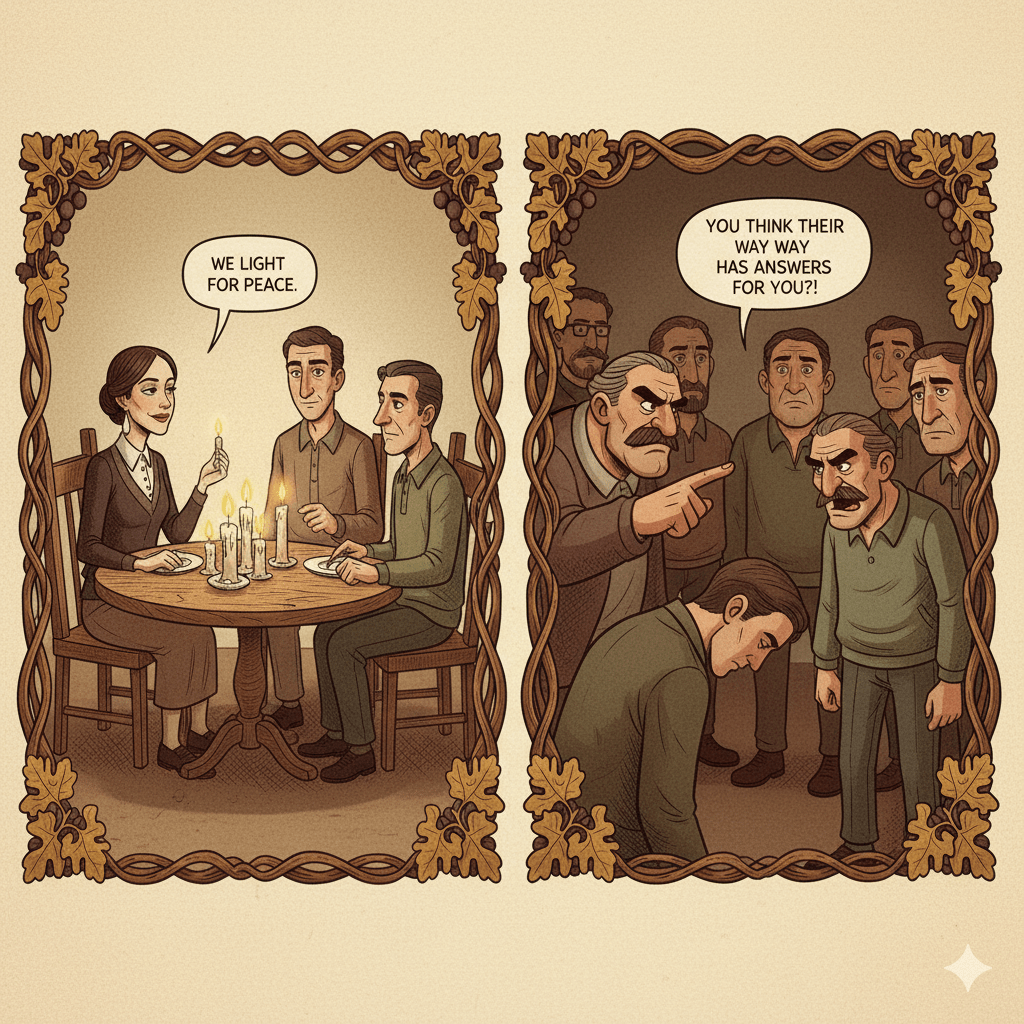
“You think their way has answers for you?” his uncle demanded.
Elias lowered his gaze. It wasn’t answers he had found, but calm—and calm was more dangerous to his family than any creed.
The online world offered no sanctuary. Forums blazed with sarcasm and rage, strangers lobbing insults like stones. At first Elias reveled in the duels, but soon fatigue set in. His posture sagged, his eyes burned, his fingers hovered uselessly over the keyboard. Connection corroded. What looked like a meadow in bloom was a superbloom, suffocating everything beneath.
By the time the election came, the household was split open like a log under an axe. His father canvassed with grim leaflets, his mother knocked on doors for the opposition, his uncle thundered from makeshift stages. Elias refused.
“You’re a coward,” his father hissed.
“A traitor,” his uncle barked.
His mother wept. “Why won’t you stand for something?”
But Elias felt a flicker of strength. Silence, once suffocating, was now deliberate. His refusal was a choice.
Once, trembling, he begged: “Can we just have one meal without politics? Please.”
For an hour it worked. Laughter bubbled, glasses clinked. Then fissures split, grievances roared back, accusations cut sharper than knives. Elias’s chest tightened, his breath rasped. Optimism, he realized, could be cruel—hope collapsing under its own weight.
The factory came next. Machines lined the floor in rigid ranks, overseers barking orders. At first the discipline soothed him. After years of chaos, the order felt almost holy. But when one worker faltered, punishment fell swift and merciless. The silence of the others was heavier than any shout. Elias tasted iron in his mouth. Stability had its cost, and the price was silence.
The storm broke in winter. Candles flickered, shadows leapt. Words turned venomous until Elias erupted.
“Enough!” His voice cracked like thunder. He stood shaking, fists trembling. “I am not your recruit, not your hope, not your echo. I am me!”
Silence fell, cavernous and liberating. Even the storm outside seemed to pause. Fear curled in him, but so did freedom.
By spring, Elias was no longer the same.
He walked alone through the city square, coat unbuttoned to the warming breeze. Protesters shouted, priests blessed, merchants bargained, children laughed. The air smelled of bread, incense, sweat, and blossoms. Every voice was a thread in a tangled tapestry—messy, discordant, alive.
Once, he had craved certainty. Now he understood his purpose was not to surrender to one banner, nor to silence all others. It was to question, to resist easy answers, to carve meaning amid the clamor.
He thought of the boy he had been—the one who shrank at the dinner table, fork idle, lungs tight. That boy’s silence had been fear. His silence now was chosen, deliberate, strong.
The searching season was not over. Perhaps it never would be. But Elias no longer feared the search. He embraced it.
WE&P by: EZorrillaMc.
 Travel in Life
You must be logged in to post a comment.