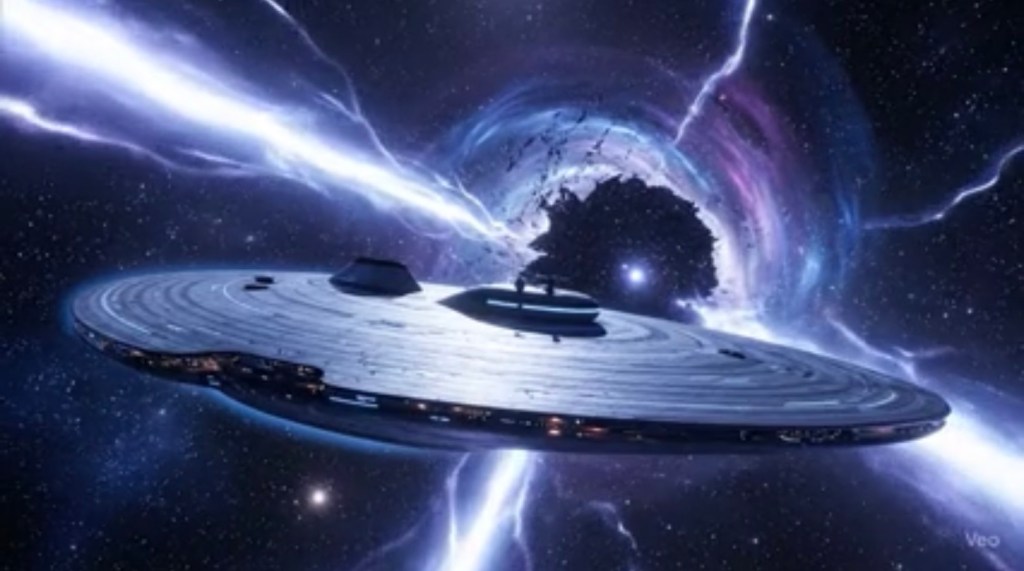
Episode 3: The Relativity Paradox
The USS Endeavour slid across the fractured gravity well of a collapsed binary system, its hull echoing with the thrum-thrum-thrum of inertial compensators straining against shifting vectors. The stars themselves seemed to flicker, stretched like taffy, squeezed like clay, warped into strange geometries that defied the eye.
On the bridge, every console chirped with irregular warnings: beep-beep… pause… beep-beep-beep. The sound was unsettlingly arrhythmic, as if the ship’s instruments were uncertain of their own place in time.
“Report,” Captain Sorel commanded, her voice measured but firm, as though anchoring the ship itself.
Commander Rehn at the science station frowned at the readouts. His fingers danced across the panel, pulling up overlapping chronometric fields. “We’re experiencing asynchronous dilation. Portions of the ship are in accelerated time, others in decelerated. The bow is aging seconds faster than the stern. Left unchecked, we could shear apart.”
Dr. Veyra, summoned to the bridge, interjected. “Crew perception is already fragmenting. Sickbay recorded patients who swore they waited an hour for treatment when only minutes had passed. Others insist mere seconds covered their injuries when we spent half the shift repairing them. Their minds aren’t failing—their clocks are.”
Lieutenant Ishan at the helm tightened her grip on the console. Her brow glistened, though her hands stayed steady. “It feels like flying through a shattered mirror. Every movement echoes before it’s finished.”
The bridge fell silent for a moment, save for the ship’s strained groans: creeeak… groooan… as hull plating flexed.
The paradox seeped into daily life. On Deck 4, two engineers argued over whether they had been rerouting conduits for five hours or five minutes. Meals in the mess hall appeared cold to some, steaming hot to others. Conversations splintered, with one officer answering a question before it was asked, another trailing behind in confused delay.
The Endeavour became a symphony without conductor: brass blaring ahead, strings lagging behind, percussion pounding unpredictably.
Captain Sorel convened her department heads in the observation lounge, the stars outside distorted into ribbons of light. She let the silence linger until each officer’s breathing found rhythm with the others. Only then did she speak.
“This paradox is not only physics—it is perception, it is patience, it is persistence. If we fail to act as one, we fracture.”
Darrin the engineer growled, his words clipped. “Dampeners are calibrated to uniform fields. These fluctuations mock our machinery. Every time we adjust, the distortion dances away.”
Rehn countered, leaning forward, his tone rapid, almost breathless. “Then we must anticipate, not react. The binary’s collapse follows pattern, however strange. A waveform—erratic, but not lawless.”
“Patterns?” Dr. Veyra asked, arching an eyebrow. “And what of my patients whose bodies are bruising in accelerated pulses while their neighbors sit unchanged? What of the ensign whose heartbeat races at triple tempo while the nurse beside him feels she’s drifting in molasses? Pattern or no, lives are unraveling.”
Sorel raised a hand, steady, still. Her voice carried through their discord like a ship cutting through storm. “Then our task is neither simply repair nor diagnosis. It is alignment. We must find rhythm where none seems to exist.”
Vor, the newly promoted linguistics officer, leaned into the table, her Bajoran earring catching the distorted starlight. “Captain… rhythms can be translated. Even chaos can be read as cadence if one listens carefully enough. I propose treating these temporal waves not as anomalies but as language.”
Her suggestion drew skepticism—furrowed brows, folded arms. But Sorel’s eyes lit, just slightly.
“Explain.”
Vor touched the console, overlaying the gravimetric readouts with linguistic cadence maps. “Listen.” The speakers filled with sound—oscillations rendered audible. The crew heard whummm… click… whumm-whummm… shhhhh… repeating in complex cycles.
“It is not random. It repeats, refrains, revises. If we anticipate its verse, helm can navigate its meter rather than fight its music.”
Rehn’s lips parted in recognition. “A polyrhythm in spacetime itself…”
Ishan exhaled, her voice steadier. “Then we don’t resist the storm. We sail with it.”
Darrin scratched at his beard, skeptical but intrigued. “If this works, I’ll need to reconfigure dampeners to resonate, not oppose. That means recalibrating with micro-second precision. I’ll need Holt.”
“Then take him,” Sorel replied, her gaze moving across the table. “Each of you will take who you need. We move as orchestra, not soloists. One discordant note, and we’re torn apart.”
The work began.
In engineering, Holt and Darrin hunched over glowing conduits, synchronizing graviton pulses with the temporal waves. Sparks spat: zzzt! crack! Holt flinched but pressed on, his hands blackened with carbon residue.
On the bridge, T’Lira plotted trajectories with mathematical elegance, while Ishan adjusted helm controls by instinct, fingers dancing like a pianist searching harmony. “One, two-three, one-two, pause… yes, there,” she murmured, flying not by stars but by rhythm.
In the labs, Vor translated the oscillations into layered frequencies, her voice quietly repeating the patterns aloud: “Rise-fall-fall, rise-rise-fall, fall-pause-rise.” Her repetition anchored the team, words weaving certainty where numbers blurred.
In sickbay, Dr. Veyra and her team adapted triage protocols. Some patients healed “too quickly,” bruises vanishing mid-sentence, while others languished in elongated pain. Veyra reminded her staff, again and again, that every patient’s experience was real, even if time mocked comparison. Her care was less about correction than recognition.
At the heart of it all, Captain Sorel moved from deck to deck. She did not bark orders—she listened, nodded, affirmed, adjusted. When she spoke, it was brief, but every phrase carried resonance.
To Ishan, she said, “Your hands steer more than metal—they steady us all.”
To Holt, she said, “Every spark you endure is a star we will reach.”
To Vor, she said, “Your ear for rhythm hears what others would silence.”
Each word was chosen not as praise but as placement, fitting officers back into the collective rhythm, assuring them their beat mattered.
Finally, the ship reached the peak of the cycle. The binary remnant flared, a gravitational pulse reverberating through the system like a cosmic drum. The Endeavour shook violently: BOOM-BOOM-BOOM. Consoles flickered. Lights dimmed. Hull plating screamed.
“Now!” Sorel commanded.
Darrin engaged the resonant dampeners. The ship vibrated in counter-rhythm: whummm-whummm-whummm. The clash was dissonant, then—suddenly—consonant. The violent tremors smoothed into steady oscillation.
“Course aligned,” T’Lira reported.
“Trajectory holding,” Ishan added, her voice calm, almost serene.
“Crew stabilization improving,” Veyra confirmed.
On the main viewer, the warped starlines straightened, the fractured mirror knitting itself back into recognizable constellations. The ship sailed free of the temporal whirlpool, battered but whole.
When silence settled, it was not empty but full, like the pause at the end of a symphony before applause.
Sorel rose slowly from her chair. “Log entry: Endeavour has survived asynchronous dilation. Success was not merely technical—it was tonal. By listening rather than resisting, by aligning rather than fragmenting, we endured.”
Around her, the crew exhaled as one, breaths syncing at last.
That night, in the mess hall, officers lingered long after meals had cooled. They spoke quietly, their voices weaving into one another, overlapping, repeating, refining. Rehn mused on polyrhythms in mathematics. Vor hummed the paradox’s cadence, now less terrifying, almost beautiful. Holt recounted sparks and burns with laughter that others echoed, not mocking but mirroring.
Even those who had felt time fracture now felt time rejoin—through fellowship, through shared memory, through the steady drumbeat of belonging.
The stars outside shone unwarped, but within the Endeavour, something had shifted. The crew no longer merely worked together; they resonated.
And so the log of their journey continued, not as a chronicle of crises survived, but as a song—each voice distinct, yet each voice indispensable.
Episode 4: The Glass Archive
The USS Endeavour drifted into orbit around a dying star. The sun’s surface seethed with crimson flares, each eruption casting violent shadows across the fragmented ring of crystalline structures circling it. From afar, the ring shimmered like a shattered crown; up close, it pulsed faintly with encoded light.
“Crystalline lattice detected,” Commander Rehn reported, his voice carrying restrained awe. “Energy signatures consistent with data storage matrices. A stellar-scale archive.”
On the viewscreen, the crystals glittered: prismatic towers and shattered shards, rotating in stately procession, like a celestial library cracked open and left to weather the vacuum.
Captain Sorel leaned forward in her chair. “Prepare an away team. This archive is not simply artifact—it is testimony. We will listen.”
The Away Team
The shuttle Arbiter descended toward the largest crystal tower. Its surface refracted light into fractured rainbows that danced across the cockpit walls. The away team included Rehn (science), Vor (linguistics), Darrin (engineering), and three junior officers:
- Ensign Joren Daxen, security—a cautious Andorian, quick to critique.
- Ensign Alira Sathi, astrophysics—brilliant but defensive, easily stung by correction.
- Ensign Riehl Marat, operations—methodical to a fault, his insistence on procedure often irritating his peers.
Already, tension whispered between them.
When Daxen checked his phaser for the third time, Marat muttered, “You expect the archive to shoot back?”
“It’s not weapons I distrust, it’s mistakes,” Daxen retorted, antennae twitching.
Sathi exhaled sharply. “Mistakes? You mean like the last time, when you questioned my calculations mid-mission?”
“If you’d triple-checked like Marat insists,” Daxen shot back, “we wouldn’t have been recalibrating in the middle of a firefight.”
“And if you hadn’t panicked—”
“Enough,” Rehn cut in, sharp as crystal edge. His tone brokered no argument. “Focus on the archive. Personal grievances can wait.”
But they did not vanish. They lingered, like static at the edge of comms—subtle, persistent, disruptive.
Inside the Archive
The shuttle’s landing bay pressed against a crystalline aperture that unfolded like a petal. Inside, the team entered a cathedral of refracted light. The walls, floors, and ceiling were all crystalline planes, catching and bending illumination into a kaleidoscope that shimmered with whispered voices, faint hum-hum-hum like the echo of a choir trapped in glass.
Vor tilted her head, listening. “This isn’t random refraction. It’s phonemic encoding. The crystals resonate with stored language—millions of voices, layered.”
Her tricorder pulsed with bursts of color. “Each shard a syllable, each tower a sentence. It’s a library written in light and tone.”
Darrin frowned. “Beautiful, sure, but it’s decaying. Energy signatures are unstable. If we don’t stabilize the lattice, this archive will shatter into static within a decade.”
“Then our task is preservation,” Sorel’s voice confirmed over comms.
The Disagreement Grows
The team set to work, calibrating resonance fields to stabilize the archive. Yet friction rose among the junior officers.
Marat insisted on strict adherence to Starfleet procedure, citing regulations at every turn.
Sathi snapped that innovation, not rules, was required to decode alien archives.
Daxen muttered that both were blinded—one by books, the other by ego—and only his vigilance kept them safe.
Their words clashed like mismatched notes, their teamwork fraying even as their tricorders aligned frequencies. Rehn ignored it outwardly, but his clenched jaw betrayed his irritation.
At one point, when Sathi proposed amplifying resonance harmonics, Marat objected: “Protocol dictates we minimize interference.”
“And protocol,” Sathi countered, “didn’t design this archive. Adaptation is survival.”
“You call reckless improvisation adaptation?”
“It’s called genius,” she snapped.
Daxen chuckled darkly. “More like arrogance.”
Their voices echoed in the crystalline chamber, multiplying, as though the archive itself mocked them: reckless… genius… arrogance…
Revelation in Resonance
Vor finally cut through the tension. She placed her hand against a crystal panel, her voice soft, steady. “Listen.”
She hummed a single note, low and clear. The crystal responded: whummm. The walls answered in layered harmony, phrases overlapping, languages intertwining. The archive sang back.
“This is no mere record,” Vor whispered. “It is chorus. Each voice incomplete alone, but together, they form continuity.”
The metaphor was not lost on anyone. Even Daxen, antennae twitching, fell silent.
Return to the Endeavour
Back aboard ship, Rehn briefed Captain Sorel. “We’ve stabilized one segment of the archive. Vor has begun decoding. It appears to hold cultural memory—histories, philosophies, even personal accounts. A civilization’s attempt to transcend extinction.”
Sorel’s expression softened. “Then we will be their audience. Their survival depends not on their stars, but on our listening.”
Seeds of Conflict
Later, in the mess hall, Daxen, Sathi, and Marat sat together, though not harmoniously. Their voices were low, but tense.
“You undermined me again,” Sathi said, her words clipped.
“You undermined procedure,” Marat countered.
“You both undermine teamwork,” Daxen muttered.
Their disagreement was not explosive, but constant—like background static. It infected shifts, slowed responses, created subtle frictions others began to notice.
Dr. Veyra, passing through, paused briefly at their table. She said nothing, but her gaze lingered. Later, she filed a quiet note to the ship’s counselor: Recommend group session for three ensigns. Conflict low-grade but persistent. Potential risk to cohesion if ignored.
The Counselor’s First Session
Counselor Elian Tov, a Betazoid with calm eyes and deliberate cadence, convened the three in his office. The walls displayed gentle projections of nebulae, shifting slowly, encouraging patience.
Tov did not lecture. He asked.
“What do you believe the others do not understand about you?”
Sathi spoke first, words quick, heated. “They don’t understand that brilliance requires risk. If I wait for endless approvals, discovery dies.”
Marat responded, slower, precise. “They don’t understand that order prevents chaos. Without rules, discovery collapses.”
Daxen leaned back, arms crossed. “They don’t understand that vigilance isn’t cynicism. I watch because no one else will.”
Tov nodded, absorbing without judgment. “So: risk, order, vigilance. Three voices. Each incomplete alone. Together… perhaps chorus.”
The word lingered, echoing memory of the crystalline archive. None of them admitted agreement, but none dismissed it either.
Resolution Deferred
The session ended unresolved, but seeds were planted. Tov scheduled follow-ups over the next two weeks, knowing transformation was rarely instantaneous.
The crew returned to duty, carrying both the burden of the archive and the tension of their dispute. But aboard the Endeavour, nothing was left to fester. Conflicts, like archives, were decoded piece by piece, until voices harmonized.
Closing Reflection
That evening, Captain Sorel stood in the observation lounge, the shimmering crystals of the archive visible in orbit below.
She recorded her log:
“The Glass Archive reminds us: civilizations perish, but voices endure when held in chorus. Our own harmony is fragile, tested even among the smallest of disagreements. Yet if we, too, listen—if we allow risk, order, and vigilance to find rhythm together—our memory will not shatter. It will sing.”
Outside, the crystalline towers glowed faintly, like candles in cosmic cathedral. Inside, the Endeavour pulsed with its own unresolved but resonant chords—an orchestra still tuning, yet preparing for the symphony ahead.
Episode 5: The Leviathan Rift
The USS Endeavour cruised through a subspace corridor at half-impulse, its shields shimmering faintly with invisible strain. On the main viewer, space rippled. Shadows folded upon themselves, curling like serpents through the void.
Vor leaned forward from the science station, brow furrowed. “Disturbance ahead. Energy readings—anomalous. Rhythmic.”
The rhythm grew into roar. The ship’s hull rrrrrummbled, deck plates quivering under boots.
Suddenly, the shadow moved. A colossal shape glided from subspace—a leviathan of negative energy, not beast but phenomenon, drawn inexorably to warp fields. Its form bent perception: edges that would not stay still, eyes that were not eyes but voids reflecting starlight.
Rehn’s voice dropped, reverent. “A subspace predator. Attracted to motion, not mass.”
The bridge fell silent, listening to the creature’s whaoooom resonance reverberating through the hull.
Predator and Prey
“Helm, hold steady,” Sorel ordered. “No warp. Minimal impulse. We are not prey if we do not flee.”
Ishan’s hands hovered over controls. “If it strikes?”
“Then we endure,” Sorel said, eyes locked on the shimmering leviathan.
The crew worked in hushed tones. Engineering rerouted power to structural integrity. Science mapped the predator’s energy pulses. Sickbay braced for shock trauma.
But on Deck 6, three voices rose above the hum.
Escalation of Disagreement
Daxen, Sathi, and Marat were stationed together at sensor relay. The predator loomed on external scans, its presence warping subspace fields in pulses.
“Adjust the frequency filters,” Sathi snapped, fingers flying.
“No,” Marat countered, jaw set. “Protocol requires phased recalibration before altering baseline readings.”
“That wastes time!”
“And your improvisations risk destabilizing the sensors entirely.”
“Better unstable readings than no readings.”
Daxen snorted. “Both of you miss the point. We should be reinforcing security, not debating science trivia. If it comes for us, sensors won’t matter.”
Their voices clashed, overlapping like discordant notes. The predator’s hum deepened, vibrating through the deck: whoooom… whoooom.
Crew nearby shifted uncomfortably. The trio’s quarrel had ceased to be background static; it was now disruptive signal.
Bridge Revelation
Back on the bridge, Vor’s eyes widened. “Captain. It’s echoing our emissions. Every surge from our ship—every fluctuation, every raised frequency—it mirrors back amplified.”
“Like a hunting call,” Rehn added grimly.
Sorel’s gaze flicked to Vor. “Then what does it respond to?”
“Harmony,” Vor whispered. “When our systems aligned during the dilation paradox, we passed through unharmed. If this… leviathan… is drawn to discord, perhaps the reverse holds.”
The Collective Maneuver
Darrin’s voice came through comms, gruff but steady. “Captain, I can synchronize dampeners with helm thrusters. But it’ll require every department matching phase to microseconds. Any misstep—any disagreement—and the system buckles.”
Sorel rose, her posture commanding quiet. “Then we breathe as one. Helm, science, engineering, medical—align.”
Ishan’s hands hovered, precise as a pianist. Rehn counted rhythm under his breath. Vor hummed softly, steady tone. Darrin barked timing cues. Dr. Veyra adjusted medical monitors to biofeedback. Even sickbay patients slowed their breathing, syncing unconsciously.
The Endeavour moved—not in jerks or bursts, but in slow, synchronized arcs. The predator pulsed once, twice, then hesitated. The ship’s resonance matched its rhythm. The leviathan shimmered, its void-eyes dimming, before sliding back into the folds of subspace.
The silence afterward was immense, profound. Only the ship’s hum remained: steady, unbroken.
Aftermath
In the observation lounge, Sorel debriefed her staff. “We survived because we moved as one. Not individuals. Not departments. A whole.”
Her gaze flicked briefly toward the three ensigns seated at the far end, tension still visible in their postures. She said nothing more, but Counselor Tov, present at her side, noticed.
Counselor’s Second Session
Tov convened Daxen, Sathi, and Marat again. The three sat in taut silence.
“You faced the predator together,” Tov began. “But you did not face it with each other. Why?”
Marat spoke first, defensive. “I follow procedure. Without procedure, we die.”
Sathi retorted. “Without innovation, we stagnate.”
Daxen muttered. “Without vigilance, both of you drag us into danger.”
Tov leaned forward. “Do you hear yourselves? Three notes clashing. Yet the predator was repelled only when the ship resonated as one. What lesson whispers here?”
No one answered. Silence stretched. Then, grudgingly, Daxen spoke. “That survival… isn’t about being right.”
Marat shifted, uneasy. “It’s about… timing.”
Sathi crossed her arms, then let them fall. “And listening.”
Tov nodded, satisfied but not concluding. “We’ll continue. Harmony takes time.”
The Science Program Arc Begins
Meanwhile, in the ship’s astrometrics lab, a parallel program commenced. Commander Rehn and Vor proposed a five-week research initiative: to study the collision of two distant galaxies and construct a full-scale holographic simulation within the holodeck.
“Galactic collisions shape universes,” Rehn explained at briefing. “Yet their scale defies direct perception. We will weave observation into simulation—science into story—so the crew can see creation.”
Sorel approved. “Five phases, five episodes. Each department will contribute.”
- Phase 1 (Ep. 5): Collect raw stellar data from long-range arrays.
- Phase 2 (Ep. 6): Map gravitational dynamics with engineering precision.
- Phase 3 (Ep. 7): Integrate linguistic patterns, interpreting cosmic events as narrative structures.
- Phase 4 (Ep. 8): Overlay cultural meaning—how civilizations might perceive cosmic collision.
- Phase 5 (Ep. 9): Present holographic symphony of galactic collision in the holodeck.
The science program was not mere academic exercise; it was cultural endeavor. Every officer, from seasoned commander to bickering ensign, would have a role in shaping it.
Closing Reflection
That evening, Sorel stood in the ready room, recording her log.
“The leviathan tested us with discord, and we endured by resonance. Yet among us, discord lingers still. It must be resolved, or it will undo us when no predator hovers outside. At the same time, our scientific mission expands. To render galactic collision in holographic chorus is to see not destruction but transformation. Perhaps in studying galaxies, we will learn how to collide without shattering—how to merge, to harmonize, to create.”
Outside her window, the stars gleamed, steady as breath. Inside the ship, the hum of belonging was not yet perfect, but growing stronger.
WE&P by: EZorrillaMc.
 Travel in Life