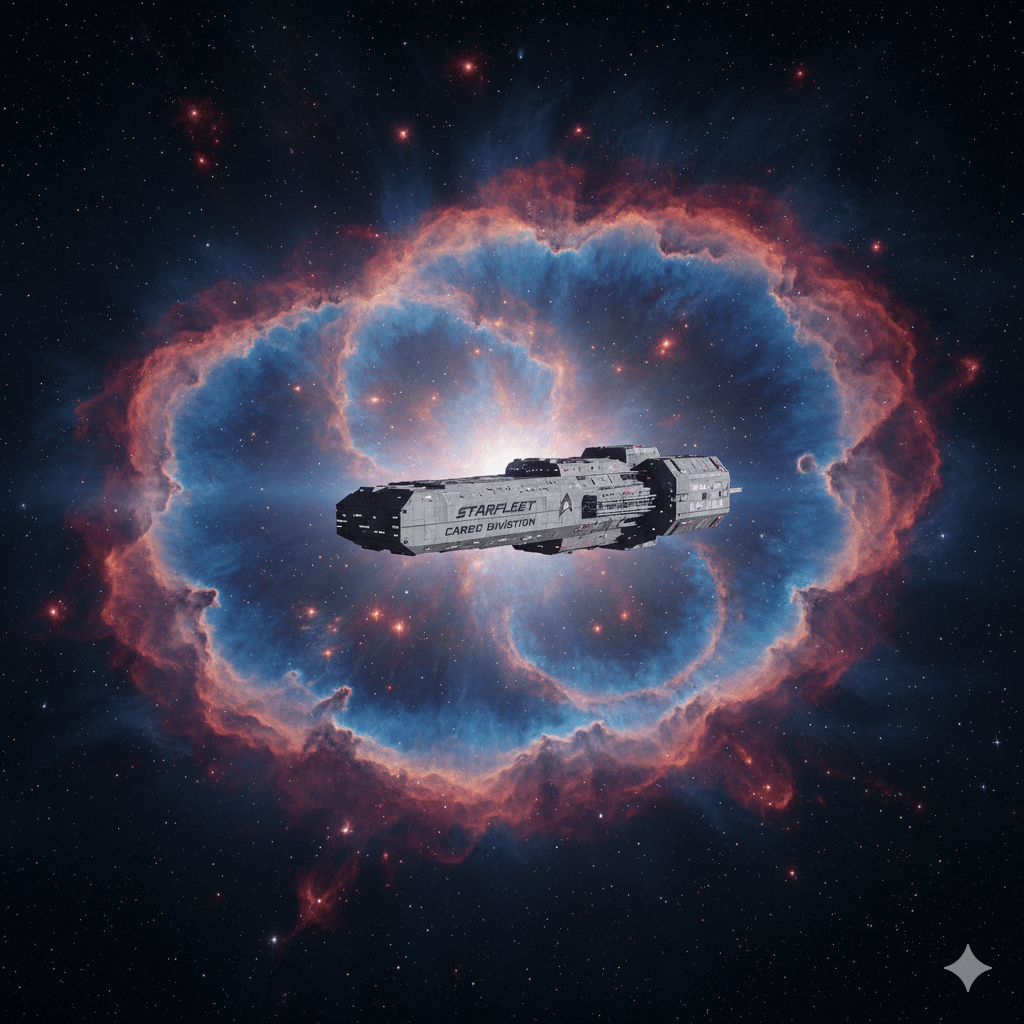
Title: Haul Stars, Meet Strangeness
(I have added two new episodes)
I returned to Deep Space Nine grumbling about gravity. Gravity grumbles back, you know—especially Cardassian gravity, which is calibrated to make cargo handlers feel just slightly fatter and slightly more regretful about that third replicated knish.
Chief Kevarn, the Bolian loading overseer, met me at Docking Port C with his usual war-crime-level cheer.
“Well, if it ain’t Gorlan the Grumpy, back from the void with another empty freighter and full bladder of excuses!”
“Excuse you,” I said, ducking past him, “but I have just made first contact with what I think is either an intelligent nebular lifeform—or an aggressively amorous ion cloud.”
He laughed like a man who’d swallowed too much engine coolant as a boy. “You what?”
“Precisely!” I barked, a finger in the air like a philosopher mid-pontification. “I what. And I have logs. And samples. And what might be a poem, but it might also be a distress call written in radiation.”
Kevarn’s grin wilted slightly. “You’re serious.”
I nodded, solemn as a Vulcan at a ventriloquist show.
The whole mess began three days prior in the Barratha Belt—somewhere between “Nobody cares” and “Absolutely no one goes there on purpose.” I was hauling dilithium scrap to Dantar IV, because glamour and glory were already booked. The hauler—S.S. Proletariat Princess—had seen better centuries. Her systems coughed more than they computed, and her replicator could only make toast. Not good toast. Just… toast.
Out past Barratha’s 8th rock, my sensors started screaming. Not the usual “We’re all going to die” shriek—more like a high-pitched flirt. You know, the kind of alert you’d expect if the ship was being serenaded by a saxophone made of solar wind.
At first, I assumed it was sensor static, a byproduct of boredom and bad coffee. But then the lights dimmed. The stars dimmed. And something looked back.
Picture this: a luminescent lattice—like lace made of lightning. It shimmered and shimmered more, folding space into origami shapes that weren’t in the manual. It didn’t move, not in the usual way. It inferred motion, like it was politely suggesting it existed.
I hailed it. Because, you know, that’s what you do. You’re in space, you’re lonely, something glows at you—standard protocol says you wave.
“Unknown entity, this is the Proletariat Princess. Do you require assistance, compliments, or directions?”
It replied. Not in words, but in an overwhelming wave of warmth and worry and what I later called “psychic sympathy.”
It was curious. It was confused. It was me—or some projection of me, projected back with all the defensiveness filed off.
It asked why I was alone. It asked what I wanted. It asked if I’d ever been hugged by a hydrogen cloud. (That one might’ve been metaphor.)
“You can’t seriously expect me to believe this,” said Commander Halvik when I made my report on the Promenade.
He was a man of logic, uniforms, and unyielding eyebrows. I’d known furniture with more flexibility.
“Look,” I said, tapping my padd with theatrical flair, “my logs show sensor anomalies, ship-to-entity data streams, and elevated serotonin levels inside the ship. That means something was talking to me—and made me happy about it. That’s unnatural.”
Halvik squinted. He had a squint that could interrogate. “Serotonin can be faked. You could’ve eaten chocolate.”
“I wish,” I muttered.
But then he checked the logs. Frame by frame, he watched my proximity readouts twist like taffy. Read my biometric spikes. Saw the nebula’s shadow form a human silhouette—my own, dancing in the plasma like a puppet on positrons.
He looked up, slow. “This… is unprecedented.”
“Yeah, well, so was my last bowel movement in zero-G. But this feels more important.”
We both sat in silence for a second, considering existence, sentience, and whether the replicator could be convinced to make celebratory schnapps.
The expedition was approved within hours. Science officers squealed. Botanists begged to go. One theoretical physicist locked herself in a closet and wept with joy. First contact with a non-corporeal empathic intelligence—and it had chosen a hauler with mismatched socks and a fondness for snack cakes.
I asked to name it. The entity. The phenomenon.
Halvik raised one imperious eyebrow. “And what would you call it, Mr. Gorlan?”
“The Hug Nebula.”
“You’re serious?”
“As a spatial rupture in a Romulan warp core.”
He considered. “We’ll file it as Tentative Designation Hug Nebula—pending official nomenclature.”
I grinned. “A bureaucratic embrace. How fitting.”
So now they’re prepping the U.S.S. Valiant-III to go kiss the cosmos. And me? I’m back in the hauler, sipping lukewarm coffee and telling my ship she’s beautiful.
Because somewhere out there, something bright and brilliant is still listening.
And it knows my name.
2 Continued: Into Hug
It’s two weeks later, and the Hug Nebula is missing.
Not missing in the sense of gone—no. Missing like a misfiled feeling. Like a memory you’re sure you had but can’t quite find. Starfleet science says it “phased,” which is scientist-speak for “We don’t know where it went, but we’re embarrassed about it.”
Commander Halvik called me back in, tight-lipped and tin-voiced.
“Mr. Gorlan,” he said, with the strained civility of someone trying not to curse in front of a child or a Klingon ambassador. “The entity is unresponsive. You’re going back.”
My stomach sank like a warp core dropped in molasses. “Me? Alone?”
“You established contact,” he replied, folding his arms with measured stillness—the kind of posture that doesn’t say ‘I trust you,’ so much as ‘I ran out of other ideas.’
“Right,” I said, adjusting my collar and pretending I wasn’t shivering like a tribble on a transporter pad. “Back to the belt, back to the blob.”
Inside, though, I felt it already: the low hum of anticipation curling in my chest like a cat before chaos.
This time, the Proletariat Princess had upgrades: fine-tuned sensors, real-time subspace recorders, and an actual toaster oven.
The mission brief was clear:
- Return to sector 14-Gamma.
- Re-establish contact with the entity.
- Don’t get absorbed.
In that order.
I arrived at the coordinates, sensors screaming serenity again—but quieter, like a whisper from a former lover unsure if they’re still welcome.
No nebula. Just emptiness smeared across the stars like a canvas awaiting color. I floated. I waited. I felt ridiculous.
So I did what any lonely, underpaid hauler would do: I talked.
“Hello again. It’s Gorlan. Remember me? Small ship. Large personality. You briefly made me feel less like I’m drifting through an indifferent universe. Ring any bells?”
The comms crackled.
Nothing.
I slumped in the pilot’s seat. Frustration gnawed at me: shallow breath, hunched shoulders, palms itching to do something, fix something. From The Emotion Thesaurus, I recognized the signs of powerlessness—jaw clenching, feet tapping, nervous sarcasm creeping into my self-talk like mold into old bread.
But then—something flickered.
A ripple. A wrinkle in reality’s bedsheet.
Space… sighed.
Not audibly—but in feeling. Pressure lifted. The stars leaned in. The hairs on my arms stood up and saluted.
Then came the light: soft, cerulean, not blinding but beckoning. The Hug Nebula unfolded like origami uncrumpling itself. A metaphor made manifest. A simile with gravity.
And this time—it brought friends.
Three more—fractal forms, spiraling in non-Euclidean elegance—joined it in formation. They glimmered with what could only be described as… joy.
But not joy like a party. Joy like a reunion. Like finding the missing puzzle piece tucked under the couch cushions of the cosmos.
I reached for the comms, voice thick with awe and cracked emotion. “DS9, this is Gorlan. We’ve got company.”
Back on the station, Halvik reviewed the transmission. His face changed in degrees—disbelief curdled into belief, then fermented into something like wonder. He rubbed his chin, muttered something about protocol, then promptly ignored it.
“They responded,” he whispered, half to me, half to himself. “Not just a response—coordination. They brought others. This… this isn’t first contact anymore.”
“It’s first conversation,” I said. “And they missed us.”
He nodded once. “Prepare the Valiant. We’re not just observers now. We’re guests.”
I became a celebrity overnight, which is unfortunate, because I sweat under scrutiny. (Also, my good shirt had a replicator burn.)
Biologists begged to interview me. Psychologists wanted to dissect my subconscious. One Betazoid counselor said I exhibited linguistic intimacy rooted in disassociative empathy—which I assume is Betazoid for “you talk to clouds too much.”
What no one understood, what I couldn’t explain in scans or synaptic charts, was how it felt.
Connection.
That word gets thrown around a lot—especially in Starfleet, where everything’s about unity and understanding and not shooting first. But this was different. This wasn’t just contact. This was recognition.
Like being seen without being measured.
Like being mirrored without being mimicked.
And still, deep in the back of my mind, Adler whispered—because he always does.
He whispered that all behavior is goal-directed. That the Hug Nebula didn’t reach out for fun or folly. It wanted something.
Not conquest. Not curiosity. Something older. Simpler. Sameness.
The way a child finds another child and says, “You too?”
The way a wanderer meets another and asks, “Still lost?”
Maybe the entity was looking for something like itself.
Maybe it saw itself in me.
And maybe, just maybe—I saw myself in it.
Next mission: we go in. Not around. Not near. In.
Into the heart of Hug. To listen. To learn. To speak, if we dare.
The Valiant launches next week.
They offered me a science uniform. I declined. I’ll wear my usual jumpsuit, patched and stubborn, like the rest of me.
Because I’m not a scientist. I’m not an ambassador.
I’m a hauler.
But in the vast, vacuumed silence of space, sometimes it takes a hauler to haul meaning back home.
3 Continued: Into Hug
The Valiant-III wasn’t built for poetry.
It was all polished corridors and disciplined hums, a ship engineered for certainty, not sentiment. Even the chairs felt judgmental—unforgiving slabs that dared you to slouch.
I didn’t fit. Not really.
But they needed me. Not because I wore brass or had badges, but because something out there—something other—had answered me. And now, everyone else wanted in on the conversation.
They called it an “expedition.” I called it what it was: a gamble with good lighting.
We broke through the Barratha fringe on a Wednesday. At least, I felt like it was a Wednesday. The kind of day where your thoughts drag their feet and the universe feels just a bit off-kilter, like a tilted painting that no one dares fix.
Commander Halvik stood on the bridge, spine stiff enough to skewer a roast. His voice came clipped, composed—every consonant placed like a chess piece.
“Mr. Gorlan, you’re up.”
I swallowed. My throat was dry, tongue thick—classic cocktail of fear and responsibility, aged in insecurity and served over crushed ego.
I stepped forward. Sensors primed. Comms ready.
The Hug Nebula loomed before us—not a thing, but a presence. Like standing at the edge of an unfinished thought. Its shape unfixed, its color… conceptual. Shifting from deep violet longing to soft blue contentment.
No one spoke.
I did.
“Hey again.”
Static.
Then shimmer.
Then sound—not through speakers, but through sensation. A collective intake of breath that wasn’t air. The crew flinched. I exhaled. Not relief—something sharper. Recognition. My body knew before my brain.
They remembered me.
Here’s the thing they don’t teach in officer training or xenolinguistics: some beings don’t speak.
They resonate.
You don’t parse their meaning—you match it. Like a cello tuning itself to a whale song. A frequency of feeling.
Adler whispered in the background of my brain—guiding without guiding, the way a good therapist lets you find the door but makes damn sure you see it.
What do they want?
Belonging.
How do they ask?
By showing you who you are, and waiting to see if you flinch.
The bridge dimmed. Not from system failure—from consent. The Hug Nebula reached through the hull not with force, but invitation. Images unfurled in the minds of the crew—memories, moments, metaphors—each tailored like dreams stitched from secondhand thoughts.
Lieutenant Jaro gasped. She whispered, “It showed me my sister. From before the war.”
Halvik gripped the rail. His knuckles whitened. “It’s in my head.”
I stood still. Open. Present.
I let it in.
And there—suddenly—I was not alone.
Not emotionally. Not philosophically. Literally.
Another Gorlan stood before me. Not a copy—an echo. Same nose, same guilty slouch. But kinder. Wiser. A version of me that hadn’t flinched so much in life. That had chosen connection instead of dodging it.
I didn’t speak. I didn’t have to.
He reached forward and I—we—touched.
The room fell away. Gone were consoles and duty rosters. I stood barefoot in a memory I’d forgotten: my first spacewalk. Sixteen. Scared. Shaking. Clutching the tether as if my bones would evaporate. But now… I was watching me from the outside. Not judging—just witnessing.
The entity wasn’t probing. It was sharing. Making its understanding of me a mirror I could walk through.
Adler again, whispering beneath awareness:
People aren’t driven by facts. They’re driven by feeling. We reach for what reflects us. We recoil from what reveals us.
The crew began to breathe slower.
No screams. No orders. Just wonder.
Because in the Hug Nebula’s embrace, everyone saw someone they could’ve been. Should’ve been. Still might be.
When we came back—if you can call it “coming back”—none of us spoke for a long while.
Not because we were stunned.
Because words are so stupidly small sometimes. You try to explain a sunset to a blindfolded Vulcan and realize language is just a blunt tool for sharp beauty.
Eventually, Halvik broke the silence.
“Well, that was… illuminating.”
I barked out a laugh. Not elegant, not officer-approved. Just real.
“You finally smiled, Commander. Mark the calendar.”
He turned to me, and I saw something raw behind those cold eyes. Not emotion. Not yet. But the possibility of it. A blueprint.
“You were right, Gorlan,” he said. “They didn’t want to teach. Or trade. They wanted to be known.”
“Same as us,” I said. “Just… better at asking.”
They left us with something. Not tech. Not treasure.
A tone.
One harmonic note, encoded in our systems. No translation. Just vibration.
When played, it feels like your chest remembers something your brain forgot.
We don’t know what it means. We argue over it. Starfleet’s got a team decoding it as we speak. I don’t bother.
Because I felt it.
It means: You’re not alone.
So now, I float.
Back in the Proletariat Princess. Back to hauls and hull breaches and half-heated meals.
But different.
Because I met something impossible, and it looked into my head, and it didn’t flinch.
And when I stare into the stars now, I don’t see silence.
I see listening.
And sometimes, when I’m out past the edge of where the maps end and the myths begin—I hum that note.
And I swear—
The stars hum back.
WE&P by: EZorrillaMc.
 Travel in Life