The Event
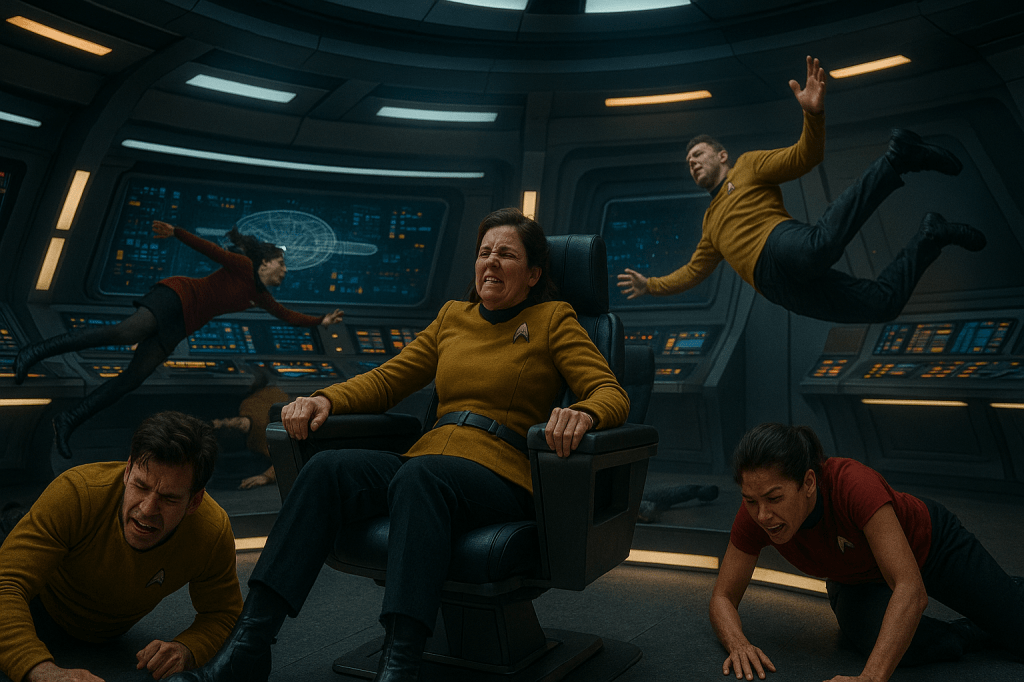
The starship USS Endeavour, a mid-sized science vessel of the late 24th century, hung at the edge of an uncharted nebula. The crew had prepared for a simple survey mission, expecting little more than stellar cartography and routine scans. But as the ship edged closer to the nebula’s distorted subspace currents, a sudden surge of gravimetric energy raced across its hull.
The inertial dampeners—those unsung heroes of starship engineering—flinched.
It began with a subtle vibration through the deck plates, the kind that officers with years of experience instinctively recognized as a systems hiccup. Then, without warning, the inertial dampeners cut out for a fraction of a second. That moment was enough to remind the crew of what raw Newtonian physics felt like. The Endeavour lurched as if struck by an invisible fist.
Crew members were slammed against consoles and bulkheads. A helmsman’s forehead struck the edge of his station; a science officer was flung from her chair, sailing across the bridge in a terrifying arc before colliding with the far wall. Even Captain Rena Sorel, firmly seated in her command chair, felt her ribs bruise as the restraints barely kept her from being thrown across the deck.
The inertial dampeners snapped back online within moments, reasserting their protective grip against the forces of acceleration. But the bridge was left in chaos. Medical teams rushed in, triaging injuries ranging from concussions to broken bones. The engineers in main engineering worked frantically, sweat beading as warning lights blinked across the warp core control panels.
“Report!” Captain Sorel barked through the chaos.
Lieutenant Commander Darrin, the ship’s chief engineer, replied grimly over comms: “Dampener grid is destabilized. Subspace shear from the nebula’s outer layer caused a cascade overload. We’re running on only forty percent compensation. If we take another hit at warp velocity—”
He didn’t need to finish. Everyone knew the truth: without functioning inertial dampeners, even a single impulse maneuver could pulp the crew against their bulkheads. A starship moving at warp speeds with failed dampeners was a coffin traveling faster than light.
The crew fought for hours to stabilize the systems. Every adjustment bought them precious minutes, but the nebula’s interference grew worse, hammering the ship with unpredictable gravimetric shocks. The captain ordered the ship to full stop, but even that maneuver pressed bodies against the decks until blood vessels burst in some unlucky crew members.
In the dim glow of emergency lighting, the engineers rerouted power through secondary compensators, jury-rigging the system with techniques older than the Federation itself. For a breathless span of seconds, the ship seemed to hang between survival and annihilation. Then, with a shuddering sigh, the inertial dampeners reengaged fully, stabilizing the ship as though nothing had happened.
Silence filled the bridge, broken only by the strained breathing of survivors. The ship was battered, but intact. The crew, shaken but alive, understood what many Federation citizens forgot: inertial dampeners weren’t just machines. They were the invisible shield that allowed fragile human bodies to sail among the stars.
Episode 1: The Aftermath
The USS Endeavour drifted like a wounded bird at the edge of the nebula. Her hull plating still trembled from the gravimetric waves, and the faint hum of systems rebooting filled the silence after the chaos. The inertial dampeners were stable again, but the memory of their brief failure lingered in every sore muscle, every bruised rib, every wary glance at the flickering consoles.
On the bridge, Captain Rena Sorel drew in a careful breath. Her uniform was torn at the shoulder, the edge stained with blood where she’d been thrown against the armrest. Yet she stood rather than sat. The crew watched her with the quiet expectation born not from fear, but from the shared knowledge that they must face this together.
“Damage control, full priority on structural integrity. Helm, hold us steady—no course changes until engineering confirms stability.” Her voice was steady, commanding, but it carried something else too: a tone that reminded her people they belonged here, even amid pain and fear.
Down in sickbay, the true weight of the incident unfolded. Stretchers lined the corridor outside the medical bay. Inside, the air was thick with antiseptic and the low hum of biobeds. The chief medical officer, Dr. Anika Veyra, moved briskly from patient to patient, her voice clipped but calm.
“Fractured ulna. Set and stabilize. Concussion, grade two—keep her awake, check ocular responses every five minutes. Next!”
Her team flowed around her, nurses and med-techs responding to her directions without hesitation. Veyra never paused long at one bedside; she trusted her staff, empowering them rather than controlling them. She leaned in briefly to speak to each patient—sometimes a word, sometimes only a look—but always leaving them with a fragment of reassurance: You matter. You belong. We will get through this.
One young ensign, still pale from shock, clutched at her sleeve as she passed.
“Doctor… I thought we were all going to die.”
Veyra didn’t dismiss the fear, nor did she soften it with false comfort. She crouched down so their eyes were level. “You didn’t die. You endured. That’s what matters. You held on when it counted.” Then she moved on, leaving the ensign not merely comforted, but subtly redirected—encouraged to find strength in having endured.
The corridors of the Endeavour echoed with repair crews hauling conduits and splicing power relays. In engineering, Lieutenant Commander Darrin barked updates over the comms, but his tone was cooperative, not authoritarian. Each order was framed as part of the shared task: “We’ll need those relays secured if we’re to keep life support balanced. Who’s with me?” He invited participation rather than demanded it, drawing out initiative in his people even in crisis.
Meanwhile, the bridge remained tense. Helm officer Lieutenant Mara Ishan, still with a cut across her brow, kept glancing at the navigational readouts as though sheer vigilance might prevent another surge. Captain Sorel noticed. She stepped closer, resting a hand lightly on Ishan’s chair.
“You kept us steady during the hit,” she said, softly but firmly. “That made the difference.”
The words mattered. Ishan’s shoulders straightened, her breathing slowed. In the absence of overt praise, the acknowledgment was enough—an affirmation that her contribution mattered to the whole.
Hours passed. The ship stabilized. Medical teams reported that no lives had been lost, though dozens were injured. Engineering announced a partial recalibration of the inertial grid, enough to grant them cautious maneuverability. The crew was exhausted, battered, but the sense of unity ran deeper than fatigue.
Later, in the captain’s ready room, Sorel convened her senior staff. Dr. Veyra stood with arms crossed, her eyes tired but unflinching. Darrin leaned against the wall, his uniform smeared with grease. Ishan sat at the far end of the table, silent but attentive.
Sorel spoke plainly. “We’ve survived this nebula, but not by chance. We survived because every one of you acted—not for yourselves, but for each other. That is what will carry us through the next challenge, and the next after that.”
The room was silent for a moment, but it wasn’t the silence of fear. It was the silence of belonging. They didn’t need to voice agreement; the bond was clear in the way eyes met, in the nods exchanged.
In the days that followed, the incident became a quiet marker in the life of the Endeavour. The bruises healed, fractures knitted, consoles were repaired. Yet the memory remained, woven into the collective spirit of the crew. Ensigns who once doubted themselves carried new confidence, having seen themselves endure. Veterans who had weathered countless crises found fresh purpose in guiding others through this one.
For Dr. Veyra, the infirmary was never empty, but her rounds became lighter. Patients spoke less of fear, more of resolve. For Darrin, engineering ran smoother, as junior officers stepped forward with suggestions and initiative. For Captain Sorel, there was no need for speeches. Her crew already understood what she valued: not the individual standing apart, but the community striving together, shoulder to shoulder, in the vast dark of space.
And though this was only one of trials that awaited them across the stars, it was one that etched itself deeply into the Endeavour’s log—not as a story of failure, but as proof that even when machines faltered, the human spirit, united and purposeful, carried them forward.
Episode 2: The Weight of Stars
The USS Endeavour had emerged from the nebula scarred but still intact. Yet, in the quiet that followed, grief settled across her decks. Three names had been entered into the memorial logs: an engineer crushed when a conduit ruptured, a navigator thrown fatally against the helm console, and a linguistics officer who never regained consciousness after her skull struck a lab bulkhead. Their deaths marked the first time the Endeavour had lost lives since her launch.
Starfleet protocol demanded efficiency, but Captain Rena Sorel knew efficiency alone would not sustain her crew. They required belonging, meaning, and the affirmation that the fallen had not lived—or died—in vain. The next morning, she convened the department heads in the observation lounge.
The room, with its wide starfield windows, had been reset after the last incident. A fresh carafe of tea sat on the table, though fewer cups were taken this time. The atmosphere was heavy, but not hopeless.
Sorel remained standing at the head of the table. Her tone was quiet, but it carried through the silence like steel beneath silk.
“Yesterday we stabilized systems. Today, we must stabilize the crew. We lost three of our people. They were not just names on a roster—they were part of us. And part of us is missing.” She let that truth linger, not softening it, not rushing past. “To honor them, we move forward. To move forward, we must appoint those ready to step up.”
Her gaze fell first to Lieutenant Commander Darrin. The engineer’s uniform was still smudged with grease, his eyes red from hours in the core chamber. He stiffened, expecting critique, but instead Sorel turned to the ensign beside him.
“Ensign Kieran Holt,” she said.
The young engineer straightened, startled at hearing his name in such company. His sleeves were rolled to the elbow, his hands still faintly blackened from plasma residue. He had worked tirelessly during the dampener crisis, his improvisation stabilizing an EPS conduit that might have taken out half a deck.
“You took responsibility without waiting for orders,” Sorel continued. “You trusted your team, and they trusted you. Today, you are promoted to Lieutenant Junior Grade, and you will serve as systems specialist in place of Lieutenant Arven.”
Holt swallowed hard, his throat working against words that wouldn’t come. Finally, he managed, “I won’t let the crew down, Captain.”
“You won’t,” Sorel replied. Her voice was quiet, but absolute.
She turned next to the helm. Lieutenant Mara Ishan looked stricken, guilt etched into the lines around her eyes. The navigator who had died had been her close colleague, often trading shifts with her.
“Helm lost a steady hand,” Sorel said. “But we cannot allow that void to remain.” She nodded toward Ensign T’Lira, a Vulcan officer who had served at auxiliary navigation for months. Calm, precise, unflappable even in turbulence, T’Lira’s hands folded neatly on the table as if she had already anticipated the moment.
“T’Lira, your precision at the console prevented further loss yesterday. You anticipated course corrections even as systems failed. Effective immediately, you are promoted to full navigator.”
“I accept,” T’Lira said simply, but her gaze moved to Ishan. There was no rivalry in it, no sense of replacement—only solidarity. Ishan inclined her head in return, acknowledging that together, helm and navigation would steady the Endeavour.
Finally, Sorel faced the science division. Commander Elias Rehn had prepared himself for this. The linguistics officer, Lieutenant Fenn, had been his protégé—a brilliant xenolinguist whose sudden absence left the labs strangely silent. Rehn kept his features composed, but his fingers tapped faintly against the table, betraying emotion he would not voice.
Sorel called forward Ensign Ilyana Vor, a Bajoran officer who had worked under Fenn. Her long hours cataloging linguistic signals had often gone unnoticed by the wider crew. But when Fenn was incapacitated, Vor had stepped in seamlessly, translating an alien frequency streaming from the nebula into navigational data the helm could read. That contribution had saved lives.
“Ensign Vor,” Sorel said, “your insight bridged science and survival. Effective today, you take Lieutenant Fenn’s station. You’ll continue her work, and in doing so, carry her legacy forward.”
Vor’s eyes shone with restrained tears, but she lifted her chin. “Yes, Captain. I will not forget what she taught me.”
The promotions complete, Sorel did not allow the room to sink into mourning again. Instead, she steered the energy forward, subtly invoking a principle her crew already lived by: the individual mattered because the group mattered, and the group mattered because each individual contributed.
The meeting turned toward technical planning. Darrin outlined a secondary graviton regulator grid to support the inertial dampeners. “Think of it as a parallel spine,” he explained, gesturing to the schematic. “If the primary grid collapses, the secondary picks up the slack. It won’t be elegant, but it will buy us survival time.”
Commander Rehn proposed recalibrating long-range arrays to track the nebula’s cycles. “It’s not about avoiding turbulence—we can’t. It’s about predicting when the waves crest, so we time maneuvers between them.”
Navigator T’Lira added her logic. “Micro-adjustments rather than large course changes will minimize strain on the dampeners. I will synchronize helm input with engineering readouts directly.”
Sorel listened without interruption, her eyes moving from officer to officer, weighing not just their words but their investment in each other. She asked questions that tied their plans together: “Darrin, how will your parallel spine affect Rehn’s sensor recalibrations? T’Lira, what do you need from Ishan to maintain helm-precision timing?” Each query nudged them toward interdependence rather than isolation.
Dr. Veyra spoke last, her arms crossed. “I’ll keep medical response teams on standby. But my priority is reintegration. Injured crew want to return to duty. If you push them too hard, they’ll break again. If you hold them back too long, they’ll feel useless. My staff and I will find the balance.”
“Do it,” Sorel said, simply.
When the meeting adjourned, the officers left not only with tasks but with renewed clarity: the Endeavour’s strength was not in perfect systems but in people finding meaning through shared effort.
That night, a memorial was held in the arboretum. The ship’s gardens, usually bright with Terran lilies and Vulcan desert flora, were dimmed to twilight. Three candles floated in a shallow pool, their flames reflected in the still water. Crew gathered silently, scattered among the pathways and benches, their presence itself the ritual.
Captain Sorel spoke only briefly. “They lived among us, and they live still in what we continue to do. Not in statues, not in words—but in our hands, our choices, our shared work. As long as we endure, so do they.”
No applause followed. Only silence, heavy but purposeful, as if every officer carried away an unspoken vow.
From the balcony above, Dr. Veyra watched. She noted how Holt stood slightly apart, yet still close enough to hear the murmurs of his fellows. How T’Lira clasped her hands behind her back, dignified but attentive. How Vor touched the candlelight reflection, whispering something only she knew.
Each one, she thought, was already moving from loss toward contribution—not denying grief, but transforming it.
Later, as the Endeavour resumed its survey of the nebula, the ship’s corridors hummed with subtle changes. The dents in bulkheads had been patched, though faint discolorations remained. The transparent aluminum windows bore new reinforcements. And across every deck, the crew moved with slightly straighter spines, slightly steadier steps.
The ship herself seemed to respond. The warp core’s pulse steadied. The inertial dampener hum regained its usual even rhythm. Lights brightened. The Endeavour was not just repaired; she was renewed.
Captain Sorel, in her ready room, gazed again at the nebula. It was as volatile as ever—brilliant arcs of plasma, unpredictable surges of gravimetric force—but it no longer felt like chaos. It felt like a challenge, one they would face together.
She recorded her log quietly:
“Three names were added to our memory today, but three more were added to our future. Holt, T’Lira, Vor. They step forward not to replace, but to continue. This crew is stronger because each one knows they matter—not for themselves alone, but for the whole. The stars will test us again. We will endure.”
WE&P by: EZorrillaMc.
 Travel in Life