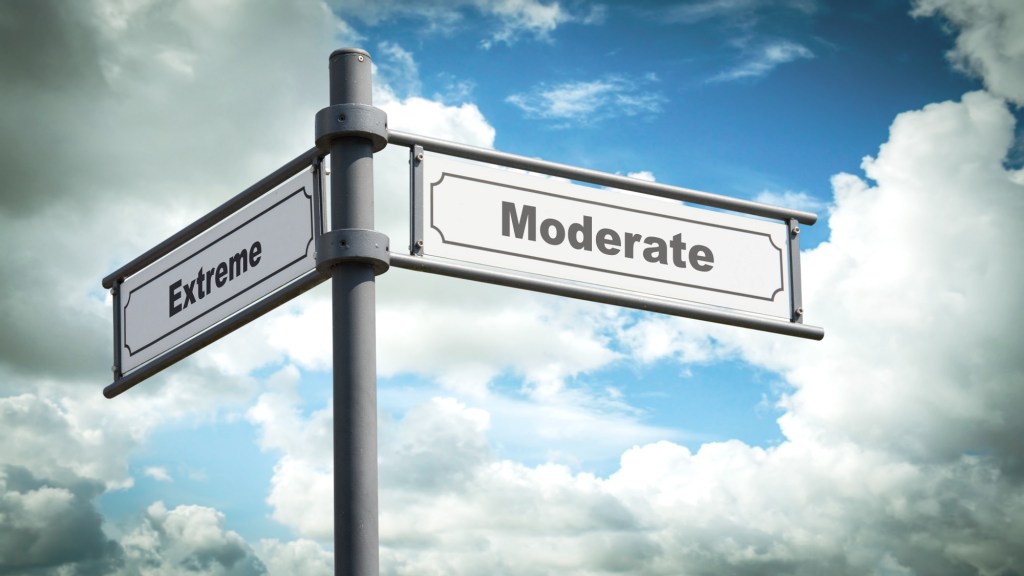
Passionless or Accepting. An interesting distinction, highlighting two very different potential origins for a moderate stance.
Moderate as Passionless:
This view suggests that moderation comes from a lack of strong feeling or conviction. It can be seen as:
- Apathy: A simple lack of interest in the subject.
- Indifference: An inability to see a meaningful difference between the options.
- Detachment: An emotional distance that prevents investment in any particular outcome.
In this context, being moderate is a passive state—an absence of passion.
Moderate as Accepting:
This view frames moderation as an active and conscious choice rooted in a specific worldview. It can be seen as: - Wisdom: The understanding that complex issues rarely have simple or extreme answers.
- Empathy: The ability to see and acknowledge the validity in multiple, often competing, perspectives.
- Tolerance: A deliberate choice to find common ground and promote balance over conflict.
In this context, being moderate is an active state—the result of a commitment to understanding and equilibrium.
Essentially, you’re asking about the “why” behind the moderation. Is it an empty space where passion should be, or is it a considered position built on the foundation of acceptance?
In American politics, a “moderate” is not a single, easily defined category. The term describes a wide range of voters who place themselves in the ideological center, but they arrive there for different reasons. This variance lies at the heart of your question: Is a politically moderate stance the result of being “passionless” or “accepting”?
The answer, according to political research, is both. Political moderates in the United States can be broadly understood through these two distinct motivations.
The “Passionless” Moderate: Disengaged and Inattentive
A significant portion of self-described moderates fall into this category, characterized more by what they lack than what they believe. Their moderation is often a byproduct of disinterest in the political process.
- Low Political Sophistication: Some scholars argue that many moderates are simply “politically unsophisticated.” They do not follow politics closely, have low information levels, and may not possess a coherent, overarching ideology. Their views appear moderate because they haven’t engaged deeply enough to form strong partisan opinions.
- Disillusionment with Parties: Many moderates are registered independents who are disenchanted and disaffected with the two major parties. This can be a form of apathy born from frustration, leading them to reject both “teams” rather than actively seeking a middle ground. Their stance is less about a centrist philosophy and more about an exhaustion with partisan conflict.
- Conflicted Views: Some individuals hold a mix of strong liberal and conservative views on different issues (e.g., fiscally conservative but socially liberal). When averaged out, this makes them appear moderate, but it is not born from a consistently centrist ideology.
The “Accepting” Moderate: Pragmatic and Deliberate
This group embodies the more philosophical ideal of moderation. Their position is an active, conscious choice rooted in a particular mindset. - Ideological Humility: These moderates believe that no single party or ideology has a monopoly on truth. They are open to hearing from both sides, believing that opponents can sharpen their own arguments and reveal flaws in their thinking. This approach is not a lack of conviction but a passion for balance and fairness.
- Pragmatism Over Purity: Accepting moderates are often focused on practical solutions rather than ideological purity. They reject extreme or radical viewpoints because they see them as unworkable and detrimental to a functioning society. Their goal is stability and progress, which they believe is best achieved through compromise.
- Resistance to “Affective Polarization”: A key characteristic of modern American politics is “affective polarization”—not necessarily disagreeing on all policies, but feeling visceral dislike and distrust for the opposing party. Accepting moderates consciously resist this trend. They strive to maintain open lines of dialogue and practice civility, even with those they disagree with.
What Makes a Political Moderate in the USA?
Ultimately, a political moderate in the USA is defined by their position relative to the two dominant and increasingly polarized parties. While nearly 40% of Americans identify as moderate, they are not a monolithic bloc. They are a diverse group that includes: - Genuine Centrists: Those who consistently hold middle-of-the-road views on a wide range of issues.
- Disengaged Independents: Who are moderate by default due to a lack of political engagement.
- Cross-Pressured Voters: Who hold a mix of liberal and conservative beliefs.
Therefore, the identity of a political moderate is a blend of both passionlessness and acceptance. It encompasses the voter who is too disengaged to pick a side, as well as the voter who is too engaged with multiple perspectives to comfortably align with just one.
WE&P by: EZorrillaMc.
Google&GeniniSoueced
 Travel in Life