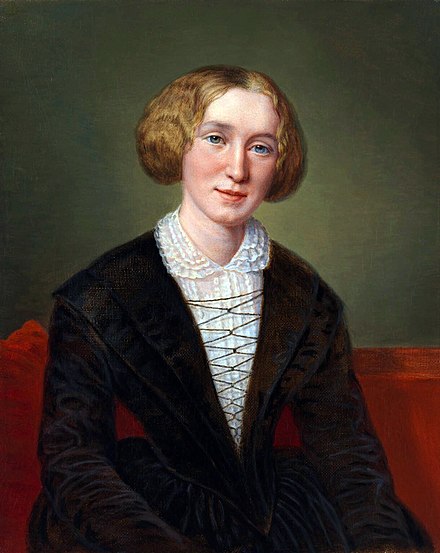
“Middlemarch” by George Eliot
“Not for the world, not for the world. A cross is the last thing I would wear as a trinket.” Dorothea shuddered slightly.
“Then you will think it wicked in me to wear it,” said Celia, uneasily.
“No, dear, no,” said Dorothea, stroking her sister’s cheek. “Souls have complexions too: what will suit one will not suit another.”
“But you might like to keep it for mamma’s sake.”
“No, I have other things of mamma’s — her sandal-wood box which I am so fond of — plenty of things. In fact, they are all yours, dear. We need discuss them no longer. There — take away your property.”
Celia felt a little hurt. There was a strong assumption of superiority in this Puritanic toleration, hardly less trying to the blond flesh of an unenthusiastic sister than a Puritanic persecution. (Loc.202)
“How very beautiful these gems are!” said Dorothea, under a new current of feeling, as sudden as the gleam. “It is strange how deeply colors seem to penetrate one, like scent I suppose that is the reason why gems are used as spiritual emblems in the Revelation of St. John. They look like fragments of heaven. I think that emerald is more beautiful than any of them.”
“And there is a bracelet to match it,” said Celia. “We did not notice this at first.”
“They are lovely,” said Dorothea, slipping the ring and bracelet on her finely turned finger and wrist, and holding them towards the window on a level with her eyes. All the while her thought was trying to justify her delight in the colors by merging them in her mystic religious joy. (Loc.217)
But talking of books, there is Southey’s ‘Peninsular War.’ I am reading that of a morning. You know Southey?”
“No” said Mr. Casaubon, not keeping pace with Mr. Brooke’s impetuous reason, and thinking of the book only. “I have little leisure for such literature just now. I have been using up my eyesight on old characters lately; the fact is, I want a reader for my evenings; but I am fastidious in voices, and I cannot endure listening to an imperfect reader. It is a misfortune, in some senses: I feed too much on the inward sources; I live too much with the dead. My mind is something like the ghost of an ancient, wandering about the world and trying mentally to construct it as it used to be, in spite of ruin and confusing changes. But I find it necessary to use the utmost caution about my eyesight.”
This was the first time that Mr. Casaubon had spoken at any length. He delivered himself with precision, as if he had been called upon to make a public statement; and the balanced sing-song neatness of his speech, occasionally corresponded to by a movement of his head, was the more conspicuous from its contrast with good Mr. Brooke’s scrappy slovenliness. Dorothea said to herself that Mr. Casaubon was the most interesting man she had ever seen, not excepting even Monsieur Liret, the Vaudois clergyman who had given conferences on the history of the Waldenses. (Loc.282)
“But you are fond of riding, Miss Brooke,” Sir James presently took an opportunity of saying. “I should have thought you would enter a little into the pleasures of hunting. I wish you would let me send over a chestnut horse for you to try. It has been trained for a lady. I saw you on Saturday cantering over the hill on a nag not worthy of you. My groom shall bring Corydon for you every day, if you will only mention the time.”
“Thank you, you are very good. I mean to give up riding. I shall not ride any more,” said Dorothea, urged to this brusque resolution by a little annoyance that Sir James would be soliciting her attention when she wanted to give it all to Mr. Casaubon.
“No, that is too hard,” said Sir James, in a tone of reproach that showed strong interest. “Your sister is given to self-mortification, is she not?” he continued, turning to Celia, who sat at his right hand.
“I think she is,” said Celia, feeling afraid lest she should say something that would not please her sister, and blushing as prettily as possible above her necklace. “She likes giving up.”
“If that were true, Celia, my giving-up would be self-indulgence, not self-mortification. But there may be good reasons for choosing not to do what is very agreeable,” said Dorothea. (loc.297)
Utilitarianist or Hedonist?
I don’t know if I am stopping myself or simply not pushing. So I find this book fascinating.
It may sound trivial, but it explains what I mean. I exercise because it’s good for me, and I like the feeling I get and with the results, but it’s mainly after the fact. I’ve learned to like it; it is an acquired taste, but which exercise do I like? Do I favor any?
I like jogging for how it makes me feel because it tires me, and I sleep better. It’s easy and doesn’t require a team, but would I rather ride a bike?
The answer would probably depend on if I felt safer, but I want to know if I like it more than jogging, and I don’t know. I only know jogging is simpler and cheaper, and I stay close to home. But what about peddling, the breeze, and the feeling of speed?
I’ve done what is expected, necessary, and beneficial, but do I like to do it?
With food it’s taste, but I still avoid dishes I like and eat what’s good for me. (EZM)
Biography
Mary Ann Evans (22 November 1819 – 22 December 1880; alternatively Mary Anne or Marian[1][2]), known by her pen name George Eliot, was an English novelist, poet, journalist, translator, and one of the leading writers of the Victorian era.[3] She wrote seven novels: Adam Bede (1859), The Mill on the Floss (1860), Silas Marner (1861), Romola (1862–1863), Felix Holt, the Radical (1866), Middlemarch (1871–1872) and Daniel Deronda (1876).
Like Charles Dickens and Thomas Hardy, she emerged from provincial England; most of her works are set there. Her works are known for their realism, psychological insight, sense of place and detailed depiction of the countryside.
Middlemarch was described by the novelist Virginia Woolf as “one of the few English novels written for grown-up people”[4] and by Martin Amis[5] and Julian Barnes[6] as the greatest novel in the English language.
Career in fiction
While continuing to contribute pieces to the Westminster Review, Evans resolved to become a novelist, and set out a pertinent manifesto in one of her last essays for the Review, “Silly Novels by Lady Novelists”[36] (1856). The essay criticised the trivial and ridiculous plots of contemporary fiction written by women. In other essays, she praised the realism of novels that were being written in Europe at the time, an emphasis on realistic storytelling confirmed in her own subsequent fiction. She also adopted a nom-de-plume, George Eliot; as she explained to her biographer J. W. Cross, George was Lewes’s forename, and Eliot was “a good mouth-filling, easily pronounced word”.[37] Although female authors were published under their own names during her lifetime, she wanted to escape the stereotype of women’s writing being limited to lighthearted romances or other lighter fare not to be taken very seriously.[38] She also wanted to have her fiction judged separately from her already extensive and widely known work as a translator, editor, and critic. Another factor in her use of a pen name may have been a desire to shield her private life from public scrutiny, thus avoiding the scandal that would have arisen because of her relationship with Lewes, who was married.[39]
In 1857, when she was 37 years of age, “The Sad Fortunes of the Reverend Amos Barton”, the first of the three stories included in Scenes of Clerical Life, and the first work of “George Eliot”, was published in Blackwood’s Magazine.[40] The Scenes (published as a 2-volume book in 1858),[40] was well received, and was widely believed to have been written by a country parson, or perhaps the wife of a parson.
Eliot was profoundly influenced by the works of Thomas Carlyle. As early as 1841, she referred to him as “a grand favourite of mine”, and references to him abound in her letters from the 1840s and 1850s. According to University of Victoria professor Lisa Surridge, Carlyle “stimulated Eliot’s interest in German thought, encouraged her turn from Christian orthodoxy, and shaped her ideas on work, duty, sympathy, and the evolution of the self.”[41] These themes made their way into Evans’s first complete novel, Adam Bede (1859).[40] It was an instant success, and prompted yet more intense curiosity as to the author’s identity: there was even a pretender to the authorship, one Joseph Liggins. This public interest subsequently led to Marian Evans Lewes’s acknowledgment that it was she who stood behind the pseudonym George Eliot. Adam Bede is known for embracing a realist aesthetic inspired by Dutch visual art.[42]
The revelations about Eliot’s private life surprised and shocked many of her admiring readers, but this did not affect her popularity as a novelist. Her relationship with Lewes afforded her the encouragement and stability she needed to write fiction, but it would be some time before the couple were accepted into polite society. Acceptance was finally confirmed in 1877 when they were introduced to Princess Louise, the daughter of Queen Victoria. The queen herself was an avid reader of all of Eliot’s novels and was so impressed with Adam Bede that she commissioned the artist Edward Henry Corbould to paint scenes from the book.[43]
When the American Civil War broke out in 1861, Eliot expressed sympathy for the Union cause, something which historians have attributed to her abolitionist sympathies.[28][29] In 1868, she supported philosopher Richard Congreve’s protests against governmental policies in Ireland and had a positive view of the growing movement in support of Irish home rule.[28][29]
She was influenced by the writings of John Stuart Mill and read all of his major works as they were published.[44] In Mill’s The Subjection of Women (1869) she judged the second chapter excoriating the laws which oppress married women “excellent.”[29] She was supportive of Mill’s parliamentary run, but believed that the electorate was unlikely to vote for a philosopher and was surprised when he won.[28] While Mill served in parliament, she expressed her agreement with his efforts on behalf of female suffrage, being “inclined to hope for much good from the serious presentation of women’s claims before Parliament.”[45] In a letter to John Morley, she declared her support for plans “which held out reasonable promise of tending to establish as far as possible an equivalence of advantage for the two sexes, as to education and the possibilities of free development”, and dismissed appeals to nature in explaining women’s lower status.[45][29] In 1870, she responded enthusiastically to Lady Amberley’s feminist lecture on the claims of women for education, occupations, equality in marriage, and child custody.[29]
However, it would not be correct to assume that the female protagonists of her works can be considered “feminist”, with the sole exception perhaps of Romola de’ Bardi, who resolutely rejects the State and Church obligations of her time.[46]
After the success of Adam Bede, Eliot continued to write popular novels for the next fifteen years. Within a year of completing Adam Bede, she finished The Mill on the Floss, dedicating the manuscript: “To my beloved husband, George Henry Lewes, I give this MS. of my third book, written in the sixth year of our life together, at Holly Lodge, South Field, Wandsworth, and finished 21 March 1860.” Silas Marner (1861) and Romola (1863) soon followed, and later Felix Holt, the Radical (1866) and her most acclaimed novel, Middlemarch (1871–1872).
WE&P by: EZorrillaMc.
 Travel in Life
You must be logged in to post a comment.