
From: Love and Saint Augustine by Hannah Arendt.
“Even without Arendt’s revisions, the Ashton translation was problematic. Faithful to the text and painfully literal as a result, the translation left thickets of impenetrable phenomenological discourse in place. Awkward phrasing, repetition, and general incomprehensibility were constant difficulties. To the extent possible, without damaging Arendt’s apparent meaning, we attempt to clarify the dissertation text for contemporary readers. We have edited translations of Latin terms in the text to achieve consistency. Thus, civitas terrena is always rendered as earthly city, civitas Dei as city of God, gemeinschaft as community, and societas as society. The word “creature,” which appeared repeatedly in the translation, to the great detriment of readability, is rendered as man or person, except when “natality” and linkage to the “Creator” are at issue. Similarly, neologisms such as “creatural” or “aboriginal” are edited out and rendered in appropriate English usage.
All of the above additions and revisions expand upon rather than fundamentally reorient the original dissertation. The physical appearance of Copy B suggests that Arendt used more than one typewriter in her retyping efforts. This could reflect either the passage of time between episodes of work or the efforts of several typists. Despite the unevenness of typefaces and incompleteness of Copy B, however, Arendt maintained a remarkable continuity between the original translation and her revisions.” (Loc.153 )
The radical choice between philosophical [A:033247] self-reflection and the obedience of religious faith, as actually performed, for instance, by the young Luther, remained alien to Augustine. (Pg.6)
This essay offers three analyses. The first begins with love understood as craving (appetitus), which is the only definition Augustine gives [A:033248] of love. In the presentation of “well-ordered love” at the end of this analysis, we see the incongruities to which this definition of love leads Augustine. Thus we are led to a very different conceptual context, which is incomprehensible from the first analysis and yet in an oddly peripheral sense suggests the attempt of deducing neighborly love from love as craving (appetitus). The second analysis permits us merely to understand in what sense our neighbor is loved in adhering to the commandment of neighborly love. Not until the third analysis is any light thrown on the incongruity of the second. This incongruity is pointed up in the question of how the person in God’s presence, isolated from all things mundane, can be at all interested in his neighbor.
This is illuminated by proving the neighbor’s relevance in a wholly different context. The illumination of incongruities is not tantamount to the solution of problems arising from a relatively closed conceptual and empirical context. It only answers the question of how these incongruities come to appear, that is, what completely different intentions lead to such contradictions, incomprehensible as they are to systematic thought. We must let the contradictions stand as what they are, make them understood as contradictions, and grasp what lies beneath them. (pg.8)
But even if things should last, human life does not. We lose it daily. As we live the years pass through us and they wear us out into nothingness.23 It seems that only the present is real, for “things past and things to come are not”; but how can the present (which I cannot measure) be real since it has no “space”?24 Life is always either no more or not yet. Like time, life “comes from what is not yet, passes through what is without space, and disappears into what is no longer.”25 Can life be said to exist at all? Still the fact is that man does measure time. Perhaps man possesses a “space” where time can be conserved [B:033137] long enough to be measured, and would not this “space,” which man carries with himself, transcend both life and time?
Time exists only insofar as it can be measured, and the yardstick by which we measure it is space.26 Where is the space located that permits us to measure time? For Augustine the answer is: in our memory where things are being stored up. Memory, the storehouse of time, is the presence of the “no more” (iam non) as expectation is the presence of the “not yet” (nondum).27 Therefore, I do not measure what is no more, but something in my memory that remains fixed in it.28 It is only by calling past and future into the present of remembrance and expectation that time exists at all. Hence the only valid tense is the present, the Now. (Pg.15)
— Love and Saint Augustine by Hannah Arendt
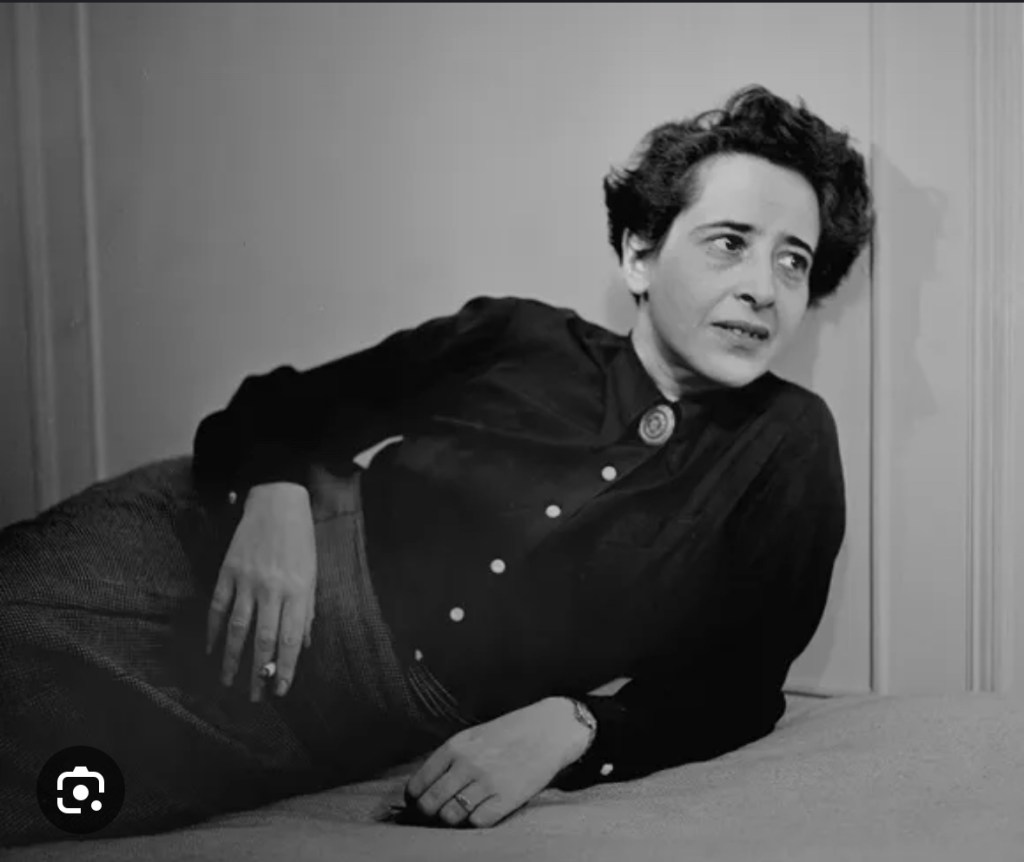
Hannah Arendt was a humanist thinker who thought boldly and provocatively about our shared political and ethical world. Inspired by philosophy, she warned against the political dangers of philosophy to abstract and obfuscate the plurality and reality of our shared world. She fiercely defended the importance of the public sphere, but she was also intensely private and defended the importance of privacy and solitude as prerequisites for a life in public. Embraced by liberals and conservatives, she also enraged and engaged interlocutors from all political persuasions.
 Travel in Life
You must be logged in to post a comment.