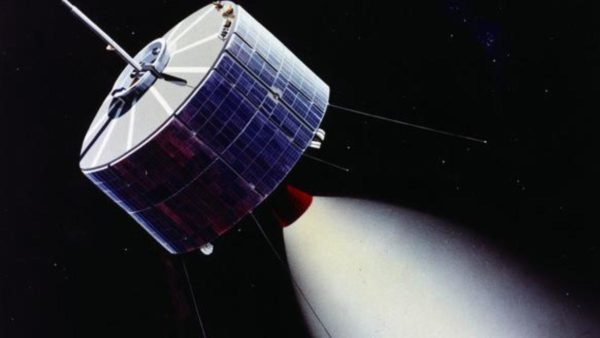
Launched atop the Thor-Delta family rocket DM-19, the active orbital repeater Syncom 3 was the first geostationary satellite in Earth’s orbit.
Syncom 3 was an experimental communication orbital repeater placed over the equator at 180 degrees longitude over the Pacific Ocean, which maneuvered to a geostationary orbit and provided live television coverage of the 1964 Olympic games in Tokyo, Japan, and conducted various communications tests.

Mission Profile
Syncom 3 was launched from Cape Kennedy on 19 August 1964 and injected into an elliptical orbit inclined 16 degrees to the equator following a third stage yaw maneuver. The apogee motor was fired to remove most of the remaining inclination and to provide a circular near-synchronous orbit of 35,670 km x 35,908 km.
The spacecraft next carried out a series of attitude and velocity maneuvers to align itself with the equator at an inclination of 0.1 degrees and to slow its speed so it drifted west to the planned location at 180 degrees longitude where its speed at altitude was synchronized with the Earth.
Inter-continental TV program transmission over the telecommunication link is a common measure for the TV broadcasters now, but just some 45 years ago, it was not practically available and the TV broadcasters relied on long-haul aircraft which carried the news films and/or video-tapes for them. In the early 1960’s, telecommunications between United States and Japan depended on narrow-band coaxial submarine cables and HF radio. Satellite communications that were being experimented at that time over the Atlantic Ocean, attracted keen interest in Japan with expectation as the overseas TV transmissions media for Tokyo Olympic Games scheduled in 1964. A joint committee consisting of the Ministry of Posts and Telecommunications, the Nippon Telephone and Telegraph Public Corporation, NHK and KDD, was organized and therein the experimental policy and the role of each party were decided. KDD (Japanese international telecommunication carrier, currently KDDI) made its preparation of the experimental earth station from 1961 and onward, while Japan participated in the Ground Station Committee sponsored by the NASA in 1962, to use communication satellites launched and operated by the NASA. [1]
Researchers and engineers of KDD in association with those of Mitsubishi Electric Corp. and NEC Corp. devoted themselves to development of the first earth station system for overseas telecommunications in Japan. Eventually, a 20-m Cassegrain antenna was installed in Ibaraki in 1963. Application of this type of antenna for commercial communications was the first in the world. The experimental earth station was completed on November 20,1963 and the public experiment of U.S.Japan TV program relay via Relay 1 satellite was announced to be on November 23.
Relay 1
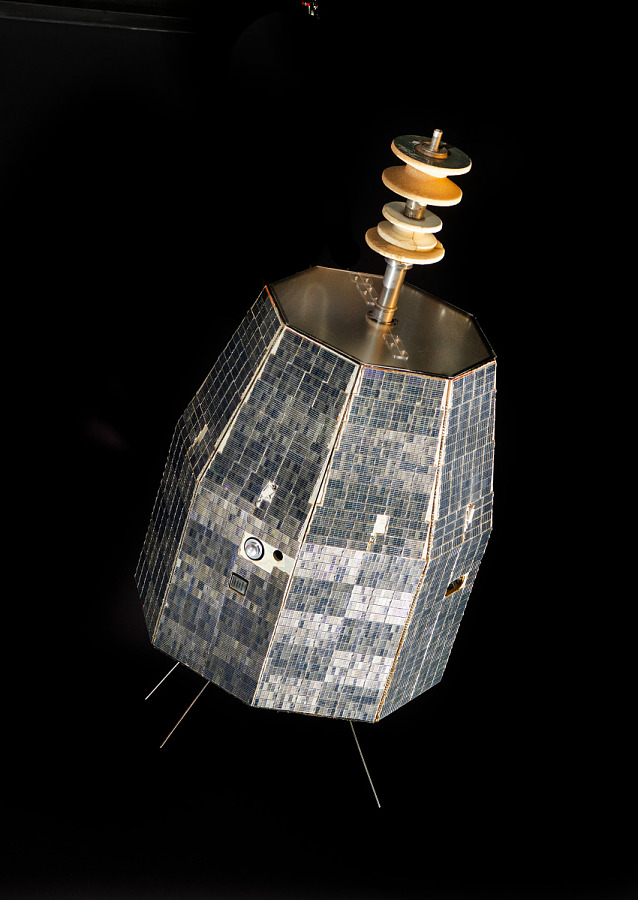
Launched by NASA in 1962, Relay 1 was one of several satellites placed in orbit in the decade after Sputnik to test the possibilities of communications from space. Relay 1 received telephone and television signals from ground stations and then transmitted them to other locations on the Earth’s surface. The satellite relayed signals between North America and Europe and between North and South America, and it also monitored the effects of radiation on its electronics. In conjunction with the Syncom 3 communications satellite, Relay 1 transmitted television coverage of the 1964 Olympics in Japan.
This prototype of Relay 1 is covered with solar cells. The antenna on top is for receiving and transmitting communications signals; those at its base are for telemetry, tracking, and control. In orbit, Relay used spin-stabilization to orient the antennas to communicate with Earth.
NASA transferred this artifact to the Museum in 1967.
1. The very first trans-Pacific TV signal transmission from U.S.A. to Japan via satellite was achieved just one year after the first trans-Atlantic TV transmission in 1962. It strongly impressed the mind of Japanese people as a “milestone” when a new age of real-time overseas TV transmission was ushered.[8][9][10][4][5][6][7][11][12][13][14][15][16][17]
2. Application of Cassegrain antennas to commercial telecommunications was the first in the world, since prime-feed parabola or gigantic horn reflectors had been used in preceding satellite communication trials in other countries. From technical view point, the Cassegrain antenna intrinsically has an advantage of low-noise, since the spill-over from the edge of sub-reflector is being directed to the cold sky. Furthermore, the Cassegrain antenna is suitable for a very large earth station, because it can locate bulky communications equipment at the back of main reflector, which the conventional prime-feed type parabola being incapable of.[2][18]
3. The Cassegrain antenna at Ibaraki was further improved later by introducing features such as 4-reflector beam-waveguide feed system and struts with a novel shape to support sub-reflector. The 4-reflector beam-waveguide feed system was designed to extend the radio frequency path between the feed horn and subreflector of Cassegrain antenna without the use of conventional waveguides, With this invention, the feed horn, low noise amplifiers and high power amplifiers with huge weight can be accommodated in a room on the ground, and high capacity earth station could be easily achieved. The beam-waveguide type design became the de-facto standard of today’s large earth station antennas in the world, The 4 struts to support sub-reflector is sometimes called Godzilla-stay from their appearance. They are uniquely shaped to scatter the reflected rays to reduce wide-angle sidelobes. [19][20]
These maneuvers were completed by 23 September, and Syncom 3 was used in a variety of communications tests, including the transmission of the Olympics, transmissions between the Philippines, USNS Kingsport, and Camp Roberts, California, and teletype transmissions to an aircraft on the San Francisco-Honolulu route. Satellite operations were turned over to the Department of Defense on 1 January 1965 and it was operated by the DoD through 1966. It was turned off in April 1969.
This short publicity film for the Syncom Satellite program dates to the 1960s. It was made after the successful launch of Syncom 3, so most likely dates to 1965. Syncom (for “synchronous communication satellite”) started as a 1961 NASA program for active geosynchronous communication satellites, all of which were developed and manufactured by Hughes Space and Communications. Syncom 2, launched in 1963, was the world’s first geosynchronous communications satellite. Syncom 3, launched in 1964, was the world’s first geostationary satellite. Syncom 3 was the first geostationary communication satellite, launched on August 19, 1964 with the Delta D #25 launch vehicle from Cape Canaveral. The satellite, in orbit near the International Date Line, had the addition of a wideband channel for television and was used to telecast the 1964 Summer Olympics in Tokyo to the United States. Although Syncom 3 is sometimes credited with the first television program to cross the Pacific Ocean, the Relay 1 satellite first broadcast television from the United States to Japan on November 22, 1963. In the 1980s, the series was continued as Syncom IV with some much larger satellites, also manufactured by Hughes. They were leased to the United States military under the Leasat program. We encourage viewers to add comments and, especially, to provide additional information about our videos by adding a comment! See something interesting? Tell people what it is and what they can see by writing something for example: “01:00:12:00 — President Roosevelt is seen meeting with Winston Churchill at the Quebec Conference.” This film is part of the Periscope Film LLC archive, one of the largest historic military, transportation, and aviation stock footage collections in the USA. Entirely film backed, this material is available for licensing in 24p HD, 2k and 4k. For more information visit http://www.PeriscopeFilm.com
 Travel in Life
You must be logged in to post a comment.